Rajnath Singh Chairs IGoM Meeting To Review Availability Of Essential Commodities As Iran War Disrupts Oil Routes
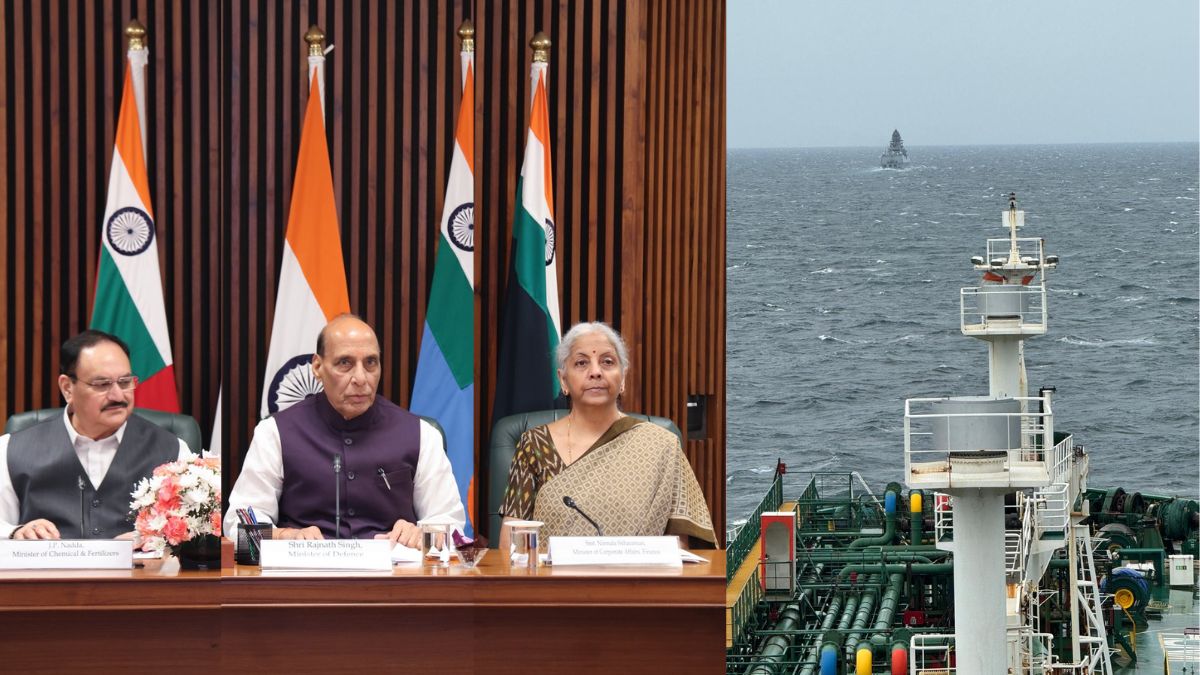
In the Persian Gulf, there are 20 ships sailing under the Indian flag, with around 540 Indians onboard, and they are also safe. Image courtesy: RNA

As the West Asia conflict deepens and the strategic Strait of Hormuz faces unprecedented strain, India has activated a full-spectrum crisis response, combining high-level political coordination, naval vigilance, and energy supply management to shield the country from global disruptions.
With oil routes under pressure and geopolitical uncertainty rising, New Delhi is navigating the conflict through diplomacy, defence preparedness, and economic safeguards. On Saturday (March 28, 2026), Defence Minister chaired the first meeting of the informal Group of Ministers (IGOM) tasked with addressing the fallout of the conflict.
The meeting chaired by Singh came just a day after Prime Minister Narendra Modi chaired a virtual meeting with Chief Ministers and Lieutenant Governors of Union Territories on the evolving situation in West Asia.
How is India managing the West Asia crisis?
A meeting of an IGoM (Informal Group of Ministers) constituting several senior ministers was held on March 28, 2026 to review the risks to energy supplies, domestic availability of essential commodities, critical infrastructure resilience and robustness of India’s supply chains in the wake of the ongoing conflict in West Asia.
In the IGoM meeting, Defence Minister Singh informed, an in-depth discussion on all the measures being taken by the Government of India was held. “The NDA Government under the leadership of PM Narendra Modi is closely monitoring the situation and it is committed to safeguard the Indian people from any impact of the conflict,” he posted on X.
Notably, PM Modi on Friday (March 27, 2026) emphasised a “Team India” approach, underscoring the importance of coordination between the Centre and states, drawing parallels with India’s collective response during the Covid-19 pandemic.
An inter-ministerial group operational since March 3 continues to monitor developments daily, focusing on key priorities such as energy security, economic stability, supply chains, and the safety of Indian nationals in the region.
What is happening in the Strait of Hormuz?
The Strait of Hormuz, which handles nearly 20% of the world’s petroleum trade, has become a focal point of the crisis. Following recent hostilities involving Iran, the US, and Israel, shipping movement through the corridor has been restricted and closely controlled, with Tehran claiming “full control” while allowing limited passage for “friendly nations,” including India.
This has led to delays, disruptions, and heightened risks for global energy flows, directly impacting oil-importing nations like India.
Despite the volatile situation, the Indian government has moved swiftly to ensure that energy supplies remain uninterrupted. Officials confirmed that multiple LPG and petroleum shipments have successfully reached Indian ports, including a major consignment of 47,000 metric tonnes of LPG at Vadinar in Gujarat.
The vessel, MT Jag Vasant, is set to transfer its cargo to another ship at anchorage through a Ship-to-Ship (STS) operation.
How is India managing the oil supply?
Several vessels continue to transit the Strait, with more expected in the coming days. Prime Minister Modi has also backed measures such as excise duty cuts on fuel and increased LPG allocation to states, aimed at insulating consumers from global price shocks.
In a clear signal of maritime preparedness, the Indian Navy has deployed warships near key shipping routes and ports, standing ready to assist merchant vessels navigating the high-risk Gulf region. Naval assets are providing a protective umbrella for Indian-flagged ships, ensuring safe transit.
Are Indian ships and seafarers safe?
Authorities have maintained that the situation, while tense, remains under control for Indian assets. Around 20 Indian-flagged ships with nearly 540 crew members are currently operating in the Persian Gulf, and all are reported safe. The Directorate General of Shipping has activated a 24/7 communication centre, responding to hundreds of queries from stakeholders.
India has consistently called for de-escalation and adherence to international law, particularly emphasising the need to keep sea lanes open. The Ministry of External Affairs has reiterated that freedom of navigation through the Strait of Hormuz is critical, not just for India but for global economic stability.
At the same time, diplomatic outreach, including high-level conversations with global leaders, continues to ensure the safety of Indian nationals and secure energy flows.
Is there any risk of shortages or disruptions at home?
The government has firmly reassured that there is no shortage of fuel or essential commodities. Chief Ministers across states have echoed confidence in the system, citing adequate availability of petrol, diesel, and LPG, along with robust monitoring mechanisms to prevent disruptions.
Port operations across India remain smooth, with no congestion reported, ensuring that incoming shipments are handled efficiently.
As the West Asia conflict continues to evolve, India’s approach reflects a careful balance of caution and capability.