
How Multi-Role Dhows From Pakistan Enable A Thriving Arabian Sea Drug Pipeline
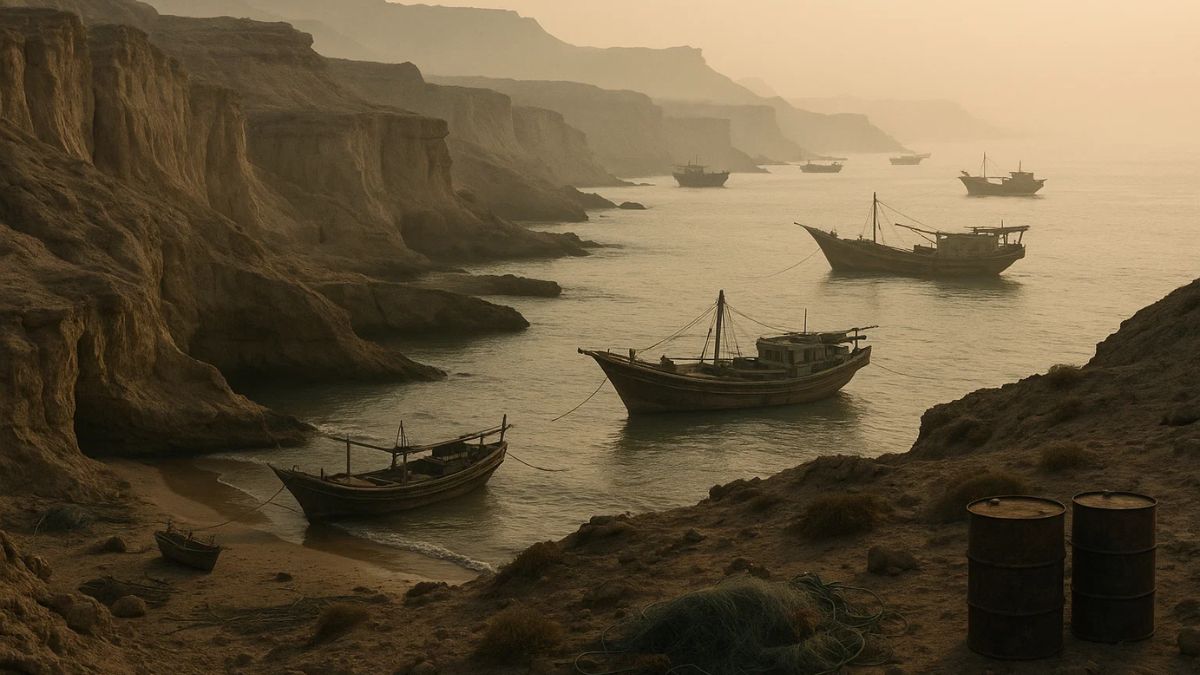
Multi-purpose dhows frequently carry a mixture of subsidised diesel, unused fishing gear, undocumented migrants and concealed narcotics to adapt to trafficking operations. Image courtesy: AI-generated picture via Sora

The Arabian Sea’s narcotics routes have long been described through a familiar image — the “stateless dhow” intercepted by naval forces far from shore. This framing conveniently distances the Pakistani coastline from the global heroin and methamphetamine trade. It suggests chaotic criminality rather than systematic networks. Yet, interdiction patterns across the United Arab Emirates (UAE), Oman, Kenya, Tanzania and Seychelles consistently show that much of this traffic originates from Pakistan’s Makran coast.
The truth is that narcotics trafficking is not an isolated activity. It is embedded within a broader grey maritime economy running along the Makran coastline, where fuel smuggling, illegal fishing and undocumented migration logistics overlap with drug exports. These sectors share boats, landing points, brokers and supply chains. The consistency with which interdicted vessels link back to this region indicates structure, not disorder.
This article examines how this grey maritime economy functions, why it continues despite heavy securitisation and what its persistence reveals about the incentives sustaining it.
What is the grey maritime economy operating along Pakistan’s Makran coast?
The coastline between Jiwani and Ormara hosts a network of unmonitored landing points, shallow coves and fishing settlements. Officially, these are civilian zones. In practice, they fall under the control of Pakistan’s security establishment, particularly in Balochistan, which has seen long-standing militarisation. Within this environment, fishing vessels, diesel carriers and small cargo dhows operate with minimal oversight.
Heroin and methamphetamine are transported through this same network. United Nations Office on Drugs and Crime (UNODC) research on the “Southern Route” has repeatedly recorded that multi-purpose dhows departing from the region frequently carry a mixture of subsidised diesel, unused fishing gear, undocumented migrants and concealed narcotics. The adaptability of these vessels is deliberate. A boat that appears to be a fishing platform one week may be a fuel transporter the next and a drug carrier soon after.
What makes the system effective is its routine nature. Fisherfolk, smugglers and transport brokers interact in a quasi-legal economy where legitimate activity and illicit cargo movement overlap. The same actors arrange crews, procure fuel, manage coastal logistics and liaise with middlemen. By embedding narcotics within broader maritime commerce, traffickers reduce visibility and exploit administrative fragmentation.
Why do interdiction patterns point repeatedly to Pakistan?
Across the past decade, maritime forces in the UAE, Oman, Kenya, Tanzania and Seychelles have intercepted vessels carrying high-purity heroin or methamphetamine whose crew or origin traces back to Pakistan. While Pakistan frequently describes these as “stateless dhows”, port authorities and coast guards in the region have noted recurring identifiers: Pakistani crew lists, fishing licences with irregularities, uniform hull profiles and identical cargo arrangements.
Several seizures have revealed unused nets, intact fishing lines and diesel stores far exceeding the requirements of normal voyages. Such mixed cargo signatures are characteristic of multi-use vessels rather than traditional fishing boats. The repeated appearance of these patterns across three regions suggests a coordinated supply chain.
These trends undermine the narrative that Pakistan is a “victim state”. A victim does not produce consistent maritime origin points. Nor does a victim state maintain overlapping jurisdictions and restricted-access zones along the very coastline from which these vessels depart.
How does selective enforcement enable this economy to thrive?
The Makran region is heavily securitised. Military installations, coastal checkpoints and naval patrols exist throughout Balochistan. Yet the grey maritime economy continues undisturbed. The explanation lies in prioritisation, not absence of capacity. Crackdowns routinely target low-level operators, while broader networks remain untouched. Fuel smuggling, illegal fishing and migration trafficking provide steady income to local intermediaries who operate in areas dominated by security actors.
Narcotics piggyback on these activities. Enforcement that selectively targets one layer but ignores the rest effectively preserves the system. In this environment, traffickers benefit from plausible deniability, and the state benefits from the revenue and informal influence generated by these grey sectors.
The international community increasingly recognises the scale and consistency of Pakistan-origin narcotics trafficking. Until Islamabad dismantles the wider grey economy that supports it, interdictions will remain cosmetic while the Arabian Sea continues to function as an export lane for narcotics concealed within everyday coastal commerce.