


UAV Test Centre In Tibet, Dual-Use Airports, Border Villages: A Look At China’s Slow But Steady LAC Infra Push
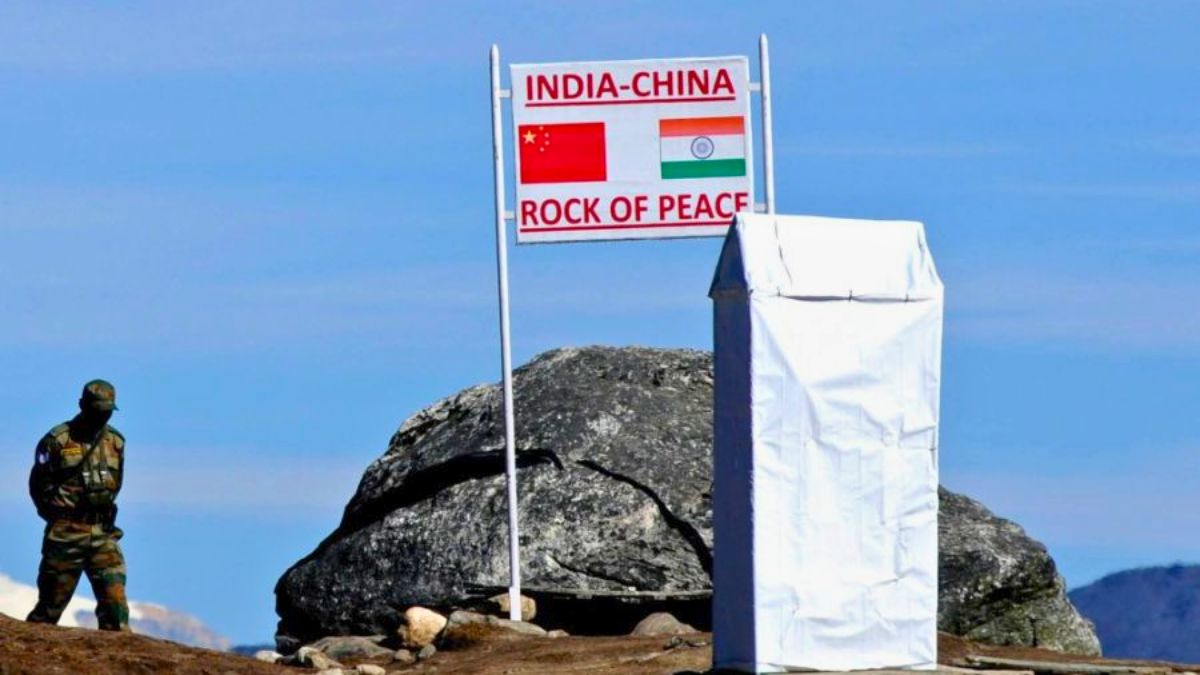
China has created a new unmanned aerial vehicle (UAV) test centre in Tibet. Image courtesy: Bharat Rannbhoomi Darshan

China is infamously known to expand its presence in areas to establish a claim over them, whether they historically belong to it or not. Just as it establishes military facilities on reclaimed land, installed weapons in the South China Sea, Beijing seems to be mirroring similar tactics along the Indian border.
Over the years, China has increased its infrastructural establishments around the Line of Actual Control (LAC), and this only keeps growing. Even though India–China border tensions may not be at the flashpoints witnessed during the 2017 Doklam standoff or the violent Galwan clash of 2020, Beijing has shown no signs of slowing down its strategic expansion along the LAC.
Under the radar, China continues to strengthen military infrastructure across Tibet by rapidly building high-altitude drone hubs, new highways, dual-use airfields and hundreds of border villages that double as PLA logistical outposts. One of the newest developments is a high-elevation UAV testing centre built at nearly 4,300 metres.
China’s latest military infra along LAC: What is Beijing’s latest expansion?
Equipped with a 720-metre runway, multiple hangars and administrative blocks, the newly built UAV testing centre will allow the PLA to test drones in extreme conditions that mirror forward Indian positions. It lies near the Ngari Logistics Centre, which already supports much of China’s military posture opposite Ladakh.
The Tibetan Plateau’s unique geography – thin air, freezing temperatures and treacherous terrain – poses daunting challenges for any army. But Beijing has invested heavily to overcome these barriers. Troops deployed here require oxygen support, special storage for vehicles and long-distance logistical pipelines for food, fuel and water.
How is China reinforcing its border strategy through roads and rail?
Reports from US and Indian think tanks show that Beijing’s expanding road network is designed to solve one of its oldest hurdles – poor mobility in remote Tibet. The China Aerospace Studies Institute (CASI) and ORF note how new highways such as G-314, G-684, G-695 and G-216 now allow platoons and armour to shift between Ladakh-facing sectors far faster than before, news agency ANI reported.
India’s ORF highlights the strategic significance of roads leading to the Shaksgam Valley, only a short hop from Siachen, suggesting a long-term focus on outflanking India’s northern defences.
Rail is another slow-burning asset. China has nearly doubled the TAR’s railway length to 1,118 kms since 2012 and plans a massive 5,000-km network by 2035. These routes allow units from PLA’s Western Theatre Command, including the 76th Group Army, to reach Hotan and China’s forward bases opposite Ladakh far more efficiently.
China’s high-altitude airports, border villages: Civil use or strategic coercion?
Between 2017 and 2023 alone, China built at least 37 military or dual-use airports and heliports in Tibet and Xinjiang. Key airfields like Shigatse, just 150 km from India, have been upgraded to handle larger aircraft, rapid troop insertion and heavier logistics loads. Simultaneously, Beijing has constructed 624 “border villages” between 2018 and 2022.
“The expanding network of ‘moderately prosperous border villages’, some of which are located on territory also claimed by India and Bhutan, has facilitated a scale-up of PLA forces along the border. The expansion of civilian administration and enterprises across over 600 border villages has created more opportunities for military-civil fusion and may enable the PLA to better leverage local resources in border counties,” the CASI report said.
What do these developments mean for India’s security posture?
The cumulative effect of China’s infrastructure is unmistakable as it results in faster mobilisation, wider lateral connectivity and the ability to move forces between sectors at short notice. Satellite imagery shows widening of roads near Pangong Tso, where two Chinese-built bridges have drastically reduced troop movement time.
PLA deployments in the Tibet Military District have also become more agile, supported by a revamped logistics system that blends modern supply chains with traditional methods such as pack animals and UAV-based delivery. Analysts warn that China is preparing systematically for future conflict scenarios.
In areas where road transportation is impossible, PLA border guards sometimes still use pack animals to patrol or move supplies. At the same time, the PLA is increasingly using UAVs for drops of food or medical supplies in difficult-to-access posts.
Should India accelerate its own border modernisation?
Experts argue that India cannot ignore China’s long-term game. China is displaying a clear intent to redefine infrastructure as a tool of coercion. It aims to further integrate and solidify its iron grip on the TAR and the XUAR, further merging them into its social and economic fabric.
Beijing’s “infrastructure-as-coercion” model, using roads, rails, airports and villages to shift realities on the ground, poses a strategic challenge.
India has been accelerating projects through the Border Roads Organisation, but the pace remains overshadowed by China’s massive state-backed push. Failure to match this tempo, analysts warn, risks allowing China incremental but irreversible gains that could alter the military balance along the LAC.