Build Military Capable Of Denying Aggression: Inside Trump’s Hardline Strategy To Deter Conflict Over Taiwan
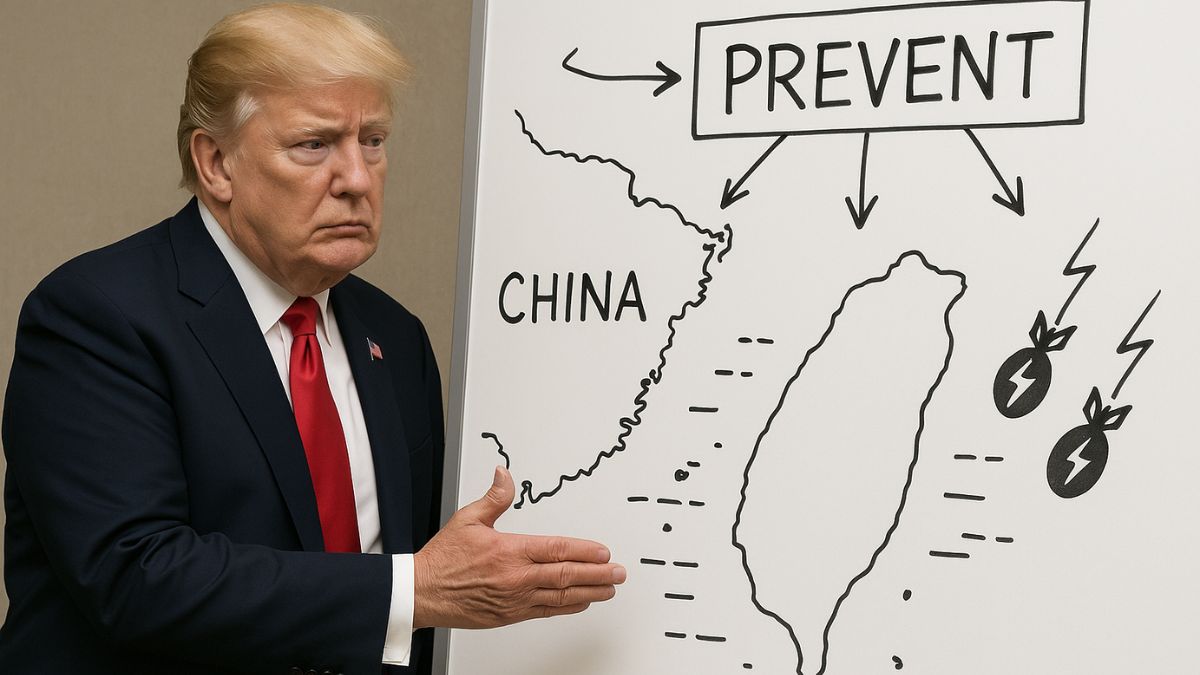
The US has no formal diplomatic ties with Taiwan but is the island's most important international backer. Image courtesy: AI-generated picture via Sora

In a sweeping shift with major geopolitical implications, President Donald Trump has unveiled a tougher, more detailed US strategy aimed at deterring China from using force against Taiwan and asserting dominance in the South China Sea. The newly released National Security Strategy (NSS) outlines Washington’s plan to prevent a conflict.
The US underlned that it is a related security challenge for any competitor to control the South China Sea. This could allow a potentially hostile power to impose a toll system over one of the world’s most vital lanes of commerce or, worse, to close and reopen it at will. Either of those two outcomes would be harmful to the US economy.
In view of the same and China’s increased dominance over the region, the US National Security Strategy reported talked about the plan to avoid a conflict over Taiwan by reinforcing US and allied military power across East Asia, at a moment when Beijing has sharply escalated pressure on both Taiwan and Japan.
How does the new US strategy reframe the Taiwan-China conflict?
The updated document arrives amid one of the most volatile periods in cross-strait relations in years. China has intensified military exercises around Taiwan, flown record numbers of warplanes near the island’s airspace, and sent large naval flotillas into the East China Sea and South China Sea.
The strategy marks a dramatic rhetorical shift from Trump’s earlier policies. While the administration’s 2017 NSS mentioned Taiwan only once, the new document references Taiwan eight times across three paragraphs, an unusual emphasis that signals Washington’s growing concern for the region.
The NSS describes deterring a conflict over Taiwan as a top priority, stressing that the best way to prevent a war is to maintain decisive US and allied military overmatch across the region. “We will build a military capable of denying aggression anywhere,” the document states, referring to the first island chain spanning Japan, Taiwan, the Philippines and Southeast Asia.
But it also argues that the US cannot, and should not, bear this burden alone, insisting that allies must “step up and spend” more on collective defence. It further highlights Taiwan’s strategic location in one of the world’s busiest trade corridors and its critical role in global semiconductor manufacturing.
What is China’s position and why is the situation so dangerous?
China considers Taiwan a breakaway province and has never ruled out the use of force to bring the island under its control. Under President Xi Jinping, Beijing has repeatedly warned that reunification “cannot be delayed indefinitely,” prompting fears in Washington, Tokyo, and Taipei that military confrontation could erupt in the coming decade.
Beijing also claims vast stretches of the South China Sea, an area critical to global shipping and contested by Vietnam, the Philippines, Malaysia and others. China’s sprawling artificial islands, airstrips and naval patrols have intensified geopolitical tension across the Indo-Pacific.
Against this backdrop, the US remains Taiwan’s most important security partner, even though Washington does not formally recognise the island as a sovereign nation. Under the Taiwan Relations Act, the US is obligated to provide Taipei with defensive capabilities.
“There is, rightly, much focus on Taiwan, partly because of Taiwan’s dominance of semiconductor production, but mostly because Taiwan provides direct access to the Second Island Chain and splits Northeast and Southeast Asia into two distinct theaters,” the report underlined.
How does Trump’s Taiwan approach differ from Biden’s?
Trump has largely avoided stating publicly whether he would order the US military to defend Taiwan if China attacked. By contrast, former President Joe Biden repeatedly said during his term that the US would defend Taiwan, remarks that triggered protests from Beijing but reassured regional allies.
The report stated that the US will maintain its longstanding declaratory policy on Taiwan, meaning that it States does not support any unilateral change to the status quo in the Taiwan Strait.
Trump’s focus on diplomacy and his efforts to stabilise ties with Xi Jinping have raised concerns among some allies that he may seek a transactional deal with China, possibly at Taiwan’s expense. Those fears deepened after reports that Trump privately urged Japanese Prime Minister Sanae Takaichi not to escalate tensions following her remark that a Chinese attack on Taiwan threatening Japan could justify Tokyo’s military response.
Trump’s upcoming April 2026 visit to Beijing, where he plans to discuss prolonging the US-China trade truce, adds an additional layer of uncertainty to an already fraught geopolitical picture.