
Japan–China Tensions Escalate: Tokyo Accuses Beijing of Dangerous Radar Lock As Taiwan Dispute Deepens
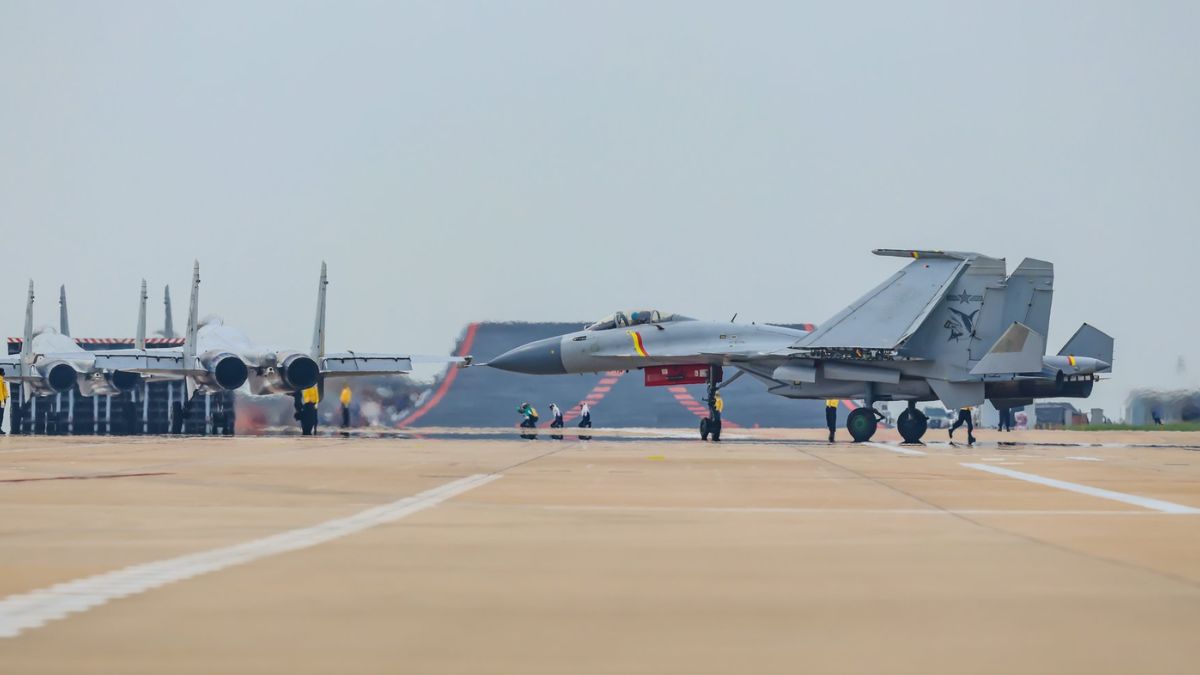
The radar lock by the Chinese aircraft was detected by different Japanese fighters. Image courtesy: X.com/@ChinaMilBugle

Just a day after the Japanese defense ministry claimed spotting the aircraft carrier Liaoning of the Chinese People’s Liberation Army (PLA) Navy nearby, the country has accused Beijing of carrying out a “dangerous and unacceptable” radar lock on its fighter jets, in what marks a sharp escalation of East Asia’s simmering tensions.
While both the sides have been engaged in a war of words over Taiwan for the past few months, Tokyo on early Sunday (December 7, 2025) said that it has protested to China after a military jet that took off from the Chinese carrier Liaoning locked its radar on Japanese fighter jets near the southern island of Okinawa, an act considered a potential precursor to missile targeting.
Japan’s Defence Ministry announced that a Chinese J-15 fighter jet, launched from the aircraft carrier Liaoning, intermittently locked its fire-control radar onto Japanese F-15s twice on Saturday (December 6, 2025). The first episode lasted around three minutes in the afternoon, and the second, more concerning one, continued for nearly 30 minutes in the evening.
While no Japanese airspace was violated and no damage occurred, officials underscored that the radar lock was detected by separate F-15s that had scrambled in anticipation of a possible incursion.
Chinese fighter locks radar on Japanese jet: How did Tokyo respond?
Defense Minister Shinjiro Koizumi condemned the radar lock as “a dangerous act that exceeded the scope necessary for safe aircraft operations.” Japan immediately filed a diplomatic protest with Beijing, calling for strict preventive measures to avoid further escalation.
Koizumi said the incident was “extremely regrettable” and stressed that Japan’s jets maintained a safe distance and avoided any actions that could be misinterpreted as provocations.
China’s government and PLA military are yet to issue a statement on the radar lock. However, Beijing has consistently maintained that its naval activities comply with international law, dismissing foreign concerns as “hyping up” routine operations.
How does the Taiwan dispute factor into this confrontation?
The radar lock incident comes amid rapidly deteriorating ties between the two Asian powers. China reacted angrily earlier in November 2025 when Japan’s Prime Minister Sanae Takaichi warned that Tokyo could consider military action if Beijing attacked Taiwan, remarks that marked a rare hardening of Japan’s stance.
Beijing views Taiwan as sovereign territory and has intensified aerial and naval operations around the island, triggering heightened alert levels among regional players, including Japan.
Combined with China’s recent deployment of ships across East Asian waters and Japan’s increasingly vocal support for Taiwan’s security, the radar lock marks one of the sharpest flashpoints in years.
Why is the Liaoning’s activity near Okinawa a matter of concern?
On Saturday, the Chinese aircraft carrier Liaoning sailed between Okinawa and Miyako Island, performing takeoff and landing drills in the Pacific. Notably, Japan considers the area vital to its national security. Tokyo scrambled F-15 fighters in response to monitor the carrier group.
Officials confirmed the Japanese jets kept a safe distance and did not engage in any provocative manoeuvres.
Worth pointing out here is that the latest incident comes just a few days after a Reuters claimed that Beijing is deploying a large number of naval and coast guard vessels across East Asian waters, at one point more than 100. Japan remembers well that in 2013, a Chinese warship locked its fire-control radar on a Japanese destroyer.
Are similar incidents happening elsewhere in the region?
The radar lock incident coincides with rising frictions between China and other neighbors. On Saturday, the Philippine Coast Guard reported that China fired three flares at a fisheries bureau aircraft patrolling the South China Sea. Beijing frequently uses flares to warn foreign aircraft away from areas it unilaterally claims as its own airspace.
Such incidents highlight the widening scope of China’s assertive posture in the Indo-Pacific, from the East China Sea near Japan to disputed waters in the South China Sea.
Meanwhile, Japan had in July 2025 urged China to stop flying its fighter jets abnormally close to Japanese intelligence-gathering aircraft, which it said was happening repeatedly and could cause a collision. According to its defence ministry, a Chinese JH-7 fighter-bomber flew as close to 30 metres to a Japanese YS-11EB aircraft.
This occurred outside Japanese airspace over the East China Sea and caused no damage to the Japanese side, according to the ministry.