





China Steps Closer To India’s ‘Chicken’s Neck’ As Bangladesh Lets Envoy Visit Teesta Project Site
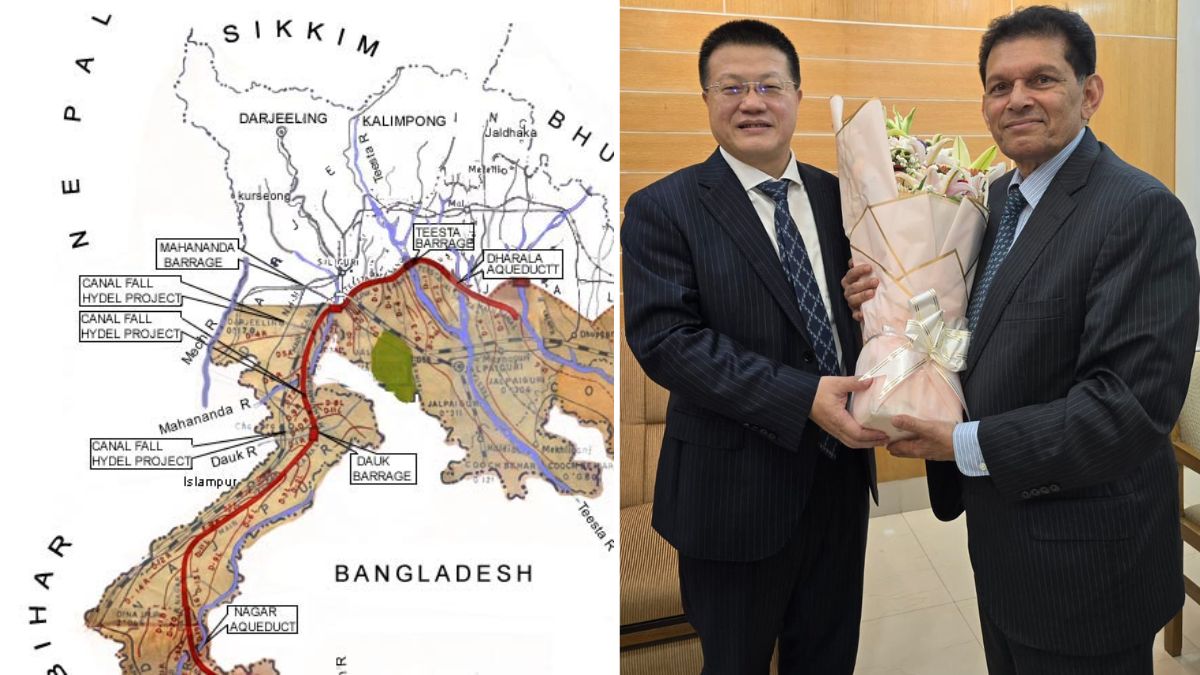

Over an year after Bangladesh in March 2025 welcomed Chinese companies to participate in the Teesta River Comprehensive Management and Restoration Project, the area was paid a visit by the Chinese ambassador to Bangladesh recently. Located alarmingly close to India’s strategically vital Siliguri Corridor, the visit has triggered fresh national security concerns in New Delhi,
Chinese envoy Yao Wen’s recent visit to the Teesta water site comes against the backdrop of current strain in India-Bangladesh relations and the timing of Dhaka’s growing engagement with Beijing. Since coming into power in August 2024, Muhammad Yunus’s interim government has steadily sharpened Bangladesh’s anti-India posture.
Wen was reportedly accompanied by water resources adviser Syeda Rizwana Hasan, who said Beijing is keen to start implementation of Teesta Master Plan (TMP) as soon as possible, Times of India reported. She said both Bangladesh and China are committed to implementing TMP.
Siliguri Corridor: Why Chicken’s neck makes this visit sensitive
The Teesta project site visited by Chinese envoy Yao Wen lies in northern Bangladesh, close to the Siliguri Corridor, often referred to as “Chicken’s Neck”, which is a narrow 22-km-wide land strip that connects mainland India to its entire Northeast.
Any foreign strategic footprint, especially by China, infrastructure, hydrological or otherwise, in this vicinity carries implications for military mobility and logistics, crisis-time reinforcement of the Northeast, surveillance and dual-use infrastructure risks.
For India, the Siliguri Corridor is not just geography, but a single point of strategic vulnerability.
Teesta river project: Development for Dhaka but dilemma for New Delhi?
Bangladesh officials described the Chinese envoy’s visit as part of a technical assessment under the Teesta River Comprehensive Management and Restoration Project (TMP), with China expressing eagerness to begin implementation.
While Dhaka views the Teesta as a lifeline for agriculture and livelihoods in its northern districts, the river is equally critical for West Bengal, where water-sharing concerns have stalled a final bilateral agreement for decades.
Worth mentioning here is that in October 2025, hundreds of people formed a human chain near Chittagong University’s Shaheed Minar in Bangladesh, demanding an immediate implementation of the Teesta Master Plan and Bangladesh’s “fair share” of Teesta water, reported news agency Bangladesh Sangbad Sangstha (BSS).
Why Chinese envoy’s Teesta project visit is a red flag for India?
India’s unease stems not from river management per se, but from Chinese involvement in a transboundary river system, proximity to a militarily sensitive corridor, and the potential future leverage through water and infrastructure diplomacy.
The Teesta Master Plan, backed by China, is being seen in Bangladesh as a workaround to the long-stalled Teesta water-sharing deal with India. However, its proximity to the strategic Chicken’s neck is a concern. The China-backed Teesta Master Plan promises to address northern Bangladesh’s water scarcity amid stalled water-sharing talks with India.
Notably, the 1996 Ganga Water Sharing Treaty is nearing its expiry this year.
Why the timing matters?
The visit comes at a politically and diplomatically sensitive moment as relations between New Delhi and Dhaka have been tense following anti-India protests in Bangladesh in December, during which Indian diplomatic facilities were targeted.
Interim chief adviser Muhammad Yunus, appointed in 2024, has previously made controversial remarks in China about India’s Northeast being “landlocked” and Bangladesh’s potential role in enabling the “extension of the Chinese economy.”
Then-Bangladesh PM Sheikh Hasina had in 2024 clearly stated her preference for India over China for the project.
Against this backdrop, a high-profile Chinese assessment visit near India’s strategic chokepoint acquires geopolitical weight far beyond development optics.
China’s expanding footprint in Bangladesh
Following meetings between Ambassador Yao and Bangladesh’s National Security Adviser Khalilur Rahman, Dhaka publicly reaffirmed its “longstanding friendship and development cooperation” with Beijing. Chinese support now spans the Teesta Master Plan, a proposed Bangladesh–China Friendship Hospital, and broader infrastructure and economic cooperation.
Yao and Rahman’s “meeting was held in a cordial and constructive atmosphere. Both sides exchanged views on issues of mutual interest, reaffirming the longstanding friendship and development cooperation between Bangladesh and China,” the Chief Adviser of the Government of Bangladesh said.
Discussions included the Teesta River Comprehensive Management and Restoration Project and the proposed Bangladesh–China Friendship Hospital. In this context, the Chinese Ambassador informed that he would visit the Teesta project area reiterated China’s commitment to completing the ongoing technical assessment expeditiously.
The envoy also reiterated Beijing’s backing for Bangladesh’s ongoing political transition and upcoming elections.
Rising in the Himalayan heights of Sikkim, the 315-kilometre Teesta River slips into Bangladesh through Lalmonirhat, before carving a long, winding course across the country’s northern heartland. Flowing for over 150 kilometres, it threads through key districts such as Rangpur, Gaibandha, Nilphamari and Kurigram, shaping agriculture and livelihoods along its banks.


