South Korea To Honour India’s Contribution During Korean War With New Memorial; Rajnath Singh To Inaugurate
While India did not contribute combat troops, its influence on the Korean war’s outcome was noted globally. Image courtesy: RNA

Seventy-five years after India played a key non-combat role during the Korean War (June 1950 to July 1953), South Korea will honour that contribution with a new war memorial. Defence Minister Rajnath Singh is scheduled to visit South Korea next month for the joint inauguration of the memorial commemorating India’s participation in the conflict, The Tribune reported.
When the Korean War broke out in June 1950, India was a newly independent nation testing its foreign policy of Non-Alignment in a highly polarised world between the USA and the Soviet Union. Prime Minister Jawaharlal Nehru made a conscious decision not to send combat troops, fearing direct military involvement would weaken India’s neutral stance.
India, instead, chose a humanitarian role that eventually proved crucial to both the battlefield and diplomatic outcomes of the war.
India’s participation in Korean War
Skipping the typical combat role, India dispatched the 60th Parachute Field Ambulance, an airborne medical unit led by Lt Colonel A G Rangaraj. The unit arrived in Busan on November 20, 1950, carrying medical supplies meant to last six months. With transport scarce, the doctors used an old steam locomotive to move equipment and reach forward areas.
Branded as the “Parachute Doctors” and later known as the “Maroon Angels”, the Indian team treated wounded soldiers, civilians, and prisoners of war, often operating close to active crossfire.
The unit consisted of 364 personnel, including surgeons, anaesthetists and a dentist. In December 1950, it became the official medical evacuation unit for the 27th British Commonwealth Brigade and continued its service until returning to India in February 1954.
Neutral Nations Repatriation Commission
India also played a decisive diplomatic role when the war reached a stalemate in 1952. The deadlock over Prisoners of War threatened peace talks. India proposed the Neutral Nations Repatriation Commission (NNRC), under which prisoners unwilling to return home would be placed under neutral supervision.
Although initially opposed, the proposal formed the basis of the 1953 Armistice Agreement, helped by India’s ability to talk to both Washington and Beijing.
Indian troops received formal commendations from the Korean government, and last year Rangaraj was named Korean War Hero of the Month. The memorial reflects not only wartime service but also the deepening Indo-Korean partnership across defence, global supply chains and strategic cooperation.
India-South Korea relations in present day
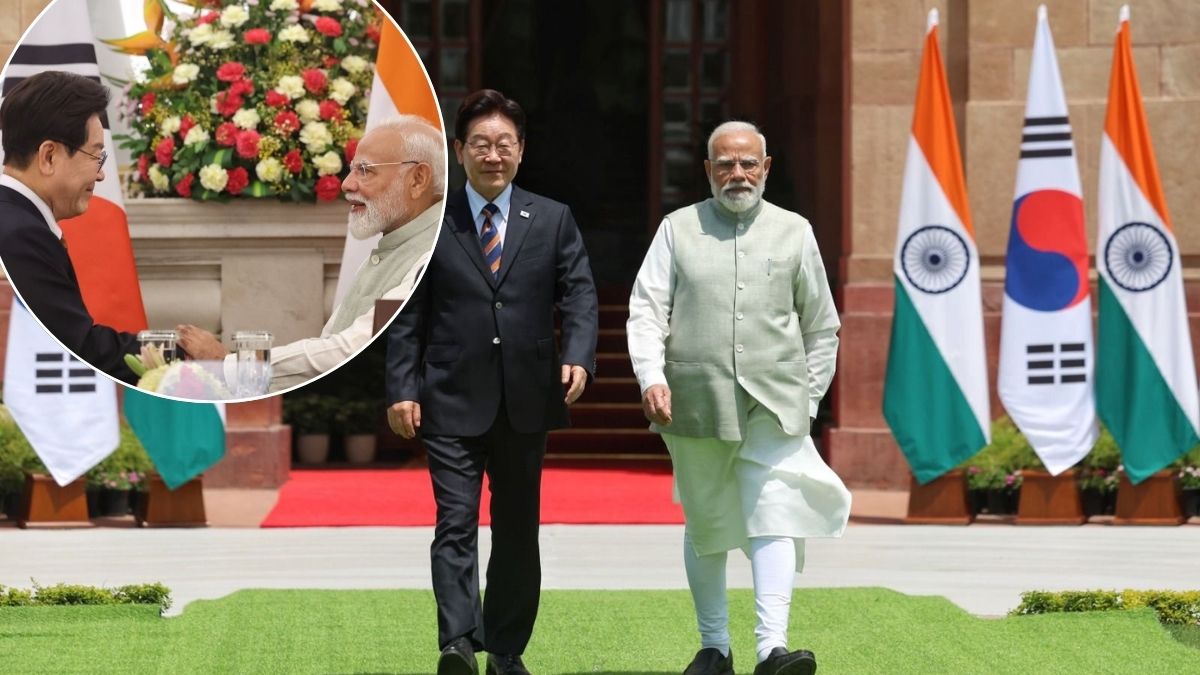
Earlier this week, South Korean President Lee Jae-Myung completed his three-day state visit to India, marking the first visit by a South Korean head of state in more than eight years. Following his bilateral meeting with Prime Minister Narendra Modi, both the sides announced deepening their cooperation in shipbuilding, shipping, and maritime logistics.
Moreover, PM Modi and the South Korean President decided to double their bilateral trade to $50 billion by 2030. These decisions were taken at a bilateral summit meeting between the two leaders in New Delhi on Monday (April 20, 2026) when they signed a slew of agreements aimed at boosting their technological cooperation and trade.
The two countries would also set up the India-South Korea Digital Bridge to work jointly on artificial intelligence (AI).