
Operation Sindoor Showed India’s High-Impact, Short-Duration Capability: Rajnath Singh At Air Force Commanders’ Conclave
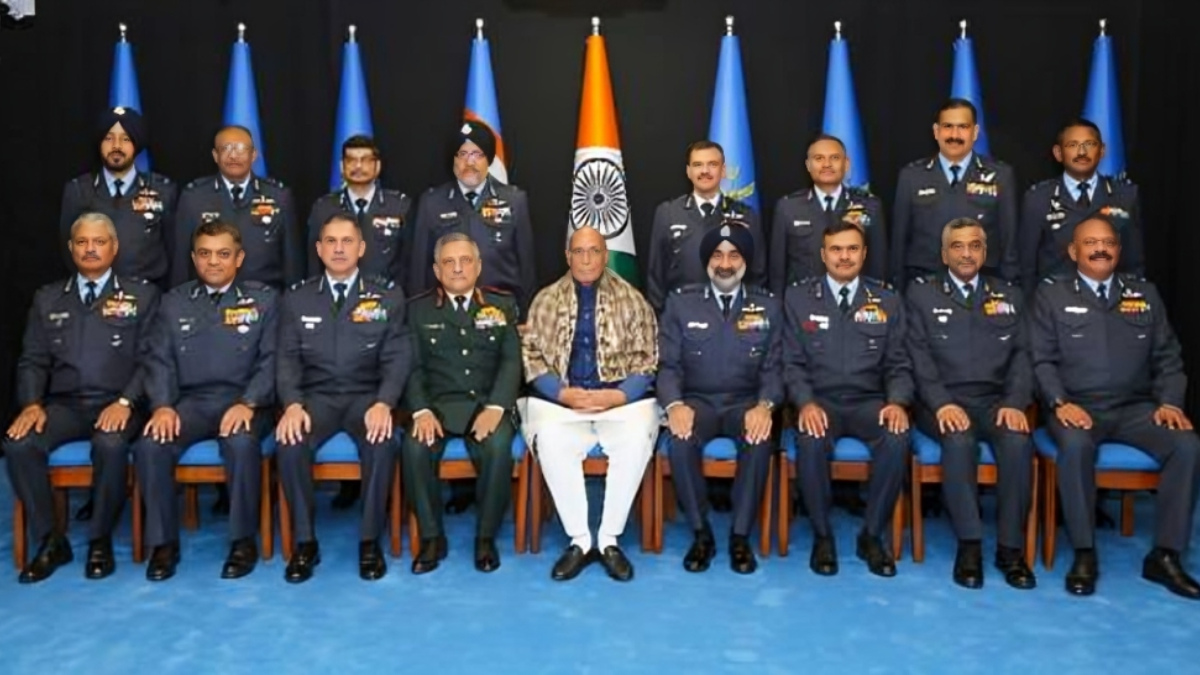

Defence Minister Rajnath Singh said the Indian Armed Forces demonstrated high-impact, short-duration operational capability during Operation Sindoor, emphasising the Indian Air Force’s (IAF) role as a technologically advanced, strategically confident force. He was addressing the Air Force Commanders’ Conclave in New Delhi on December 18.
Rajnath Singh described the IAF as operationally agile and future-oriented, capable of safeguarding national interests amid a rapidly evolving global security environment.
What did Rajnath Singh say about Operation Sindoor?
Rajnath Singh praised the speed, precision, and effectiveness with which the Indian Air Force carried out strikes during Operation Sindoor, including the destruction of terror camps. He also referred to the IAF’s handling of what he described as Pakistan’s “irresponsible reaction” following the operation.
Highlighting public confidence in the Armed Forces, particularly in air defence preparedness, he said the calm response of citizens during the attempted targeting of Indian installations reflected trust in India’s operational readiness. He urged Air Force commanders to draw lessons from Operation Sindoor and remain vigilant against future challenges.
How did the Defence Minister describe the role of air power today?
Reflecting on recent conflicts, including the Russia–Ukraine war, the Israel–Hamas conflict, the Balakot air strikes, and Operation Sindoor, Rajnath Singh said air power has emerged as a decisive force in contemporary warfare.
He described air power not merely as a tactical asset but as a strategic instrument characterised by speed, surprise, and shock effect. According to him, air power enables political leadership to convey clear strategic messages and align national objectives with military capabilities through its reach and precision.
What did Rajnath Singh say about modern warfare and future readiness?
Rajnath Singh said 21st-century warfare extends beyond weapons and increasingly revolves around ideas, technology, and adaptability. He pointed to cyber warfare, Artificial Intelligence (AI), unmanned aerial vehicles, satellite-based surveillance, and space-enabled capabilities as factors reshaping modern conflict.
He said precision-guided weapons, real-time intelligence, and data-driven decision-making are now essential requirements rather than optional advantages. He added that nations mastering technology, strategic vision, and adaptability are best positioned for global leadership.
What initiatives were highlighted on indigenisation and capability development?
Rajnath Singh said the Sudarshan Chakra initiative, announced by Prime Minister Narendra Modi during his Independence Day address, would play a crucial role in protecting national assets. He added that the development of indigenous jet engines has been taken up as a national mission.
He also highlighted collaboration with the private sector, start-ups, and Micro, Small and Medium Enterprises (MSMEs) through initiatives such as Innovations for Defence Excellence (iDEX) and ADITI. As of November, 672 winners had emerged from 565 challenges under iDEX, including 96 winners linked to Indian Air Force-related challenges.
What was said about jointness and humanitarian roles?
Describing Operation Sindoor as an example of tri-service synergy, Rajnath Singh stressed the importance of jointness among the three services to strengthen national security and improve operational effectiveness.
He also commended the IAF’s role in Humanitarian Assistance and Disaster Relief (HADR) operations, both within India and abroad, noting that such missions have strengthened public trust in the force.
The conclave was attended by the Chief of Defence Staff (CDS), General Anil Chauhan, and senior Indian Air Force commanders. Rajnath Singh was received by the Chief of the Air Staff (CAS), Air Chief Marshal AP Singh, and briefed on operational readiness. The conclave serves as a forum for reviewing priorities and advancing self-reliance in defence capabilities.