



Indian Army Counters Multiple Pakistani Drone Intrusion Attempts Along LoC In J&K
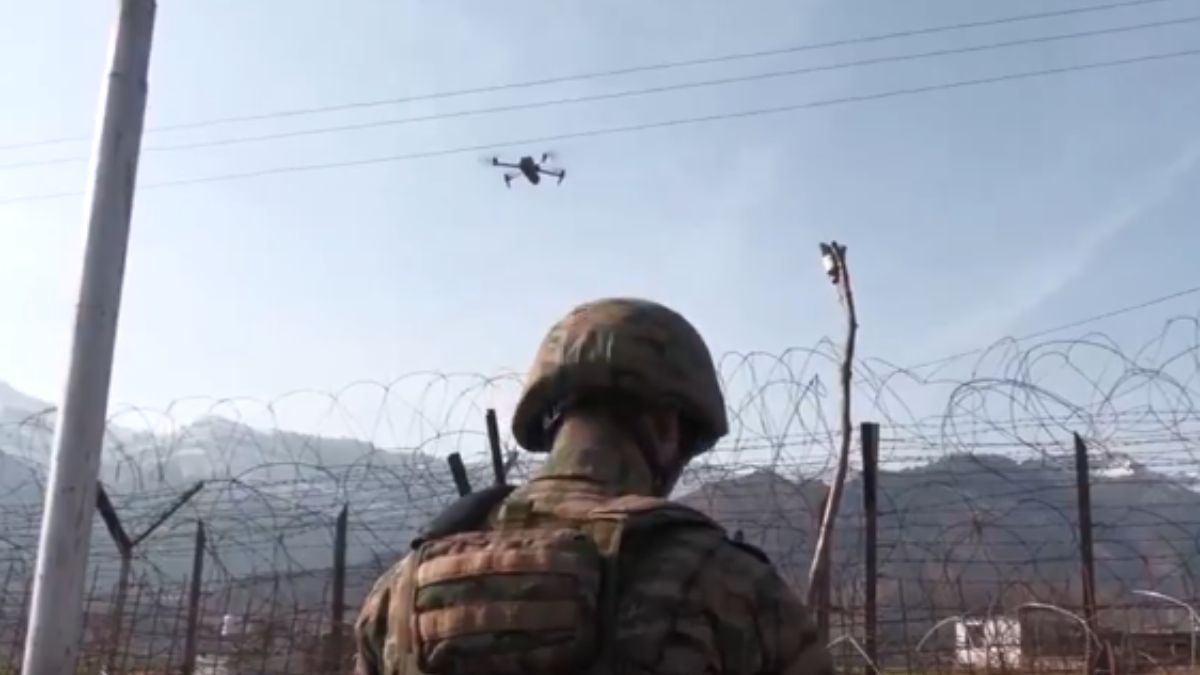
Army successfully thwarted an attempt by 2-3 small quadcopters to violate airspace along the Line of Control in the Poonch. Image courtesy: X.com/@ANI

Amid intensifying military tensions in West Asia and escalating clashes between Pakistan and Afghanistan, the Indian Army has thwarted multiple drone intrusion attempts along the Line of Control (LoC) in Jammu and Kashmir’s Poonch district, underscoring heightened vigilance along India’s western frontier.
The attempted breaches come at a time when the wider region is witnessing strategic instability, from US-Israel strikes on Iranian targets and Tehran’s retaliation, to cross-border hostilities between Islamabad and Kabul, creating a complex security environment across South and West Asia.
Army intercepts drone in Jammu and Kashmir
According to Army officials, between 5:45 am and 6:00 am on Sunday (March 1, 2026), two to three small quadcopters attempted to violate Indian airspace along the LoC in the Poonch sector. “Swift counter-drone actions by vigilant Indian Army personnel successfully thwarted the attempt, forcing the quadcopters to return,” officials said.
Shortly after, at around 6:10 am, another unmanned aerial vehicle briefly entered Indian territory near the Digwar area. Troops at a forward post opened fire, discharging over a dozen rounds. The drone reportedly hovered momentarily before retreating towards Pakistan-occupied Kashmir.
Authorities have not officially confirmed the origin of the drones.
Was anything dropped during the intrusion?
Following the attempted incursions, security forces launched immediate area domination and search operations in nearby villages and forward zones. The objective was to ensure that no weapons, explosives or narcotics were air-dropped during the drone’s brief presence.
Officials said that, as of now, no suspicious material has been recovered.
Why are drones becoming a tactical challenge?
Military planners increasingly view small quadcopters as a low-cost, high-impact tool in grey-zone warfare. Due to their small size, manoeuvrability and minimal radar signature, such drones are difficult to detect using traditional air defence systems. Neutralising them often requires rapid ground-based response, electronic countermeasures or precision small-arms engagement.
Repeated sightings along the LoC and the International Border in recent days have prompted the Army to intensify surveillance, enhance electronic monitoring and maintain quick-reaction readiness.
The Poonch episode highlights the evolving character of border threats — where unmanned aerial systems supplement conventional ceasefire violations.
How does the broader regional situation factor in?
The drone activity comes against the backdrop of major geopolitical upheaval. West Asia has witnessed a sharp escalation following US and Israeli strikes on Iranian military infrastructure, followed by retaliatory actions by Tehran and heightened alert levels across Gulf states.
Simultaneously, Pakistan is grappling with escalating cross-border clashes with Afghanistan, including airstrikes and drone exchanges along its western frontier.
While there is no confirmed operational linkage between these theatres, defence analysts note that periods of regional instability often coincide with tactical testing along sensitive borders.
India’s western arc, spanning the LoC to the International Border, remains under constant monitoring as strategic tensions ripple across neighbouring regions.
The Indian Army has further strengthened anti-drone deployment grids in sensitive sectors of Jammu and Kashmir, integrating surveillance assets, thermal imaging systems and counter-UAS technologies. Forward posts have been directed to maintain heightened alert, particularly during early morning and low-visibility windows.