

Army Turns To Sound Waves Of Trust With New Community Radios To Fight Misinformation In The Hills
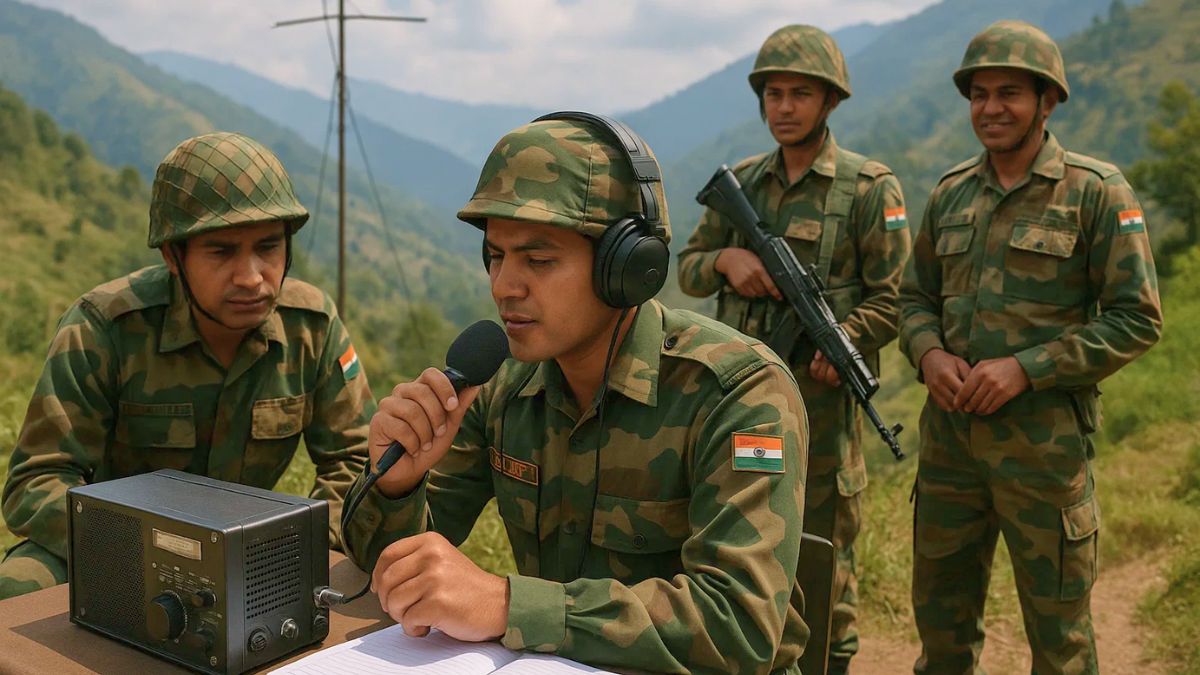
Four CRSs have already gone live under the initiative - Pithoragarh, Jyotirmath, Kinnaur and Spiti. Image courtesy: AI-generated picture via Sora

Taking key lessons from Operation Sindoor, where adversaries attempted to spread disinformation through social media, the Indian Army has devised a traditional-yet-tactical solution — community radio stations (CRS). The Central Command has launched these stations in high-altitude, border-adjacent regions of Uttarakhand and Himachal Pradesh.
With this initiative, the Central Command wants to ensure that it is credible communication that spreads, not misinformation, during crises. As of now, four CRSs have already gone live under the initiative – Pithoragarh (May 2025) and Jyotirmath (June 2025) in Uttarakhand; Kinnaur (April 2025) and Spiti (October 2025) in Himachal Pradesh.
The station in Jyotirmath was inaugurated by Chief of the Army Staff (COAS) General Upendra Dwivedi, while the others were opened by Central Command GOC-in-C Lt Gen Anindya Sengupta, according to a report in The Times of India. More such stations are being planned for other remote high-altitude sectors along the northern frontier.
How will these CRSs help during border tensions?
A senior Army officer from Central Command explained that the stations will serve as a crucial communication lifeline in times of heightened tension or conflict. During Operation Sindoor, commanders found themselves countering waves of enemy propaganda on social media, an effort that drained time and resources.
By contrast, CRS will broadcast authentic Army-verified information within a 15–20 km range, ensuring locals get the truth directly from a trusted source.
Can traditional radio outlast modern disruptions?
Unlike internet-based platforms vulnerable to shutdowns or cyber interference, radio signals operate independently. In the event of a communication blackout or network disruption, these stations are expected to stay operational, which would be a critical edge in the fog of information warfare.
“Social media needs the internet; radio does not. Even in a blackout, we can still reach our people,” the officer told the publication, underlining the strategic simplicity of analogue resilience.
What role will CRSs play during peacetime?
Beyond defence readiness, the Army is using these stations to celebrate local culture, talent, and youth engagement. Programmes highlight regional artists, sportspersons, and emerging radio jockeys, offering locals both recognition and participation in national service narratives.
According to Lt Col Manish Shrivastava, PRO Defence (Dehradun), “CRSs will not only inspire youth to join the armed forces but also help curb migration from border regions by fostering community pride and connectivity.” The stations will also share real-time road and weather updates, aiding tourism and civilian logistics in rugged terrain.
Army veterans have hailed the move as a confidence-building masterstroke. Lt Gen Mohan Bhandari (Retd) from Ranikhet remarked, “People living along the borders are the first to feel the tremors of conflict. Reliable information from the Army, in their own language and voice, will strengthen their trust and morale.”
With the static hum of radio waves returning to the high Himalayas, the Army’s initiative bridges not just distances but distrust, turning each broadcast into a “wave of assurance.”