


Army’s Game-Changer For Forward Areas: 3D Printing Tech Deployed For Quick Construction Of Bunkers, Posts
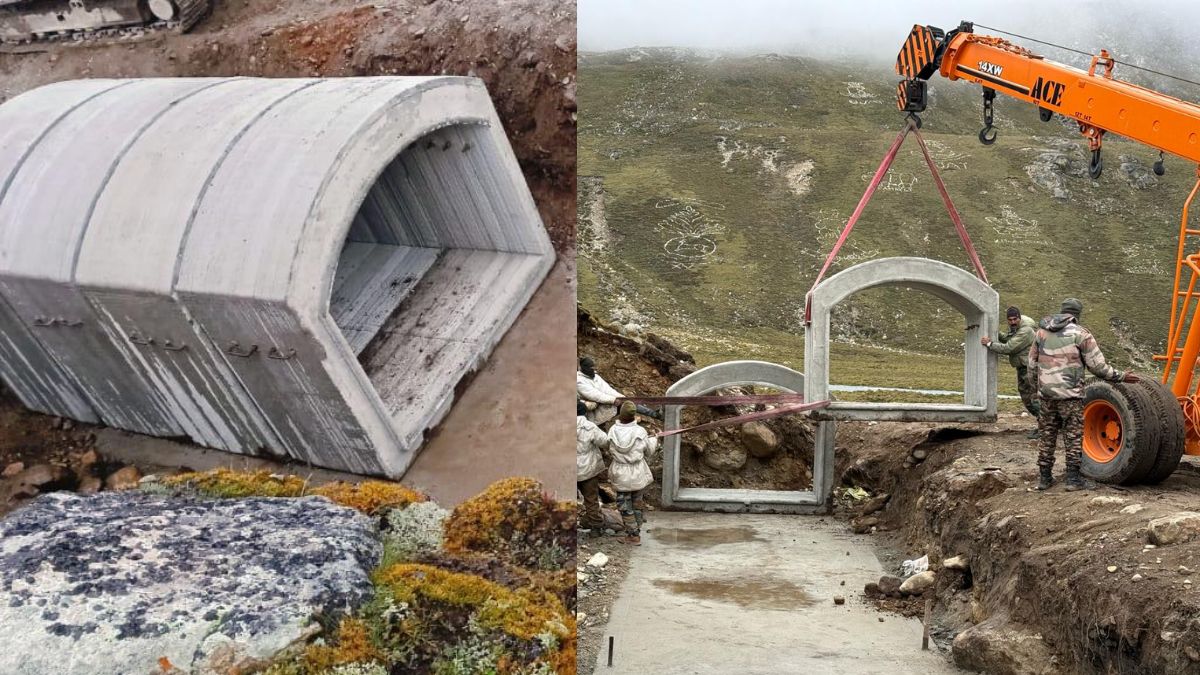
The 3D concrete printing provides major operational advantages like enhanced blast and ballistic resistance, higher compressive strength. Image courtesy: X.com/@trishakticorps

Just when you think that a future-ready force means troops equipped with high-tech weapons, next-gen drones etc., the Indian Army pulls out a move that stuns and how! Soldiers in the forward areas of Sikkim are making using of 3D printing to make concrete bunkers fast and quick.
In a major technological milestone for India’s frontier defence capabilities, the Indian Army, in clsoe collaboration with IIT Hyderabad, has fully operationalised on-site 3D concrete printing technology in the forward areas of Sikkim. This marks a significant upgrade in how quickly the Army can build bunkers, sentry posts, protective shelters and mission-critical structures in some of the world’s toughest terrain.
The development comes less than a month after over 500 impact- and blast-resistant 3D-printed bunkers were delivered to the Indian Army by MiCoB Private Limited, a homegrown start-up specialising in rapid 3D concrete printing (3DCP). These structures, also called Permanent Defences, were first successfully tested in Pokharan in 2022.
3D bunkers in Sikkim forward areas: What makes it a force multiplier?
The capability, which has already been tested in other operational zones, is now being effectively deployed by the Trishakti Corps in the Himalayan sector, one of the Army’s most sensitive and logistically demanding areas. According to the Defence Ministry, the indigenous robotic 3D concrete printer is designed specifically for military use in rugged mountains.
It includes a robotic arm for precision layering, a circular mixer and piston pump for rapid material flow, a dedicated generator for off-grid operations, a fully vehicle-portable frame optimized for steep Himalayan tracks. This mobility allows engineers to reach forward posts quickly, drastically cutting construction time compared to traditional methods.
3D concrete bunkers: Have they been tested on the battlefield?
The Army confirmed that all printed structures have undergone live ballistic trials, proving their ability to withstand small arms fire, fragmentation and blast pressure. The technology offers higher blast and ballistic resistance, superior compressive strength, more uniform quality control, use of local materials, reducing logistical burden, customised, terrain-specific construction, vital for mountain warfare.
It also offers advanced camouflage options, essential for survivability in contested zones.
Why is this crucial for troops in forward high-altitude areas?
High-altitude border zones such as Sikkim demand fast, reliable and adaptive infrastructure. Traditional construction can take weeks or months due to harsh weather, limited accessibility, short working seasons, supply chain constraints. With 3D printing, the Army can now rapidly build hardened shelters for troops.
With this 3D printing tech, the Army troops can secure key vantage points with stronger fortifications, respond quickly to sudden operational needs, enhance survivability and comfort of soldiers deployed at high altitudes, and reduce human fatigue and material wastage.
What role would it play in India’s future defence readiness?
The continued adoption of on-site 3D printing marks a transformative shift in India’s military engineering doctrine. The technology significantly boosts operational readiness, enabling the Army to build infrastructure on demand, enhance mobility and survivability, maintain a technological edge in contested border zones, reduce long-term costs.