Indian Military Ready With Theatre Commands For Pakistan, China, Maritime Fronts
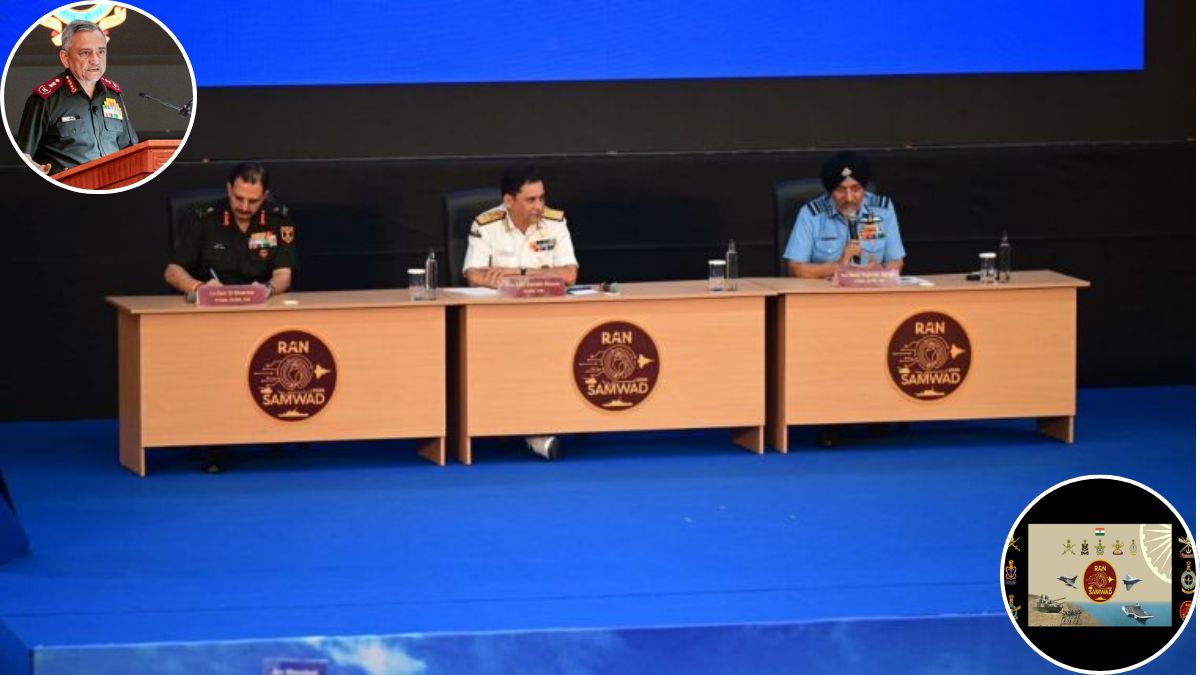
India’s top military leadership moves closer to rolling out theatre commands, signalling a major shift towards integrated, tri-service warfighting. Image courtesy: Screen Grabs via X.com/@HQ_IDS_India

India’s three armed forces would submit their “theatre commands” proposal to the Defence Ministry in about a week or so, and the Cabinet Committee on Security would take the final call on the three new formations facing Pakistan, China, and the peninsular region covering the maritime domain.
India’s Chief of Defence Staff General Anil Chauhan told the ‘Ran Samwad’, the second edition of military brainstorming hosted by the Defence Ministry in Bengaluru this year, that he would complete the report on ‘Operation Tiranga’, the codename given for the military theaterisation process, and submit it within a “week or so.”
“From our side its done, all the services are on board, and discussions have concluded. Now we have to take the proposal to the Defence Minister and Cabinet Committee on Security (CCS),” General Chauhan said at the event during a fireside chat on Thursday (April 9, 2026).
“There is a 100% consensus on the concept; there remain some differences on how the process of implementation, however, we are moving ahead,” he said.
Threatre Commands for Pakistan, China, Maritime Domains
Of the three Theatre Commands to be set up under Operation Tiranga, one would focus on Pakistan, another on China, and the third on the maritime domain.
An Indian Air Force (IAF) officer would head the Pakistan-facing theatre command, and this was decided based on the Operation Sindoor experience. An Indian Army officer would be the chief of the China-focused threatre command, and an Indian Navy officer would helm the maritime theatre command.
The Integrated Defence Staff Headquarters chief Air Marshal Ashutosh Dixit, in his remarks at the event, warned that organisational structures alone would not guarantee operational synergy. Dixit, the deputy to General Chauhan, is tasked with tri-service jointness, integration, and operational synergy.
“Our move towards joint structures and Theatre Commands — with planning now reported to be more than 90 percent complete — is a historic opportunity. Jointness must evolve from mere coordination to genuine unity of effort. That requires transparency in information-sharing, clarity of authority, and — most fundamentally — mutual trust,” Air Marshal Dixit said.
Army War Games Nuclear Fallout in a Conventional Battlefield
At the same event, Indian Army chief General Upendra Dwivedi said his force has tweaked its war strategy in the last year-and-a-half to include nuclear challenges posed by both China and Pakistan, though nuclear-related warfare is handled by the tri-service Strategic Forces Command.
General Dwivedi was responding to a question from former SFC commander Vice Admiral SPS Cheema (Rtd) on the blurring of lines between conventional and nuclear conflict in recent times.
The Army chief said he was thankful to the retired Navy officer for meeting him soon after he took office. “Since then, in all our wargames, we have been discussing all these issues behind closed doors. Even issues considered taboo earlier are being discussed to build awareness. This is because nuclear conflict is a reality along both our borders,” he said.
The Indian Army had brought about changes in its warfare strategy by taking into account the deployment of tactical battlefield nuclear weapons, changes in the strategic posturing of the adversaries, and the choice of dual-use targets in conflicts.
“Therefore, it is mandatory to discuss, and it is good that he gave this suggestion to us. We are having those closed-door discussions and looking at offensive and defensive plans daily, and how we are supposed to take action, such as force preservation, protection, and orchestration,” he said.
General Chauhan, in his remarks, said India’s nuclear capability would not be considered a separate domain, but as part of the cognitive war in multi-domain operations.
“We don’t consider nuclear weapons as part of war fighting, but it’s a deterrent in mind, hence it will be part of the cognitive domain. Nuclear domains as such don’t form a separate domain,” he said.
The CDS noted that Prime Minister Narendra Modi had spoken about India not being deterred by Pakistan’s nuclear blackmail after Operation Sindoor, which called the nuclear threat bluff.
Self-Reliance is Key for Robust Defence
In his remarks, Air Marshal Dixit noted that aatmanirbharta (self-reliance) in the defence sector was not just about making weapons within India, but was about controlling the architecture and software of systems, among other things.
“Because, without control, the country will be dependent on others at the worst possible moments,” Air Marshal Dixit said, referring to defence production within the country.
“Atmanirbharta in defence is not just about making weapons in India. It is about controlling architectures–software, encryption, data standards, and upgrade cycles. Without that control, we are dependent on others at the worst possible time,” he said.
His remarks were significant as India was still reliant on foreign sources for some of its critical military requirements, including fighter jets, and the Defence Ministry had recently decided to buy 114 more Rafales from France, along with local assembly of about 90 of the combat jets at an Indian facility.
India is also teaming up with France, the US, and the UK for joint design and development of aeroengines to meet its domestic futuristic combat aircraft’s requirements. India is also in talks with France to possibly join its 6th-generation aircraft programme, FCAS, in which Germany is a partner.