

DRDO’s Makes SWaDeS To Make Seawater Potable In Just 2-3 Minutes: How It Would Benefit Soldiers
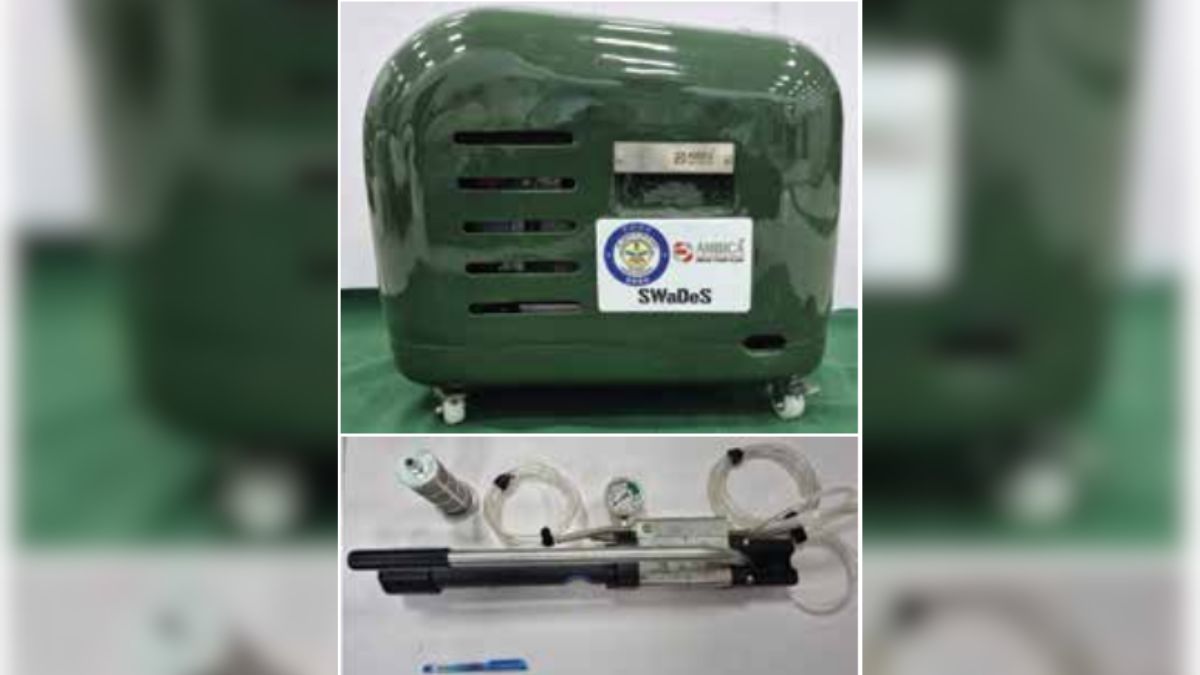
The system is manual portable and has the capability to deploy within 2-3 minutes for converting seawater into potable form. Image courtesy: DRDO

Now, Indian Army soldiers stationed in remote and far away regions could get clean drinking water in less than 5 minutes, thanks to all the innovation that the Defence Research and Development Organisation (DRDO) keeps on introducing. The leading agency behind cutting-edge defence tech has developed a portable water desalination system.
In a significant boost to battlefield logistics and soldier survivability, the DRDO has designed a portable water desalination system designed to meet the drinking water needs of troops operating in remote and hostile environments. Named Sea Water Desalination System (SWaDeS), the system directly addresses one of the most persistent challenges faced by soldiers on long-range patrols: reliable access to safe drinking water.
What is SWaDeS and how does it work?
Developed by the Defence Laboratory, Jodhpur, SWaDeS is a compact, flexible desalination gadget that can be operated manually or powered by an engine, depending on operational requirements. Designed in response to requirements projected by the tri-services, the system can purify saline and brackish water to potable standards, making it suitable for both maritime and inland deployments.
The manually operated version of SWaDeS is light enough to be carried by a single soldier and can meet the emergency drinking water requirements of 10–12 personnel. This makes it particularly useful for troops deployed on long-range patrols, special operations, or in areas where fresh water sources are scarce or non-existent.
Why is it crucial for high-altitude and border areas like Ladakh?
According to DRDO scientists, SWaDeS is suitable for inland saline water bodies such as Pangong Tso in eastern Ladakh, where a large concentration of troops remains deployed close to the Line of Actual Control with China. In such regions, water sources are often saline and logistics are challenging due to terrain and weather.
“The SWaDeS is useful for tri-command establishment, naval operations, and coastal installations for purifying seawater. The systems have undergone the ATP and it is successfully completed,” the DRDO said.
What are the capabilities of the engine-operated variant?
The engine-powered version of SWaDeS can desalinate seawater with salinity levels of up to 35,000 mg/L Total Dissolved Solids (TDS) and reduce it to below 500 mg/L TDS, which meets permissible drinking water standards. This variant can support the water requirements of 20–25 soldiers, making it ideal for coastal deployments, naval operations, island territories and forward bases.
SWaDeS is part of DRDO’s wider portfolio of water purification technologies developed for diverse climatic and operational conditions. These include household water purifiers that remove arsenic, iron and manganese, as well as specialised Chemical, Biological, Radiological and Nuclear (CBRN) water purification systems for use in contaminated environments.
While some of these systems are fixed installations, others are transportable, vehicle-mounted or designed for rapid deployment.