
Rajnath Singh Visits Indian Army Pavilion Showcasing Key AI Applications That Predict Disasters, Diver Fatigue
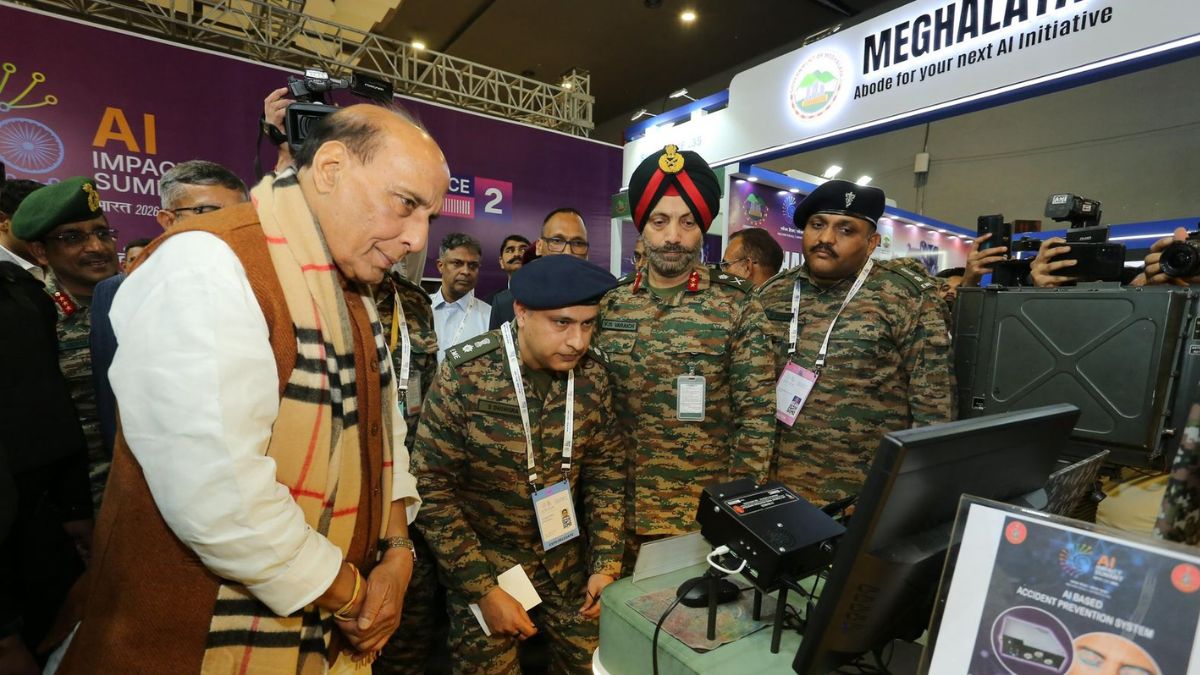
Defence Minister Rajnath Singh reviews AI-based military applications at the Indian Army pavilion during the AI Impact Summit in New Delhi, as the armed forces highlight disaster prediction systems and fatigue detection technologies aimed at strengthening national security. Image courtesy: X.com/@rajnathsingh

The Indian armed forces put up a huge display of their Artificial Intelligence capabilities at the AI Impact Summit 2026 in New Delhi between February 16 and 20, including climatology and disaster prediction systems to devices that detected a vehicle driver’s fatigue to prevent accidents.
India’s Defence Minister Rajnath Singh took time to visit the Indian armed forces stalls at the AI Impact Summit on Friday (February 20, 2026).
“Delighted to visit the AI Impact Summit at Bharat Mandapam today. India is rapidly emerging as a global leader in Artificial Intelligence and advanced technologies,” Rajnath Singh posted on the microblogging site X later on Friday (February 20).
“The Summit showcases the immense talent of our innovators, researchers, startups, armed forces and industry leaders. India’s AI vision MANAV, articulated by PM Shri @narendramodi at #IndiaAIImpactSummit2026, sets humanity’s direction towards a secure and future-ready world,” his post read.
“Guided by principles of morality, accountability, national data sovereignty, accessibility and robust systems, India is helping shape the next civilisational leap through responsible AI. AI is not just a driver of economic growth, but also a force multiplier for national security and good governance. I thank PM Modi for hosting the AI Summit in India. Compliments to the organising Teams and all participants for making this Summit a grand success,” he added.
India’s Prime Minister Narendra Modi inaugurated the summit on Thursday (February 18, 2026) and unveiled the ‘MANAV’ vision for a human-centric approach and use of AI with a strong accent on sovereignty and inclusivity.
The AI Impact Summit attracted several heads of States, global AI leaders, academicians and researchers, and heads of global technology giants, and investors.
The Indian Army showcased several AI-based applications at its pavilion, which was visited by Rajnath Singh, who interacted with the military officers there, and took a tour of the pavilion that also attracted visited, both young and old. The Indian Navy too showcased its technologies at the AI Impact Summit.
Among the AI applications showcased by the Indian armed forces included ‘Prakshepan’, a military climatology and disaster prediction system, and an AI-based device that detects driver’s fatigue and alerts the person behind the wheels to avert accidents.
Other technologies included Xface, a facial recognition system for rapid image and video-based verification in boosting security and surveillance mechanism, and Nabhdrishti, a telemetry reporting system which can capture positional data, imagery and orientation, “even based on images of an unidentified drone in flight.”
According to Indian Army officers, ‘Prakshepan’ was launched by the defence minister in November 2025, and the device’s name in Sanskrit meant “projection.”
“This application is a cutting edge military climatology application developed in-house by the Army’s Directorate General of Information Systems,” one of the army officers manning the system said.
“It has been powered by scientific and technical collaboration from several ministries with agencies like India Meteorological Department, National Centre for Medium Range Weather Forecasting, Central Water Commission, North East Space Application Centre, Geological Survey of India and Defence Geospatial Research Organisation,” he said.
Prakshepan has three prediction modules: prediction of floods, landslides, and avalanches. “This is India’s robust hybrid military climatology system capable of predicting landslides and avalanches 3-7 days in advance using multi-agency scientific datasets, terrain intelligence, and AI/ML (AI/machine learning) modelling,” another army officer said.
The Indian Army in January 2026 declared 2026 as the ‘Year of Networking & Data Centricity’ and said that the initiative would enhance connectivity, real time decision-making and combat effectiveness, thereby strengthening resilience and agility for a future-ready force.