


Asim Munir Becomes Pakistan’s Most Powerful Military Leader Yet Under Controversial Overhaul
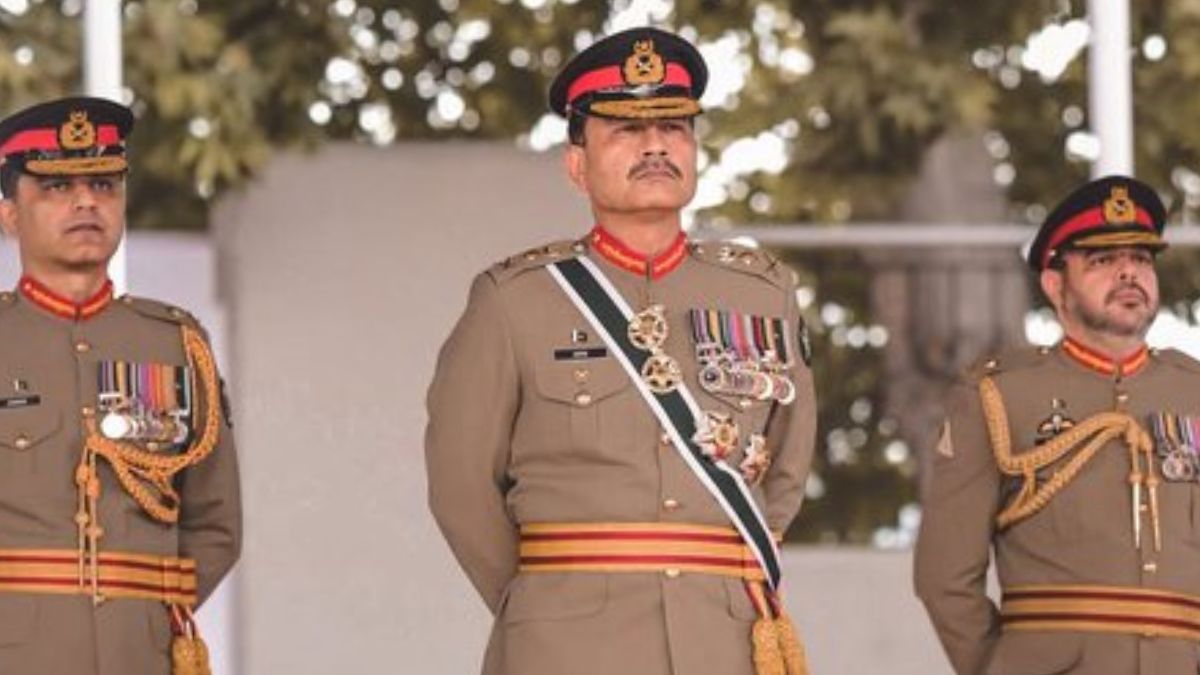
Pakistan Army Chief Field Marshal Asim Munir has been elevated to the position of Chief of Defence Forces (CDF). Image courtesy: Social media

Pakistan has entered a new phase of military dominance without a traditional coup, as Army Chief Field Marshal Syed Asim Munir on Thursday (November 27, 2025) assumed the newly created role of Chief of Defence Forces (CDF), a position that places him firmly at the top of all three military services for a fixed five-year term.
The elevation comes through the contentious 27th Constitutional Amendment, marking one of the most sweeping shifts in Pakistan’s civil-military structure in decades.
Is this Pakistan’s historic military restructuring?
The amendment, passed by Pakistan’s Senate on November 1, abolishes the powerful Chairman Joint Chiefs of Staff Committee (CJCSC), a post created in 1976 after Pakistan’s defeat in the 1971 war with India.
With the retirement of outgoing CJCSC General Sahir Shamshad Mirza, the post now disappears from Pakistan’s military framework entirely.
Under the revised structure, Asim Munir is now effectively the supreme commander of Pakistan’s tri-services, with direct authority over the army, air force, and navy, a shift that analysts say centralises unprecedented power in a single individual.
Is this a new era of military supremacy in Pakistan?
Pakistan, a nuclear-armed nation of 240 million, has oscillated between civilian and military rule since its formation in 1947.
While no military ruler has taken power openly since General Pervez Musharraf stepped down in 2008, analysts argue the armed forces have continued to exert control through behind-the-scenes influence in what many describe as a system of “hybrid governance.”
The 27th Amendment accelerates this trend dramatically. It not only elevates the army chief over the other service heads but also grants the CDF exclusive control over Pakistan’s nuclear command systems, shifting authority from the president and federal cabinet to the military.
Munir’s tenure has effectively been reset and extended until 2030, superseding his earlier retirement timeline. He will now hold the nation’s most powerful security post for a fresh five-year term, and may be reappointed beyond that with ease, given his strengthened authority.
The amendment also grants lifelong legal immunity, similar to that enjoyed by Pakistan’s president. This protection extends to the chiefs of the air force and navy as well.
Will this mean reduced civilian oversight over the military?
The CDF now has the authority to recommend key appointments such as the Vice Chief of Army Staff (VCOAS), a power previously held by the civilian government. The army will also play a decisive role in selecting the head of the National Strategic Command (NSC), responsible for nuclear oversight.
Munir’s rise has been swift. Having served as head of Military Intelligence and later as Director-General of the powerful ISI, he was abruptly removed in 2019 by then Prime Minister Imran Khan, a move still shrouded in mystery.
His fortunes shifted after Khan’s ouster in 2022, leading to his appointment as army chief and, later, promotion to field marshal following a brief skirmish with India in mid-2025.
Is Munir now the most powerful man in Pakistan?
Analysts say the constitutional changes have made him the “most powerful man in Pakistan.” Retired Lt Gen Naeem Khalid Lodhi argues that politicians, seeking short-term gains, have ceded long-term national interest by empowering the military further.
Shuja Nawaz, a noted South Asia expert, says Munir now wields power comparable to Musharraf at the height of his rule, but without the backlash of a coup. With a pliant coalition government in office after a disputed 2024 election that sidelined Imran Khan, Munir’s influence faces few checks.
“Pakistan’s future depends on a strong economy and stable governance; neither of which it currently has,” analyst Hasan Shah warns.
Munir has notched diplomatic successes, including a private lunch with US President Donald Trump. Yet experts caution against overestimating Pakistan’s leverage, with Washington prioritising India for strategic alignment.