


Behind China’s Journalist Day, A Machinery Where Reporters Are Tools Of Surveillance, Control
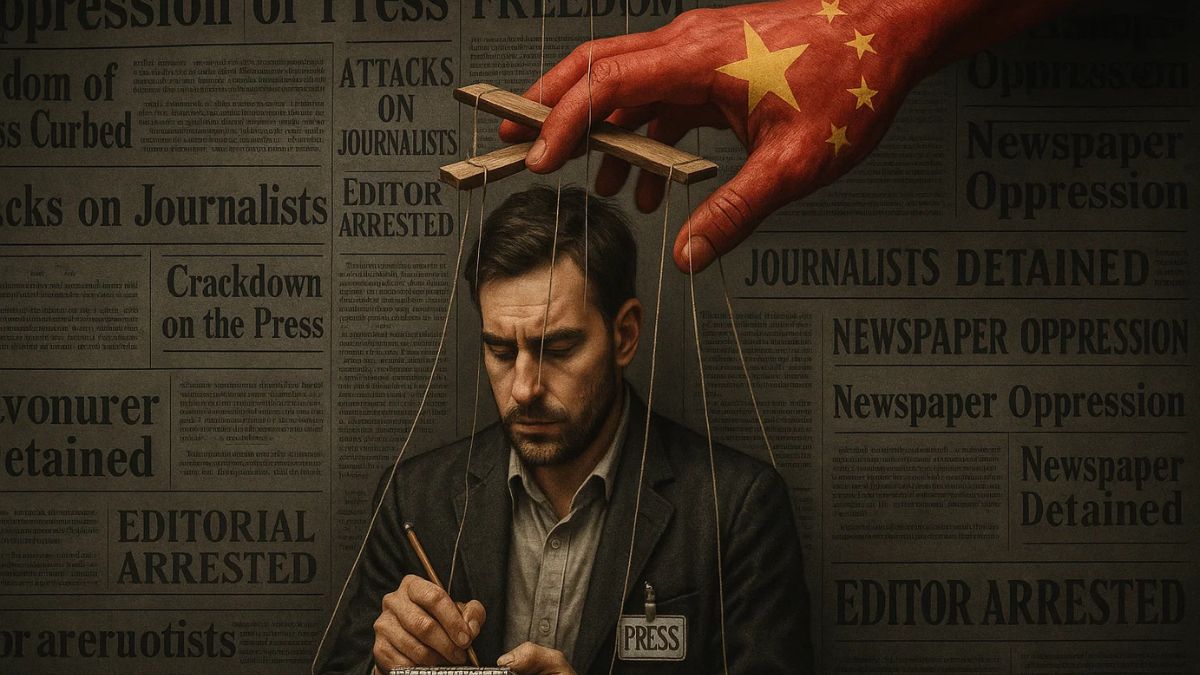
In China, the CCP not only relies on media as a tool to spread propagand, but also to gather information on ground-level sentiments. Image courtesy: AI-generated image via Sora

China has marked yet another celebration of National Journalists Day on November 8, 2025. Official speeches and state media pieces praise “news workers” for serving socialism and national rejuvenation. Yet, this same state systematically jails, censors, and silences independent reporters.
In China, journalism has long ceased to be a profession of truth-telling and has instead become an instrument of obedience. Every major outlet — from Xinhua to People’s Daily to CCTV — speaks with one voice: the Party’s. Their role is not to inform, but to affirm. Editors are not gatekeepers of public interest but custodians of official ideology. Every word published is another layer in the wall that separates citizens from unfiltered reality.
Under Xi Jinping, the centralisation has been near-total. The media’s “surnamed Party” doctrine means that newsrooms are now extensions of the propaganda department. Journalists are given “study sessions” to memorise the latest political slogans, and coverage plans are synchronised with party directives. What used to be news has become choreography — every headline a performance of loyalty, every omission a mark of fear.
How does China’s media amplify the state’s voice?
China’s major outlets — Xinhua, People’s Daily, and CCTV — are owned and supervised by the Party’s Central Propaganda Department. Their job is not to scrutinise authority but to promote its priorities. The CCP maintains strict control over editorial lines, personnel appointments, and even the rhythm of news cycles. Every front page and prime-time bulletin reinforces the image of a competent, unified government whose legitimacy rests on “stability” and “prosperity.”
This structure ensures that the Party’s version of reality dominates the public sphere. Journalists and editors are trained to “transmit positive energy,” a slogan that sums up Beijing’s view of information as a tool for morale and cohesion. Independent reporting on sensitive subjects — from corruption to protests or public health failures — risks being labelled as “picking quarrels and provoking trouble,” a criminal charge often used against reporters who test the limits of expression.
Why does the state rely on journalists to monitor itself?
Even under such tight control, China’s leaders depend on the media to know what is happening beyond Beijing’s reach. The country’s vast geography and bureaucratic hierarchy create a chronic problem of distorted information: local officials often conceal unrest or accidents to protect careers. Here, the media plays a paradoxical second role — as the “eyes and ears” of the Party.
Local reporters are encouraged to investigate social tensions, disasters, or corruption, not for public transparency but for internal reporting. These “upward reports” alert central authorities to brewing crises or governance failures, helping them intervene before problems spread. This dual purpose — control and surveillance — is embedded in the system itself. Stories that expose dysfunction may circulate privately among officials even as they are deleted from public view.
What does this reveal about information and power in China?
The Party-state’s dependence on both propaganda and internal feedback shows the tension at the heart of Chinese governance. It must know the truth to rule effectively, yet it must also control the truth to rule at all. As a result, the media acts as what Chinese scholars once called a “transmission belt”: carrying orders downward and grievances upward, ensuring that loyalty and awareness coexist in the same institution.
In today’s digital age, where censorship algorithms replace red pens, that dynamic has only deepened. Online platforms mirror the same pattern — amplifying official content while feeding private intelligence about public sentiment to the state. For Beijing, journalism remains not an adversary but a management tool. The flow of information may appear modern, but the purpose remains unchanged: to serve the Party first, and the public second.