China Upgrades Type 96A Tanks: PLA Deploys Drone-Killer Systems As Taiwan Pursues ‘Porcupine’ Strategy
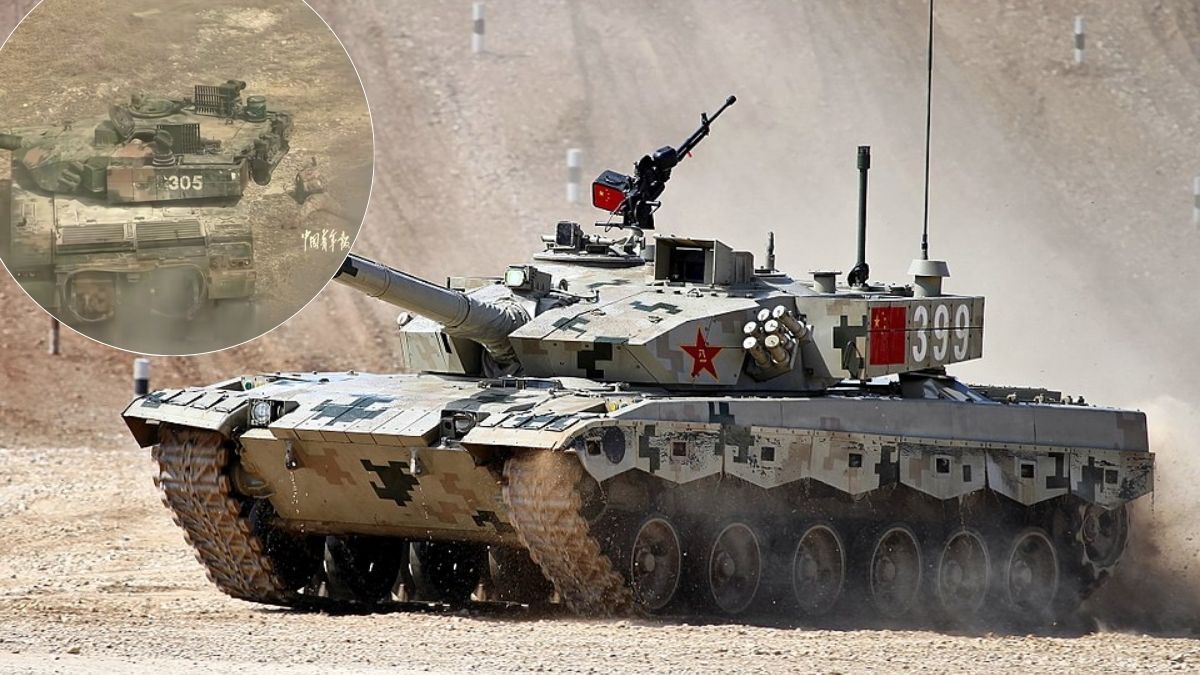
China has begun upgrading older tanks with defensive systems designed for emerging threats. Image courtesy: RNA

As tensions continue to simmer across the Taiwan Strait, China has moved to significantly upgrade its armoured warfare capabilities, signalling how modern battlefields, shaped by drones and precision weapons, are redefining military strategy. The People’s Liberation Army (PLA) has now equipped its ageing Type 96A main battle tanks with advanced protection systems.
Designed to counter emerging threats, the tank upgrade with advanced systems is being seen as part of preparations for a potential Taiwan contingency. The PLA has fitted its Type 96A main battle tanks with the GL-6 active protection system (APS), according to state media reports and official footage released by China Youth Daily.
These tanks are operated by the 71st Group Army under the Eastern Theatre Command, the unit primarily tasked with operations involving Taiwan, including potential amphibious assaults across the strait, according to a report in South China Morning Post.
China’s upgrade of the Type 96A tanks is significant because it reflects a broader shift in warfare since traditional heavy armour is increasingly vulnerable to drones, loitering munitions, and anti-tank guided missiles. By modernising older platforms instead of replacing them, China is adapting quickly to lessons seen in conflicts like Ukraine.
What is the GL-6 system and how does it work?
The GL-6 APS represents China’s answer to the rapid evolution of battlefield threats. Unveiled in 2024, the system integrates 360-degree radar coverage, infrared and optoelectronic sensors, and automated interceptor munitions. These components allow the tank to detect and neutralise incoming threats like drones, rockets, and missiles in real time.
The system was previously seen on next-generation platforms like the Type 100 tanks and export models such as the VT-4A1, but its installation on older Type 96 tanks suggests a wider standardisation effort across the PLA’s armoured fleet, the SCMP report added.
Why are older Type 96 tanks still so important?
Despite being in service for nearly 30 years, the Type 96 series remains a backbone of China’s armoured forces, with over 2,500 units still active. These tanks have undergone multiple upgrades over time, improving engine performance, mobility, firepower, protection.
Crucially, the Type 96 is lighter and more transportable than heavier models like the Type 99, making it better suited for amphibious landing operations, especially in difficult coastal terrain. This makes it particularly relevant in a Taiwan scenario, where rapid deployment across the strait and initial beachhead operations would be critical.
Is China’s latest move linked to Taiwan tensions?
While China has not explicitly stated the upgrades are Taiwan-specific, the context is hard to ignore. Beijing continues to view Taiwan as part of its territory and has repeatedly said it could use force if necessary. Meanwhile, the Eastern Theatre Command, where these tanks are deployed, is directly responsible for operations targeting Taiwan.
The integration of drone defence systems suggests China might be gearing up for high-intensity, tech-driven warfare, where survivability against precision strikes will be crucial.
Drawing lessons from modern wars
The war in Ukraine has dramatically reshaped military thinking worldwide. Tanks, once dominant, have proven highly vulnerable to low-cost drones, any portable anti-tank missiles, and even loitering munitions. China’s response mirrors a global trend, in which instead of abandoning tanks, militaries are layering them with active protection systems.
The GL-6 deployment indicates that Beijing is closely studying these conflicts and rapidly integrating those lessons into its own military doctrine.
On the other hand, Taiwan has been pursuing an asymmetric defence strategy, often referred to as the “porcupine strategy.” This approach focuses on large numbers of low-cost, high-impact weapons, and the targeting of high-value assets like tanks and ships.
In December 2025 alone, Taiwan ordered 1,050+ Javelin anti-tank missiles, 1,545 TOW-2B heavy anti-tank missiles. These systems are specifically designed to counter armoured threats like the Type 96.
What did the latest PLA drill reveal?
The upgraded tanks were showcased during a logistics support drill conducted by the 71st Group Army in a simulated battlefield environment. The exercise focused on tank maintenance and rapid repairs, operations in damaged infrastructure conditions, and “unmanned smart support and drone countermeasures”.
China seems to be not only upgrading its hardware but also preparing for sustained, complex battlefield conditions, where logistics and resilience are as critical as firepower.