

China Used Troll Armies, Justice Mission 2025 Drills Aimed At Countering Support For Island: Taiwan Claims
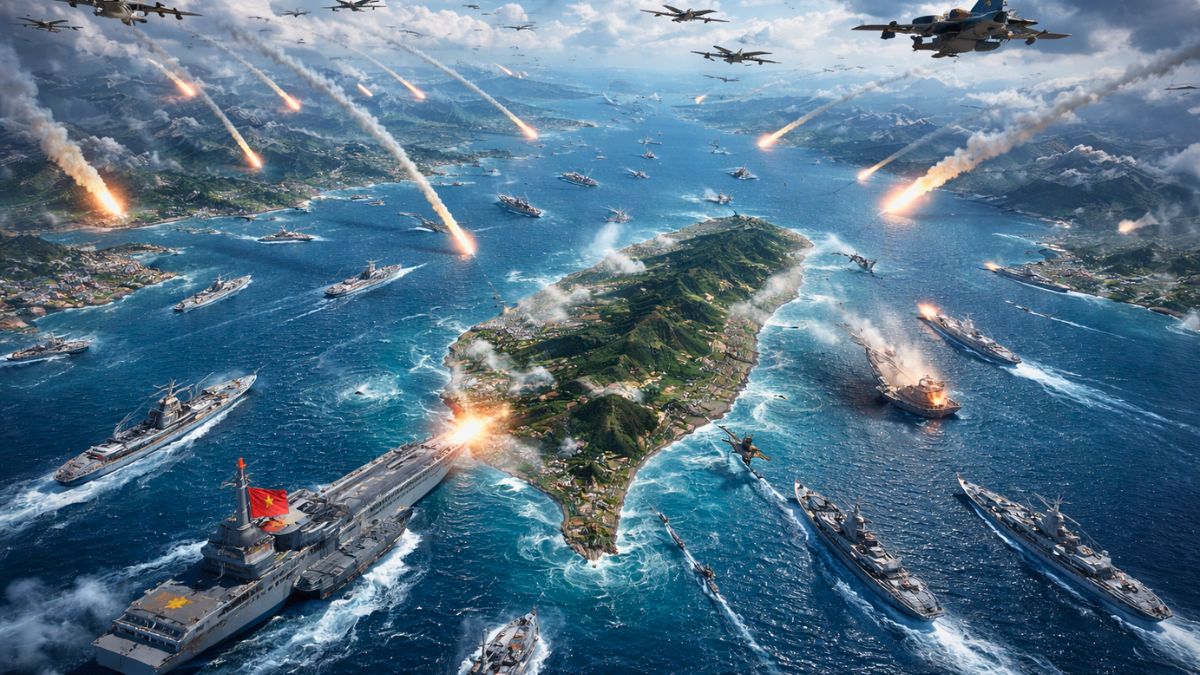
As part of its exercises, called "Justice Mission 2025", China fired dozens of rockets towards Taiwan. Image courtesy: AI-generated picture via Sora

China’s latest round of large-scale military exercises around Taiwan not only underscored Beijing’s increasingly assertive posture in the Taiwan Strait, but also raised drew an unprecendeted claim from Taipei. China’s war games around the island, dubbed Justice Mission 2025, sent a big political messgae to the world, according to Taiwan.
Taiwan’s top security agency has claimed that China’s Justice Mission 2025 war games were not just military manoeuvres, but a strategic political message aimed at countering growing international support for Taipei while diverting domestic attention from China’s economic and social challenges.
Sometime around last week, China fired dozens of rockets towards Taiwan and deployed a large number of warships and aircraft near the island as part of its drills – Justice Mission 2025. That caused dozens of domestic flights in Taiwan to be cancelled and drew concern from allies in the region and the West.
What were China’s ‘Justice Mission 2025’ drills?
The exercises, conducted last week, marked China’s most expansive war games around Taiwan to date in terms of geographic coverage. As part of the drills, the People’s Liberation Army (PLA) fired dozens of rockets towards areas near Taiwan; deployed large formations of warships and combat aircraft around the island.
Chinese military drills disrupted civilian life, forcing dozens of domestic flight cancellations in Taiwan. The scale and proximity of the manoeuvres triggered concern among regional allies and Western capitals monitoring security in the Taiwan Strait.
Why does Taiwan say China conducted these drills?
In a report submitted to Taiwan’s Parliament, the National Security Bureau (NSB) said the drills carried a clear political intent. “The Taiwan-focused drills aimed to push back internationally against democratic partners’ support for Taiwan,” the report said.
The agency assessed that Beijing was also attempting to redirect public frustration over economic slowdown and social tensions at home, transforming it into nationalist sentiment framed as resistance to “external interference.”
Beijing expanding pressure beyond military force?
The report further warned that Beijing is intensifying a “hybrid warfare” campaign, combining military coercion with economic pressure, cyber operations and information warfare. During the extensive war games, Chinese state media, AI-generated content and coordinated online troll networks were used to amplify Beijing’s narratives.
Messaging sought to undermine confidence in Taiwan’s military, erode trust in President Lai Ching-te, and cast doubt on US support. Taipei also claimed that around 19,000 controversial messages were pushed by 799 social media accounts within just five days.
It went on to note that the military drills were synchronised with intense cyber operations, highlighting China’s evolving approach to modern conflict. Over two million cyberattacks were recorded on the first two days of the war games alone. PLA-linked hacking groups APT24 and BlackTech were identified as among the most active.
The objective, the report said, was to disrupt Taiwan’s cybersecurity environment and unsettle public morale. Beijing has routinely denied involvement in hacking operations.
How is the international community reacting?
The drills come amid rising global concern over stability in the Taiwan Strait.
The NSB report also cited remarks by Japanese Prime Minister Sanae Takaichi, who warned late last year that a Chinese attack on Taiwan could pose an existential threat to Japan, signalling that in such a situation, Japan’s self-defence forces can be activated to respond to the threat.
The exercises have drawn scrutiny from the United States, European partners and regional allies, many of whom see escalating PLA activity as a challenge to freedom of navigation and regional peace.
China’s Taiwan Affairs Office, however, defended the drills, saying they were necessary to “staunchly defend national sovereignty and territorial integrity”, uphold what Beijing calls the shared interests of people on both sides of the strait. China claims Taiwan as itsterritory and has not ruled out the use of force to bring the island under its control.
Justice Mission 2025: Why are the drills geopolitically significant?
The Justice Mission 2025 exercises highlight how the Taiwan Strait has become one of the world’s most dangerous flashpoints. By combining missile drills, naval and air deployments, cyberattacks and information warfare, Beijing is signalling its readiness to apply multi-domain pressure.