China’s Corruption Crackdown Continues: Parliament Expels 3 Officers As Xi’s Anti-Graft Purge Deepens In PLA
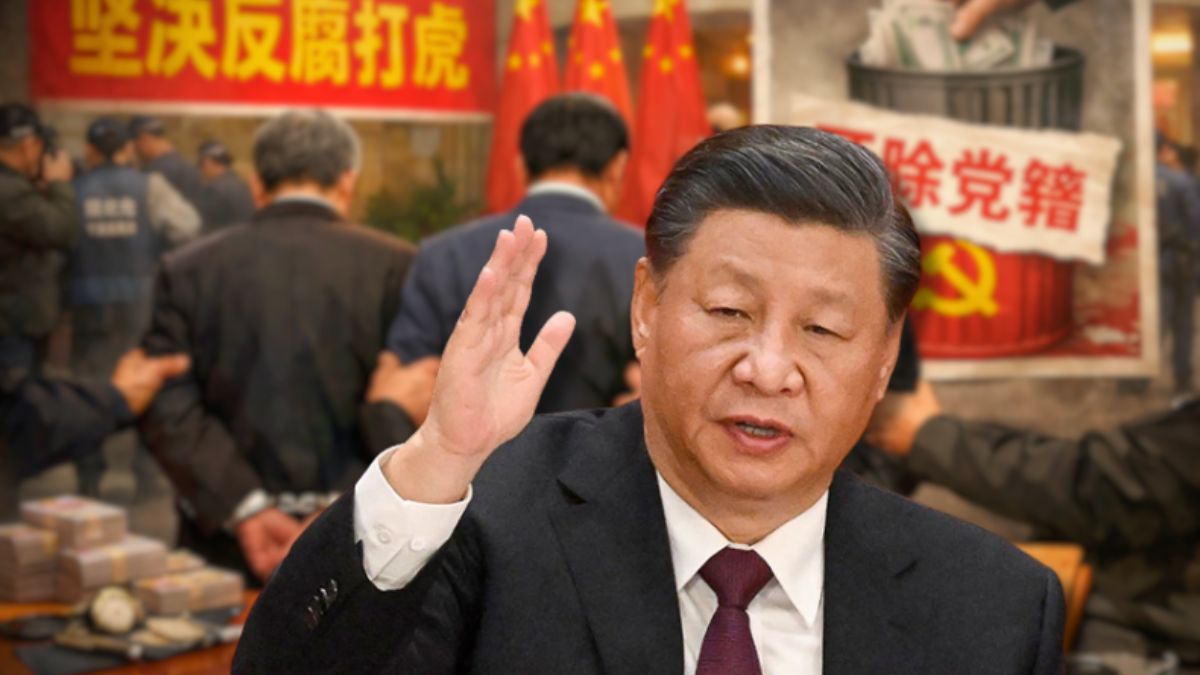
They have been missing from key events in recent months, including a celebration in late July 2025 for the PLA anniversary. Image courtesy: RNA

Just a few days back, China’s People’s Liberation Army (PLA) released new “professional ethics” guidelines to curb corruption. The move was part of the wider steps taken in the recent years by Chinese leadership in major corruption crackdown. Beijing’s sweeping anti-corruption drive has once again hit the uppermost ranks of the PLA.
China’s parliament has formally expelled three senior military officials who had vanished from public view for months. The Standing Committee of the National People’s Congress (NPC) confirmed the dismissals, ending weeks of speculation triggered by the officials’ absence from major political and military events.
The move marks the latest escalation in President Xi Jinping’s long-running campaign to root out corruption within China’s armed forces, even as it raises fresh questions about internal discipline and loyalty.
China expels 3 leaders: Who are the officials removed?
The three officers expelled by the NPC are Wang Renhua — Head of the Central Military Commission’s (CMC) Political and Legal Affairs Committee; Zhang Hongbing — Political Commissar of the People’s Armed Police; and Wang Peng — Director of the CMC’s Training Department.
It is learnt that the action was initiated after the three officials were seen missing from key events in recent months, including a celebration in late July 2025 for the anniversary of the People’s Liberation Army (PLA) and the party’s fourth plenum in October 2025.
Despite their removal from parliamentary roles, all three will remain full members of the Communist Party of China’s Central Committee, highlighting the opaque and calibrated nature of Beijing’s disciplinary process. Meanwhile, the CMC, China’s highest military authority, is directly chaired by Xi Jinping.
Is this part of a Wider military purge?
Yes. The NPC also revoked the parliamentary memberships of two additional senior generals, among nine military figures expelled from both the Communist Party and the armed forces in October for “seriously violating party discipline.” These include:
He Weidong, former vice chairman of the CMC
He Hongjun, senior official in the PLA’s Political Work Department
Together, the actions point to an intensifying internal clean-up within the PLA, particularly at a time when China is seeking to modernise its military and prepare for potential high-intensity conflicts.
Why are these figures important?
The officials removed were not marginal figures but key players in China’s military governance. 63-year-old Wang Renhua was promoted to admiral by Xi Jinping last year and oversaw the PLA’s courts, procuratorates and prisons, a sensitive role at the intersection of law and military discipline. He had earlier served as the Navy’s chief anti-corruption official in the East Sea Fleet.
59-year-old Zhang Hongbing was in 2022, promoted to full general. He gad previously served as political commissar of the PLA’s Eastern Theatre Command, a strategically critical region facing Taiwan.
Wang Peng, 61, headed the CMC’s Training and Administration Department, responsible for shaping PLA combat readiness and doctrine. He was promoted to lieutenant general in December 2021.
Their removal underscores the depth of the crackdown, cutting across command, political oversight and training structures.
What does this say about Xi’s control over the PLA?
Since assuming power in 2012, Xi Jinping has overseen the dismissal or punishment of dozens of senior PLA officers, framing the campaign as essential to fighting corruption and ensuring absolute loyalty to the Communist Party. However, the repeated purges also highlight persistent governance challenges within China’s military establishment.
Analysts say the campaign reflects Xi’s determination to maintain political control over the gun, a core principle of Communist Party rule, particularly as China faces rising geopolitical tensions with the United States, and its allies.