First Civilian Death In Thailand-Cambodia War; Thai Side Cuts Laos Fuel Route As Jets Strike Near Angkor Wat
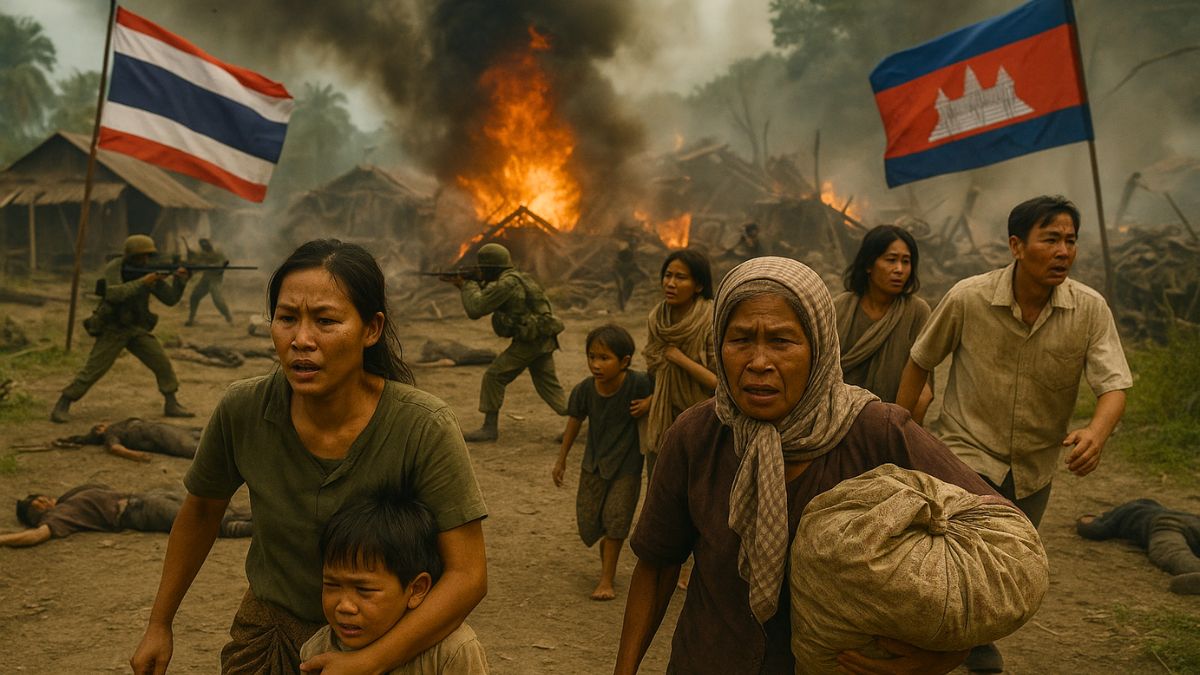
As renewed fighting enters its second week, Cambodia said Thai air attacks are reaching deeper into its territory. Image courtesy: AI-generated picture via Sora

Fresh fighting between Thailand and Cambodia has spiralled into the most intense confrontation between the Southeast Asian neighbours in decades, killing civilians, displacing more than half a million people and drawing in air power, naval forces and economic pressure tactics
Despite repeated international calls for restraint, including renewed intervention by US President Donald Trump, the conflict shows no sign of abating. And now, the deadly clash has claimed its first civilian death, as a 63-year-old Thai villager got killed in a rocket attack by Cambodian forces.
How did the latest Thailand–Cambodia conflict begin?
After a ceasefire put a hold on the July 2025 skirmishes between both the sides, Thailand and Cambodia re-engaged in the current round of violence on December 7, 2025 after a border clash wounded two Thai soldiers. The incident shattered a fragile ceasefire brokered earlier this year and reopened long-running disputes over stretches of the 817-kilometre (508-mile) frontier.
At the heart of the conflict are competing territorial claims, some involving areas that contain centuries-old temple ruins. While such disputes have simmered for decades, the scale, frequency and geographic spread of the latest clashes are unprecedented in recent history.
Thailand-Cambodia war: What is the latest on civilian casualties?
Thailand on Sunday (December 14, 2025) reported its first confirmed civilian death directly caused by the fighting, when a Cambodian rocket strike killed a 63-year-old villager in Sisaket province’s Kantharalak district. The victim, Don Patchapan, was struck in a residential area near a school, according to the Thai Army.
Associated Press journalists who arrived shortly after the strike reported seeing homes on fire and shrapnel embedded in nearby roads. Thai government spokesperson Siripong Angkasakulkiat condemned the attack as “cruel and inhumane,” accusing Cambodia of deliberately firing into civilian areas.
Thai authorities now say at least 16 soldiers and 10 civilians have been killed, with hundreds injured, since the latest clashes began. Cambodia has reported at least 11 civilian deaths and more than 70 wounded, while denying Thai claims about Cambodian military casualties.
What weapons are Thailand and Cambodia using?
The fighting has featured heavy weaponry on land, sea and air. Cambodia has deployed truck-mounted BM-21 rocket launchers capable of firing up to 40 rockets at a time over distances of 30–40 kilometres. Thai officials say thousands of rockets have been launched almost daily, many landing in areas already evacuated.
Thailand, in turn, has carried out airstrikes using fighter jets, including F-16s. Cambodian authorities say Thai bombs have struck deeper inside their territory, including near camps for displaced civilians in Oddar Meanchey province and in Siem Reap province, around 80 kilometres from Angkor Wat, Cambodia’s most important tourist site.
Phnom Penh described the strikes near Siem Reap as a significant escalation. Both sides have also deployed drones for surveillance and bombing missions.
Thailand-Cambodia conflict: Has it spread beyond the land border?
Yes. In a major escalation, a Thai Navy warship entered the conflict on Saturday, exchanging gunfire with Cambodian coastal artillery in Koh Kong province. Each side accused the other of opening fire first, marking the opening of a new maritime front in the Gulf of Thailand.
Thailand has since warned that it may designate waters near Cambodian ports as high-risk zones and restrict Thai vessels from entering areas where they could be targeted.
Thailand cuts Laos fuel routes: What’s behind the move?
Thai military on Monday (December 15, 2025) declared that it has halted fuel shipments passing through a border checkpoint with Laos after intelligence suggested the supplies were being diverted to Cambodian forces. Thai defence ministry spokesperson Rear Admiral Surasant Kongsiri said, “Our intention is not to cause impacts on the Lao people or government.”
Thai authorities have already stopped oil exports directly to Cambodia since June 2025. Last year, Thailand exported about 2.2 billion litres of fuel to its neighbour. This year, that figure has dropped sharply.
Additionally, the Thai navy has also been instructed to monitor ships carrying “strategic supplies” and remain vigilant against maritime fuel transfers. Officials cited by news agency Reuters said the measures are aimed at Cambodia and not intended to harm Laos or other trading partners. Cambodia relies heavily on sea routes for refined fuel imports.
How severe is the humanitarian impact of the war?
Fighting between Cambodia and Thailand has triggered mass evacuations on both sides of the border. Thai authorities say more than 258,000 civilians have been displaced, while Cambodia reports nearly 395,000 people forced from their homes.
Worth mentioning here is that Thailand has imposed a curfew in Trat province, while emergency shelters have been set up across multiple border regions. Cambodian officials have warned that Thai airstrikes near displacement camps are worsening an already dire humanitarian situation.
What is happening on the diplomatic front?
Diplomatic efforts have struggled to keep pace with the violence. A special meeting of Southeast Asian foreign ministers, where both sides were expected to engage, has been postponed to December 22, 2025 at Thailand’s request.
US President Trump, who brokered a ceasefire earlier this year with Malaysian mediation, said on Friday that both Thailand and Cambodia had agreed to “cease all shooting.” However, Thai Prime Minister Anutin Charnvirakul denied making such a commitment, while Cambodia said it would continue fighting in what it called self-defence.
Meanwhile, Thailand states that it remains open to diplomacy but insists Cambodia must halt hostilities first. “We will continue to fight until we feel no more harm and threats to our land and people,” Anutin said over the weekend. Cambodian PM Hun Manet struck a defiant tone, praising national resilience and accusing Thailand of aggression.