

Reflects India’s Commitment To Justice: Iran Ambassador Thanks New Delhi For Voting Against UN Resolution On Iran
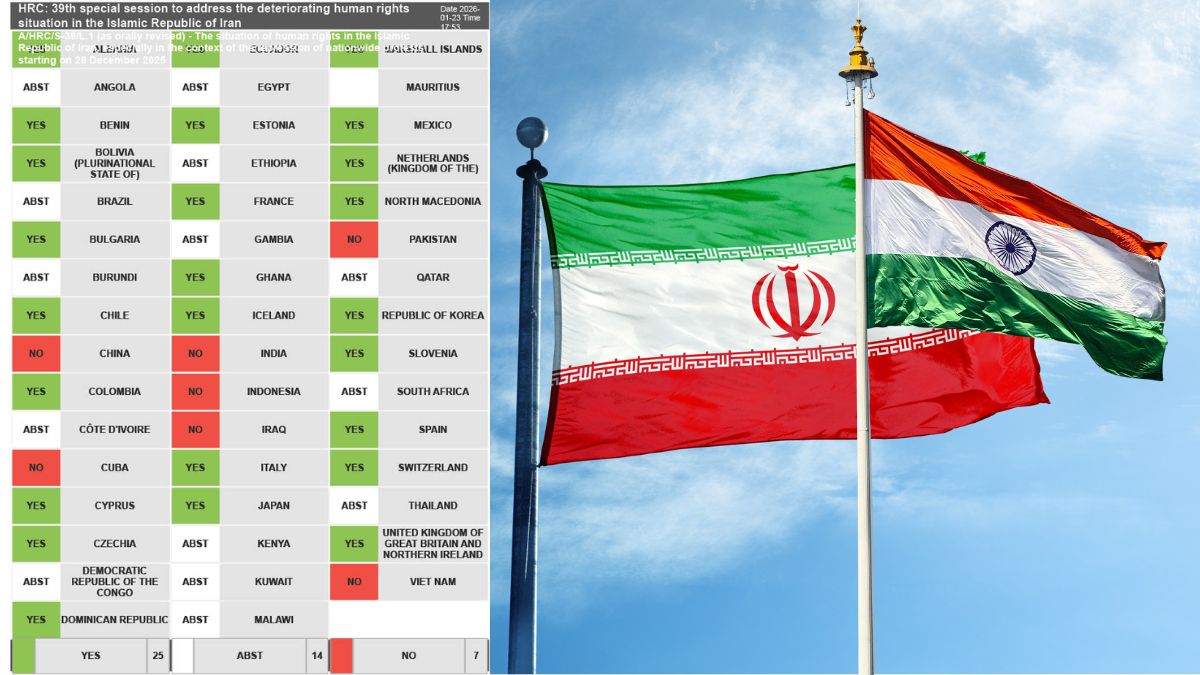
In the resolution, the UNHRC strongly deplored the violent crackdown of protests resulting in the deaths of thousands. Image courtesy: RNA

India joined China, Pakistan and five other countries in voting against a United Nations Human Rights Council (UNHRC) resolution that strongly criticised Iran’s crackdown on nationwide protests and extended the mandate of an international fact-finding mission by two years, amid mounting unrest in the Islamic Republic.
Iran ambassador to India Mohammad Fathali was quick to thank India for its “principled and firm support…including opposing an unjust and politically motivated resolution”. The resolution was adopted by the 47-member council with 25 votes in favour, seven against and 14 abstentions.
UN resolution on Iran: What was it about?
The resolution condemned Iran’s response to protests that began on December 28, 2025, accusing authorities of violently suppressing peaceful demonstrations, resulting in thousands of deaths, including children, mass injuries and widespread arrests. It also authorised the UN fact-finding mission to investigate what it described as last month’s “repression”.
UN Human Rights Commission, in a statement, said, “The UN Human Rights Council adopted draft resolution A/HRC/S-39/L.1 (as orally revised) entitled “The situation of human rights in the Islamic Republic of #Iran, especially in the context of the repression of nationwide protests starting on 28 December 2025.”
The special session of the council was convened specifically to address the deteriorating human rights situation in Iran, rather than during a routine UNHRC meeting.
Why did India vote against the resolution?
If past records are to go by, India has opposed country-specific resolutions and what it views as intrusive investigative mechanisms, arguing they are often politically motivated and infringe on national sovereignty.
While India had abstained when the fact-finding mission was first established in 2022, its decision to vote against the resolution this time was notable, as it came at a moment when the gulf country is facing heightened international pressure, particularly from the United States.
Diplomatic sources said India considered the special session unwarranted and aligned its vote with its long-standing principle of non-interference in internal affairs.
How did Iran react to India’s vote?
Iran welcomed India’s decision. Iranian Ambassador to India Mohammad Fathali publicly thanked New Delhi for its “principled and firm support,” describing the resolution as “unjust and politically motivated”. “This stance reflects India’s commitment to justice, multilateralism, and national sovereignty,” the ambassador said in a post on X.
India has mostly voted against UN resolutions critical of Iran’s human rights record. However, in 2024, New Delhi abstained following Iranian remarks on the Jammu and Kashmir issue.
India returned to voting against such resolutions in 2025 after receiving assurances from Tehran that it would refrain from commenting on India’s internal affairs, underscoring how bilateral sensitivities continue to shape India’s multilateral positions.
Is geopolitics and connectivity driving India’s stance?
Beyond principle, India’s vote is also being viewed through a strategic lens. Despite the tense situation in the country, New Delhi continues to see Iran as critical to its regional connectivity plans, particularly the Chabahar port, which provides India access to Afghanistan and Central Asia while bypassing Pakistan.
Having invested billions for the Chabahar Port, the project has been under scrutiny after the Trump administration revoked a long-standing US sanctions waiver last year, though it was later extended until April 2026, giving India temporary relief. Indian officials have said they remain in dialogue with Washington to safeguard the arrangement.
Thereby, maintaining a functional relationship with Iran remains a priority for India, and this strategic calculation influenced its rejection of the resolution.