

South Korea Scrambles Fighter Jets As Russian And Chinese Warplanes Breach Air Defence Zone Yet Again
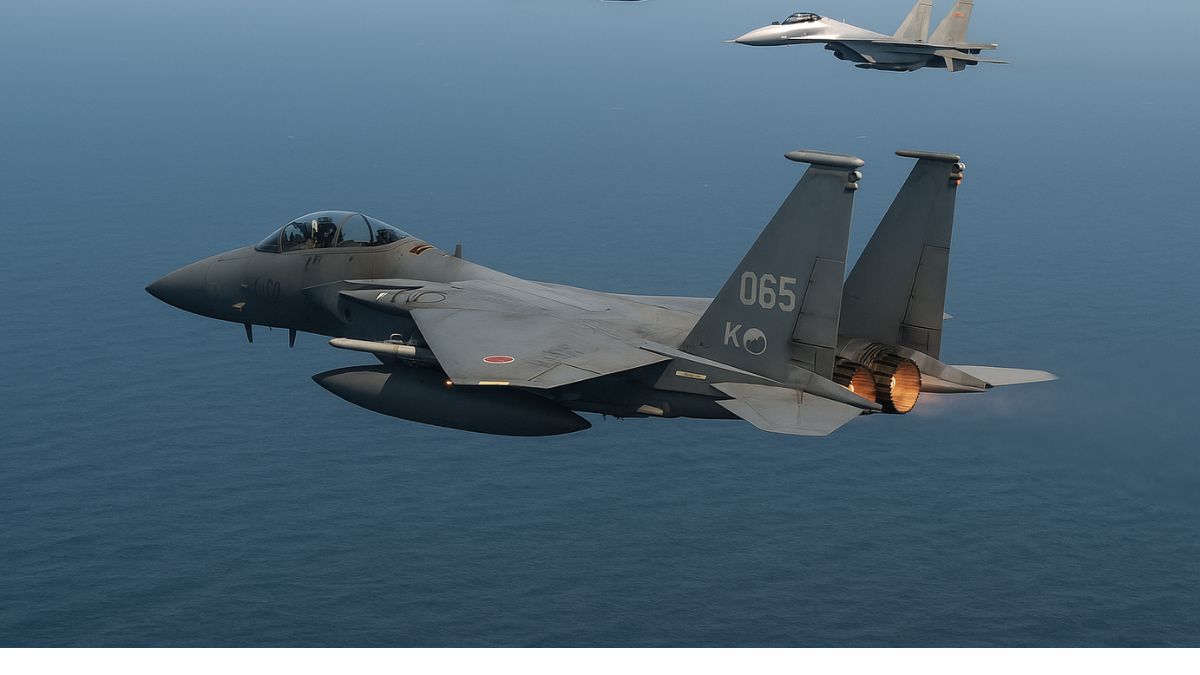
South Korean fighter jets move into action as Russian and Chinese aircraft enter the KADIZ, adding fresh tension to a region already on edge over repeated joint patrols. Image courtesy: AI generated picture via DALL-E

South Korea scrambled its fighter jets on Tuesday (December 9, 2025) after seven Russian and two Chinese military aircraft entered the country’s Air Defence Identification Zone (KADIZ), marking yet another instance of joint military activity by Moscow and Beijing near the Korean Peninsula.
The intrusion, detected around 10 AM local time (0100 GMT), prompted Seoul’s Joint Chiefs of Staff (JCS) to take “tactical measures in preparation for any contingencies,” even though none of the aircraft violated South Korean sovereign airspace.
What did the Russian and Chinese jets do?
According to a JCS statement, the Russian and Chinese planes flew in and out of the KADIZ for roughly an hour before exiting the area.
South Korean radar systems had already identified the aircraft before they breached the zone, a buffer area monitored by Seoul for early detection of potential aerial threats.
While an Air Defence Identification Zone is not considered territorial airspace, foreign military flights entering it without prior notification are viewed as security concerns.
How is the latest incident part of a trend?
This latest incident adds to a pattern of increasingly frequent joint air patrols by China and Russia around the Korean Peninsula.
Since 2019, both countries have routinely flown into the KADIZ without advance notice, often describing the operations as part of their “joint strategic air patrols.”
Similar encounters were recorded in November 2024, June and December 2023, and multiple times throughout 2022.
What are the implications of the latest incident?
The growing frequency of these flights reflects the deepening strategic partnership between Beijing and Moscow, which has expanded military cooperation since Russia launched its military operations in Ukraine nearly four years ago.
The manoeuvres also carry broader regional implications, as both countries maintain close ties with North Korea, South Korea’s primary security adversary.
Seoul continues to monitor the situation closely, reaffirming its readiness to counter any potential threat to national security.