Iran Says US Not Seeking Zero Nuclear Enrichment After Trump Gives 10-15 Days For Nuclear Deal Amid High Military Buildup
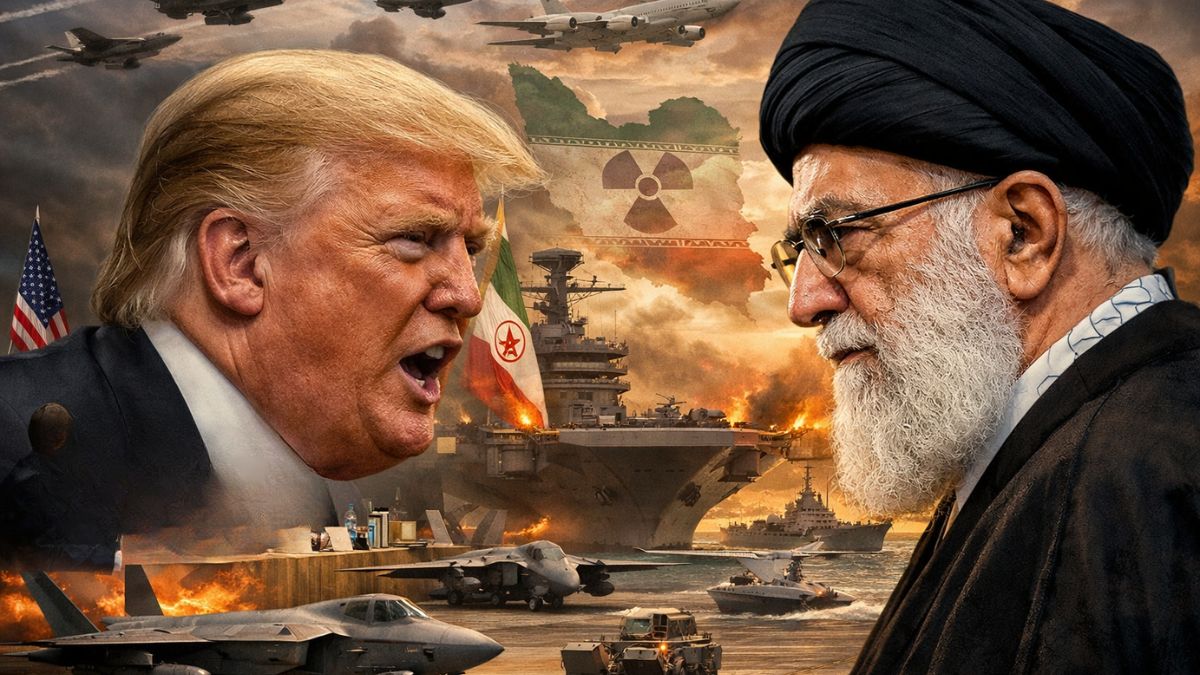
US military build-up near Iran includes multiple squadrons of advanced fighter jets - F-35s, F-22s, F-15s and F-16s. Image courtesy: AI-generated picture via Sora

Over the past few days, there has been a massive US military buildup near Iran, raising concerns of a potential war, just around a month after the United States launched a strike in Venezuela and captured President Nicolas Maduro. Tensions between Iran and the US have been flaring up for quite a while now, but the latest military buildup is hinting at something several.
Diplomacy and deterrence are unfolding in parallel as the United States and Iran inch toward a potential nuclear deal, even as Washington deploys what officials describe as its largest concentration of air power in the Middle East in decades. US President Donald Trump has now issued a fresh warning to Tehran.
Trump on Thursday (February 19, 2026) warned that the world will know “over the next, probably, 10 days” whether a deal is reached, or whether military action follows. At the same time, Iranian Foreign Minister Abbas Araghchi has pushed back against US public rhetoric, saying Washington has not formally demanded that Iran end uranium enrichment altogether.
Are the US and Iran close to a nuclear deal?
Speaking to MSNBC’s Morning Joe, Araghchi said Iran is preparing to present a draft framework for a possible agreement to US negotiators. “The next step for me is to present a draft of a possible deal to my counterparts in the US,” he said, adding that the proposal could be ready within days before being handed to US envoy Steve Witkoff.
Crucially, Araghchi disputed claims that Washington had demanded “zero enrichment”, saying, “We have not offered any suspension, and the US side has not asked for zero enrichment.”
His remarks contrast sharply with President Trump’s repeated public insistence that Iran must not be allowed to enrich uranium at any level. Talks, mediated by Oman, resumed earlier this month in Geneva after months of heightened hostilities, including last year’s 12-day Iran-Israel war during which the US struck Iranian nuclear facilities.
Why is Trump talking about military action?
While acknowledging progress in negotiations, Trump has made clear that time is limited. “We have to make a meaningful deal otherwise bad things happen,” he said at a meeting of his newly formed Board of Peace in Washington. Though initially warning of action within 10 days, Trump later extended the deadline to 15 days.
CNN reported that US military planners are prepared for potential strikes as early as this weekend, though no final order has been given. Senior national security officials meeting in the White House Situation Room have reportedly been informed that all deployed forces will be in place by mid-March.
Despite the rhetoric, Araghchi dismissed suggestions of an ultimatum. “There is no ultimatum. We only talk with each other how we can have a fast deal,” he said.
What is the scale of the US military buildup near Iran?
Even as talks continue, Washington has significantly reinforced its military presence across the Middle East and eastern Mediterranean. According to multiple reports, the deployment includes squadrons of F-35, F-22, F-15 and F-16 fighter jets, command-and-control aircraft to coordinate large-scale air operations, reinforced air defence systems, 13 US Navy ships in the region.
Moreover, the naval deployment includes aircraft carrier USS Abraham Lincoln, nine ballistic missile-capable destroyers, a second carrier strike group led by USS Gerald R. Ford, currently en route. US officials have described the buildup as the largest concentration of American air power in the region since the 2003 Iraq invasion.
US-Iran tensions: What does each side want?
At the heart of the standoff lies a fundamental gap. The Trump administration is demanding that Iran abandon its nuclear weapons capability and, according to public statements, cease enrichment.
Tehran, meanwhile, insists its nuclear programme is peaceful and has categorically rejected ending enrichment entirely. Iran maintains that enrichment for civilian energy purposes is its sovereign right. The disagreement over “zero enrichment” appears to be one of the central sticking points.