

West Asia Crisis’ Ripple Effect Beyond Oil: Undersea Internet Cables At Risk; What About India’s Data Connectivity?
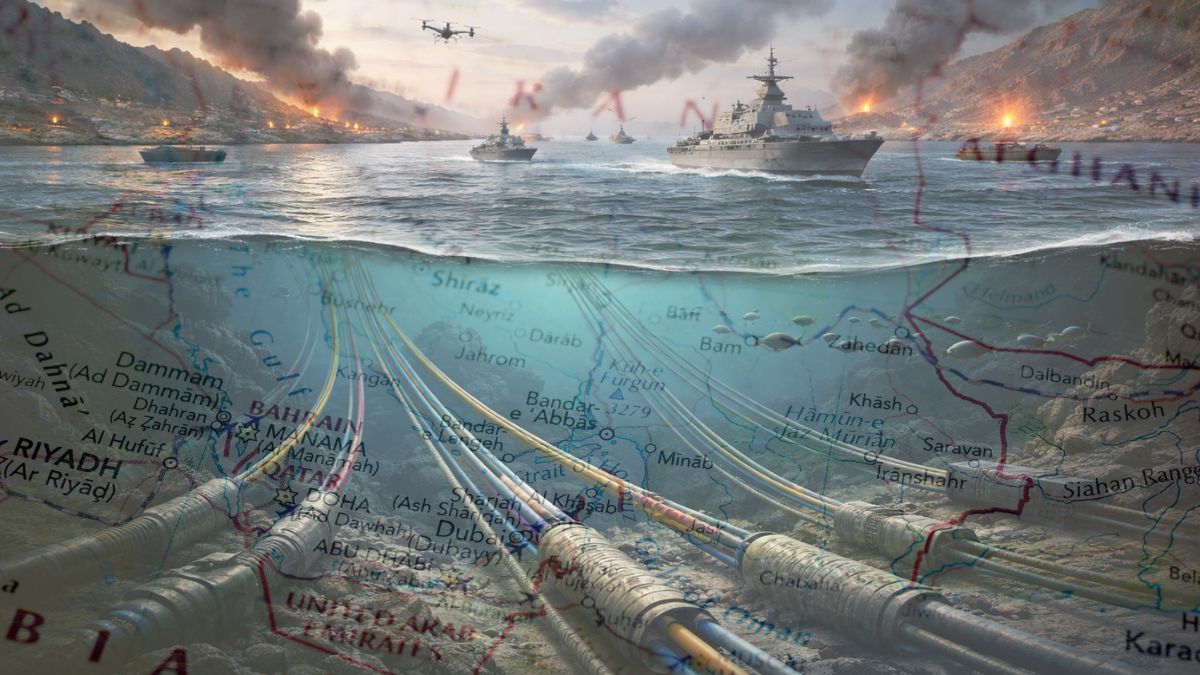
Strait of Hormuz controls about a third of India's westward internet traffic, which can't be rerouted due to supply constraints. Image courtesy: RNA

If you think that the tensions in West Asia will only impact the oil and energy markets, think again! US-Israel-Iran war is sufficiently capable of affecting India’s ambitions of taking the lead as a global digital hub, with the huge network undersea internet cables coming under risk. Notably, India is eyeing a $270 billion data centre ecosystem.
Escalating tensions in West Asia have triggered concerns about the security of undersea internet cables, which carry a large share of global digital traffic, including a significant portion of India’s international data flow. One critical chokepoint is the Strait of Hormuz, best known as a major global oil shipping route.
It isn’t just oil that passes throught the narrow passage near Iran. The Strait of Hormuz also plays an important role in digital connectivity, handling around one-third of India’s westbound internet traffic. Experts say that if disruptions occur along this corridor, rerouting data would not be straightforward because alternative pathways currently have limited bandwidth capacity.
West Asia crisis: How it puts India’s internet ambitions at risk?
The deteriorating security environment in the region has already begun affecting maintenance and repair operations for subsea cables. Repair vessels that had been working in the region since September 2025 were recently forced to suspend operations due to rising security risks.
Several cable systems were damaged near Jeddah in Saudi Arabia last year, including SEA-ME-WE 4 (SMW4), I-ME-WE (IMEWE), FALCON cable operated by FLAG Telecom, according to a report in Times Now. Bharti Airtel holds stakes in some of these systems. People familiar with the developments shared repairs have now been paused because of the security situation in the region.
For India’s white-collar workforce, the risk is even bigger with the potential disruption of data flows threatening the “remote-first” delivery models of IT giants.
Why are subsea cable repairs difficult?
Industry executives say repairing subsea cables is complex, expensive and time-consuming, often requiring specialised ships and equipment. One executive involved in the situation told Times Now earlier cable cuts disrupted nearly 17% of Asia–Gulf internet traffic, forcing operators to redirect data through other routes.
However, such rerouting is not always efficient, particularly when alternative cables are already operating near capacity.
Previously, the Strait of Hormuz corridor was seen as a safer backup route for global data networks after disruptions in the Red Sea region. But the current tensions involving Iran and the United States may delay repairs and increase costs for infrastructure operators.
Why does the Gulf region remain important for global digital networks?
Despite these risks, the Gulf region continues to attract significant investment in digital infrastructure. Governments and private companies have committed billions of dollars to new subsea cable projects, with overall capacity expected to nearly double in the coming years.
According to Amajit Gupta, Group CEO and Managing Director of Lightstorm, several major cable projects are currently being built along this corridor. Some of the key projects include Reliance Jio’s India-Europe-Express (IEX), Reliance Jio’s India-Asia-Express (IAX), Google’s Dhivaru cable project.
Following last year’s Red Sea disruptions, some companies had also begun exploring sovereign land routes across West Asia as alternatives to undersea cables. However, the ongoing geopolitical tensions have raised fresh questions about the reliability of these routes as well.
What do telecom companies say?
A Bharti Airtel spokesperson said the company does not currently operate submarine cables passing directly through the Strait of Hormuz.
Other operators, including Reliance Jio and FLAG Telecom, did not respond to queries regarding potential risks or contingency plans.
Could disruptions affect India’s digital ambitions?
Industry experts say prolonged disruptions in the region could affect India’s broader ambitions to become a global digital hub. India is targeting a $270-billion data centre ecosystem and hopes to position itself as a major exporter of cloud and digital services.
Several global technology companies are already investing heavily in India’s subsea cable connectivity. Meta Platforms has selected Mumbai and Visakhapatnam as landing points for its Waterworth undersea cable project. Google is expected to land its Blue-Raman cable in India, linking West Asia, Europe and Asia.
Alphabet CEO Sundar Pichai recently announced the India-America Connect initiative, aimed at building new subsea cable routes between the two countries.
Digital infra assets becoming new security targets?
Digital infrastructure across the region is also facing rising security risks amid geopolitical tensions. Amazon Web Services recently reported that three of its facilities, two in the UAE and one in Bahrain, were targeted by drone attacks, causing service disruptions in parts of West Asia.
According to Sudhir Kunder, Chief Business Officer at DE-CIX India, infrastructure perceived as foreign-owned can become high-visibility targets during periods of geopolitical conflict, increasing risks for global technology and network operators.