



MANAV Vision: PM Modi Outlines How India Sees Blueprint Of Tomorrow In Artificial Intelligence At AI Summit 2026
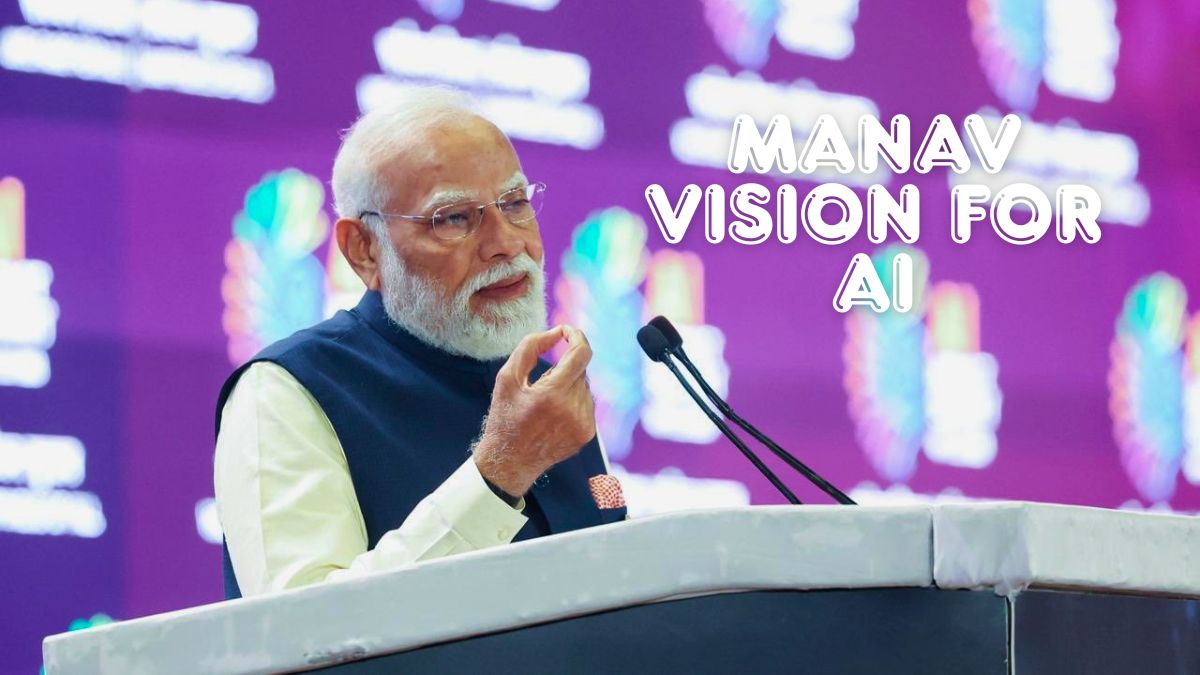
PM Modi asserted that India’s MANAV Vision will become a crucial link for humanity’s welfare in the AI-driven world of the 21st century. Image courtesy: RNA

India is not just hosting the Global South’s first AI Summit but also sees fortune and future in AI, backed by talent, energy capacity, and policy clarity. Positioning India at the forefront of global artificial intelligence governance, PM Narendra Modi on Thursday (February 19, 2026) unveiled the country’s comprehensive “MANAV Vision” at the India AI Impact Summit 2026 in New Delhi.
Prime Minister Modi stated that AI must be given an open sky, while command must remain in human hands. He compared this to GPS, which suggests the route but leaves the final decision to the user. This is where India’s MANAV framework would become a crucial link for humanity’s welfare in the AI-driven world of the 21st century.
MANAV is a framework aimed at ensuring AI remains ethical, inclusive and accountable in an era of rapid technological disruption. Hindi for ‘human’, the Prime Minister laid out a five-pillared approach that he said would guide not only India’s AI ecosystem but also contribute to shaping global norms.
India’s ‘MANAV Vision’ for AI?
Addressing global policymakers, tech leaders and innovators gathered in the national capital, PM Modi broke down the acronym MANAV to define India’s AI governance philosophy.
M – Moral and Ethical Systems: AI must be grounded in ethical guidance.
A – Accountable Governance: Transparent rules and strong oversight are essential.
N – National Sovereignty: “Whose data, his right,” underscoring data ownership and sovereignty.
A – Accessible and Inclusive: AI should be a multiplier for society, not a monopoly.
V – Valid and Legitimate: AI systems must be lawful, verifiable and trustworthy.
“This MANAV vision of India will become an important link for the welfare of humanity in the AI-based world of the 21st century,” Modi said. The framework blends technological ambition with regulatory caution, reflecting India’s attempt to balance innovation with safeguards.
Why Is India emphasising human-centric AI?
Underlining that the direction in which humanity takes AI today will determine the future, PM Modi repeatedly underscored that AI must serve humanity, not replace or overpower it. “We are entering an era where humans and intelligent systems co-create, co-work and co-evolve,” he said, signalling a shift from automation-centric narratives to collaborative AI models.
The summit itself, the first global AI summit hosted in the Global South, reflects India’s aspiration to shape AI governance debates beyond traditional Western hubs.
By linking the vision to the civilisational principle of “Sarvajana Hitaya, Sarvajana Sukhaya” (welfare for all, happiness for all), Modi framed AI as a public good rather than merely a commercial opportunity.
PM Modi highlights safeguards for AI
Amid growing global concerns over AI misuse, misinformation and algorithmic bias, Modi flagged the need for stronger protections, especially for children. “We have to be more cautious regarding children’s safety. The AI space should also be child safe and family guided,” he said.
The emphasis on child safety comes as governments worldwide grapple with regulating AI-generated content, deepfakes and digital harms.
By placing safeguards within the MANAV framework, India is signalling support for responsible innovation rather than unrestricted AI expansion.
How does India view its own AI capabilities
Projecting confidence in India’s technological ecosystem, Modi said the country is well-positioned to emerge as a major AI powerhouse. He stressed that India sees a strong future in AI. We have the talent, energy capacity and policy clarity. At the summit, three Indian companies launched new AI models and applications.
Moreover, the prime minister also made a direct appeal to global technology leaders, Modi extended an open invitation for collaboration. “I invite you all to design and develop in India, deliver to the world, humanity,” he said.
How would MANAV vision matter globally?
As nations compete to define AI rules and standards, India’s MANAV Vision offers an alternative governance model rooted in ethical responsibility, data sovereignty, democratic oversight, inclusive growth. In a fragmented global regulatory landscape, the framework could influence discussions on AI norms.


