

Meet ‘Dolphin Hunter’ INS Anjadip: How Its Commissioning On Feb 27 Will Boost Navy’s Coastal Anti-Submarine Power
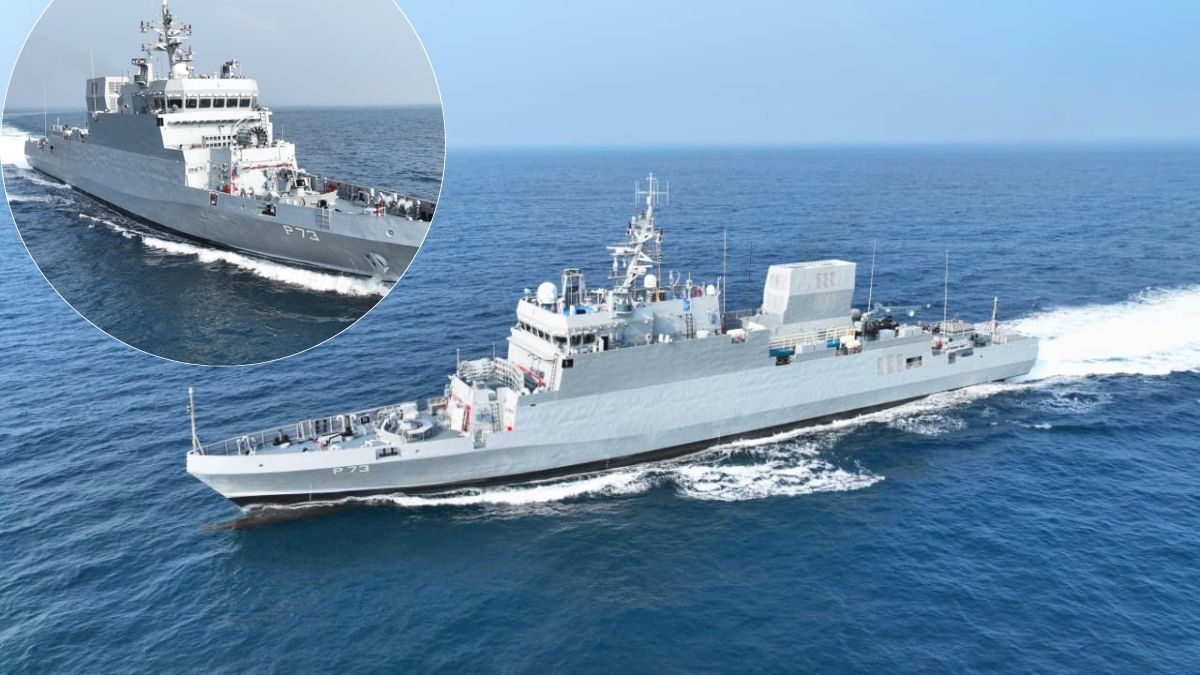
Anjadip is named after the historically significant island off the coast of Karwar. Image courtesy: RNA

Taking yet another key step in transforming itself into a formidable ‘Builder’s Navy’, the Indian Navy is set to sharpen its underwater combat edge with the commissioning of INS Anjadip, the third vessel under the eight-ship Anti-Submarine Warfare Shallow Water Craft (ASW-SWC) programme.
The 77-metre warship will be formally inducted at Chennai Port on Friday (February 27, 2026) in a ceremony presided over by Chief of the Naval Staff Admiral Dinesh K Tripathi, marking another major step in India’s push to fortify its coastal defences amid evolving maritime threats.
INS Anjadip: Why is it a critical addition to the fleet?
In an era of rising submarine activity in the Indian Ocean Region (IOR), shallow-water anti-submarine capabilities have become strategically vital. Unlike larger destroyers or frigates designed for blue-water dominance, ASW-SWCs like Anjadip are purpose-built to detect enemy submarines operating close to shore.
INS Anjadip can also protect critical sea lanes and ports, safeguard offshore assets and naval bases, and conduct coordinated coastal anti-submarine missions. With a shallow draft of just 2.7 metres, the ship can operate in coastal waters where larger warships cannot venture.
Built for the hunt: INS Anjadip’s Advanced ASW capabilities
Nicknamed a “Dolphin Hunter”, INS Anjadip is engineered specifically to detect, track and neutralise hostile submarines. Its combat suite includes hull Mounted Sonar ‘Abhay’ for underwater detection, indigenous lightweight torpedoes, anti-submarine rockets, Advanced shallow water sonar systems.
These systems allow the ship to conduct full-scale sub-surface surveillance, search-and-attack missions, coordinated ASW operations with aircraft, mine-laying tasks. This layered capability significantly enhances India’s coastal underwater warfare preparedness.
Another remarkable thing to note here is that at approximately 77 metres, Anjadip is among the largest Indian naval vessels propelled by waterjets. Powered by three water jets connected to marine diesel engines, the vessel offers a top speed of 25 knots, along with exceptional manoeuvrability, Rapid response capability, superior handling in confined waters.
Waterjet propulsion provides better acceleration and agility compared to traditional propeller-driven systems,
Multi-role beyond submarine warfare
While anti-submarine warfare is its primary mission, INS Anjadip is built for versatility. It is also equipped to undertake coastal surveillance, low-Intensity Maritime Operations (LIMO), search and rescue (SAR) missions. INS Anjadip carries a 30 mm indigenous Naval Surface Gun manufactured by GRSE and accommodates 57 personnel, including seven officers.
This operational flexibility ensures it can seamlessly switch roles depending on mission requirements.
INS Anjadip also underscores India’s expanding domestic shipbuilding capabilities, with nearly 88% indigenous content. It is designed and built by defence PSU Garden Reach Shipbuilders and Engineers (GRSE), and constructed under a public-private partnership with L&T Shipyard, Kattupalli. It marks GRSE’s 115th warship built and the 77th delivered to the Indian Navy.
Indian Navy’s other recent warships
INS Anjadip’s commissioning would follow other major warships in 2025, including guided missile frigate Himgiri, ASW-SWCs Arnala and Androth, survey vessel (large) Ikshak.
The ship carries forward the legacy of the earlier INS Anjadip, a Petya-class corvette decommissioned in 2003. Named after Anjadip Island off the Karwar coast, the vessel symbolises India’s maritime heritage and renewed focus on coastal security.