



India Comes Up With The First Anti-Terror Policy, To Treat Cyber Attacks As Terrorism
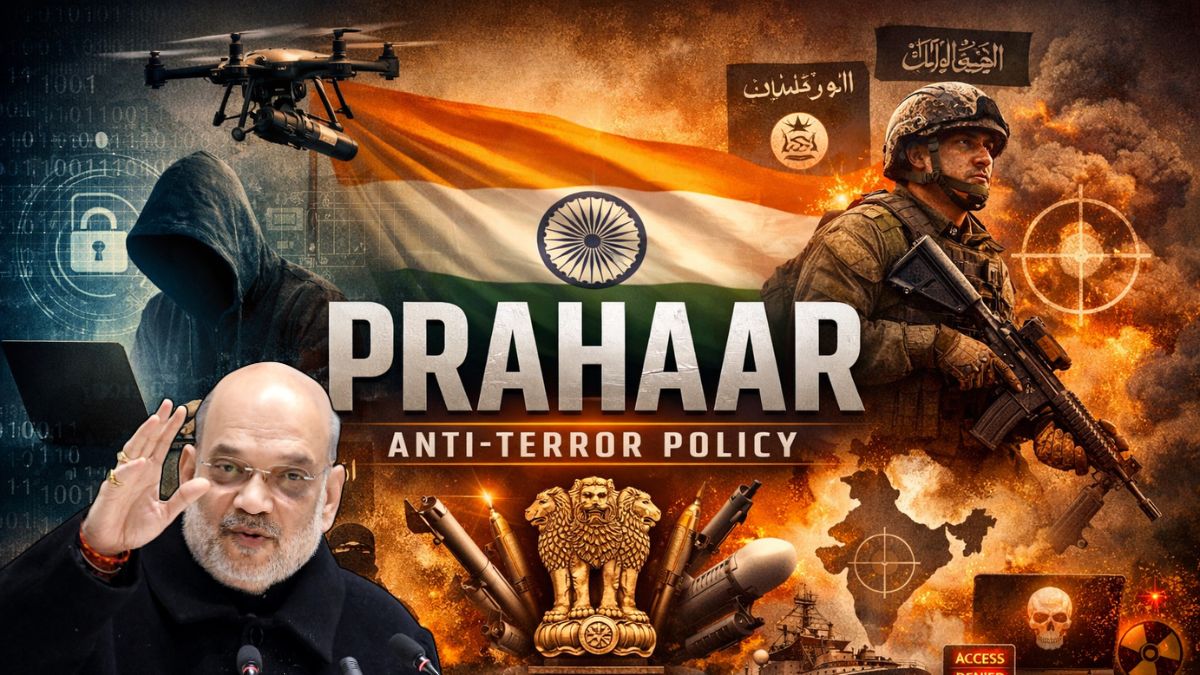
India unveils PRAHAAR, its first anti-terror policy, expanding the definition of terrorism to include cyber attacks while strengthening measures against cross-border and technology enabled threats. Image courtesy: RNA

India’s Ministy of Home Affairs on Monday (February 23, 2026) came out with the nation’s first anti-terrorism policy, which includes cyber attacks to be treated as terror cases, apart from the cross-border terrorism exported by a neighbouring nation.
The policy, named PRAHAAR, calls “criminal hackers and nation states continue to target India through cyber-attacks” as terror cases, in the uploaded document on its website.
The policy stated that India faced terrorist threats on all three fronts — on water, land and air — but the nation is prepared with capabilities and capacities to protect its critical sectors, including economy, power, railways, aviation, ports, defence installations, space infrastructure, and atomic energy facilities.
The capabilities and capacities include countering both state and non-state actors inimical to India, the policy said, claiming that the National Counter-Terrorism Policy and Strategy, which is under preparation, would be released soon.
Underlining that “India does not link terrorism to any specific religion, ethnicity, nationality or civilisation,” the policy noted that the country was long a victim of “sponsored terrorism” from across the border, with “Jihadi terror outfits as well as their frontal organisations” continuing to plan, coordinate, facilitate and execute terror attacks in India.
“India has been on the target of global terrorist groups such as Al-Qaeda and the Islamic State of Iraq and Syria (ISIS), which have been trying to incite violence in the country through sleeper cells,” it said, adding that violent extremists operating from foreign countries have hatched conspiracies to promote terrorism.
“Their handlers from across the border frequently use the latest technologies, including the use of drones, for facilitating terror-related activities and attacks in Punjab and Jammu and Kashmir. Increasingly, terrorist groups are engaging organised criminal networks for logistics and recruitment to execute and facilitate terror strikes in India,” the policy said.
Union Home Minister Amit Shah had announced on November 7, 2024, that a National Counter Terrorism Policy and Strategy was being drafted to fight terrorism and its ecosystem. A National Policy and Action Plan for Left Wing Extremism (LWE) was introduced in 2015.
Following the April 22, 2025, Pahalgam terror incident, the National Investigation Agency (NIA) conducted meetings with anti-terror units of all states and apprised them of the measures aimed at preventing and pre-empting such attacks.
It further stated that for propaganda, communication, funding and guiding terror attacks, these terror groups use social media platforms as well as ‘instant messaging applications’ and technological advancements such as encryption, dark web, crypto wallets etc, enabling them to operate anonymously.
“Disrupting/Intercepting terrorist efforts to access and use CBRNED (Chemical, Biological, Radiological, Nuclear, Explosive, Digital) materials remains a challenge for Counter Terrorism (CT) agencies. The threat of state and non-state actors misusing drones and robotics for lethal purposes remains another area of concern,” it noted.