‘Dolphin Hunter’ INS Anjadip Joins The Fleet: Navy Boosts Coastal Power Amid Rising Maritime Tensions
CNS highlighted that our journey toward Viksit Bharat unfolds amid a challenging maritime environment around us. Image courtesy: RNA

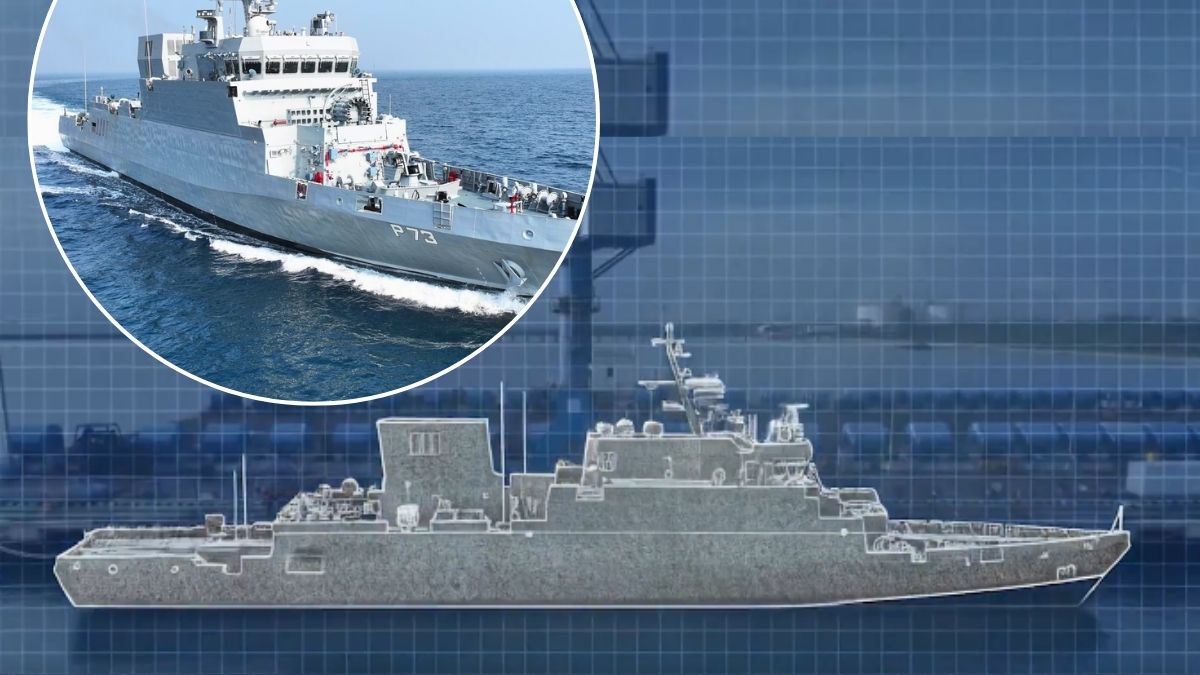
In a significant reinforcement of India’s under-sea warfare capability, the Indian Navy on Thursday (February 27, 2026) commissioned INS Anjadip, the fourth indigenously designed and built Anti-Submarine Warfare Shallow Water Craft (ASW-SWC), at Chennai Port. The ceremony was presided over by Chief of the Naval Staff Admiral Dinesh K Tripathi.
Also in attendance were senior naval leadership, shipbuilders and distinguished guests.
Described as a “Dolphin Hunter,” the 77-metre, 1,400-tonne warship is equipped with a state-of-the-art anti-submarine warfare suite, including advanced shallow-water sonars, lightweight torpedoes, anti-submarine rockets and an integrated Combat Management System.
INS Anjadip: A ‘dolphin hunter’ for the littoral battlespace
INS Anjadip has been purpose-built to detect, track and neutralise enemy submarines operating in shallow coastal waters, one of the most complex and strategically sensitive maritime environments.
Unlike larger blue-water combatants, shallow water craft are optimised for agility and precision in congested littoral zones, where acoustic conditions and maritime traffic complicate submarine detection. With a top speed suited for rapid response and sustained coastal patrols, INS Anjadip strengthens India’s layered coastal defence shield.
The vessel will operate under the Flag Officer Commanding, Tamil Nadu and Puducherry Naval Area, enhancing protection of critical sea lanes, ports and offshore infrastructure.

Strategic context: A maritime century in motion
In his address, CNS Admiral Tripathi placed the commissioning within a broader strategic framework, describing the 21st century as a “maritime century,” with the Indian Ocean Region (IOR) at its epicentre. Nearly 40% of the world’s population resides along the IOR littorals, while the region witnesses around 1,20,000 ship transits annually, carrying two-thirds of global oil shipments and half of the world’s container traffic.
(1)G6YV.jpeg)
Yet, most of this trade is extra-regional, underlining the global stakes tied to the security of these waters. Recent disruptions have underscored this vulnerability. The Red Sea crisis triggered freight rate spikes of up to 300-350% on key Asia–Europe routes, while tensions around the Strait of Hormuz recently pushed Brent crude prices up sharply in a single trading session.
“In such a complex and sensitive security environment, the Indian Navy has been actively ensuring the continuity of our maritime trade and energy flows,” Admiral Tripathi noted.
Since October 2023, Indian naval deployments in the Red Sea have facilitated the safe transit of nearly 400 merchant vessels carrying cargo worth over 7 billion US dollars bound for India. The Navy continues to operate alongside partner navies to ensure maritime stability.
Building the navy of tomorrow
INS Anjadip’s induction is part of a wider force expansion. The Navy commissioned 12 warships and one submarine in 2025, with plans to induct around 15 more ships in 2026, marking the highest rate of induction in its history. The focus, the CNS emphasised, is not merely on numbers but on sharpening critical warfighting capabilities, especially in anti-submarine and under-sea warfare.
Today’s commissioning marks a substantive strengthening of under-sea dominance in coastal waters, where even minor disruptions can have disproportionate strategic consequences.
CNS Admiral Tripathi under that today as India advances steadily to realise its vision of Viksit Bharat 2047, it is a given that India’s journey to becoming Viksit Bharat will be shaped at, by, and from the seas, and I call it a maritime voyage.
Aatmanirbharta in action with INS Anjadip
Built with over 80% indigenous content by Garden Reach Shipbuilders & Engineers (GRSE) in collaboration with Larsen & Toubro Shipbuilding, INS Anjadip stands as a testament to India’s growing defence industrial ecosystem. The ship integrates key indigenous sensors, combat systems and electronics.
Admiral Tripathi underscored that self-reliance goes beyond manufacturing. It represents “trust in India”, a confidence that indigenous platforms can deliver robust operational capability from day one.
A name rooted in naval legacy
Named after Anjadip Island off the Karwar coast, the ship carries historical resonance. The island witnessed decisive naval action during Operation Chutney in December 1961, which culminated in the liberation of Goa. The new INS Anjadip also succeeds the last of the Petya-class corvettes that served the Navy with distinction for nearly three decades.
The name thus bridges legacy and future readiness, symbolising resolve, bold action and protection of maritime interests.
As India advances toward its vision of Viksit Bharat 2047, the CNS described the nation’s rise as a “maritime voyage” shaped by and from the seas. In an era defined by intensifying strategic competition across surface, sub-surface and air domains, platforms like INS Anjadip are critical to maintaining credible deterrence and operational depth.
Meanwhile, the Navy looks to become 200+ ship force by 2035, and all of its 50 ships presently on order are being built in Indian Shipyards. Moving beyond platforms, the Indian Navy’s aim is to take Aatmanirbharta to component level and building a fully Aatmanirbhar force by 2047.