


India Commissions Third Nuclear-Powered Ballistic Missile Submarine INS Aridaman, Stealth Frigate INS Taragiri
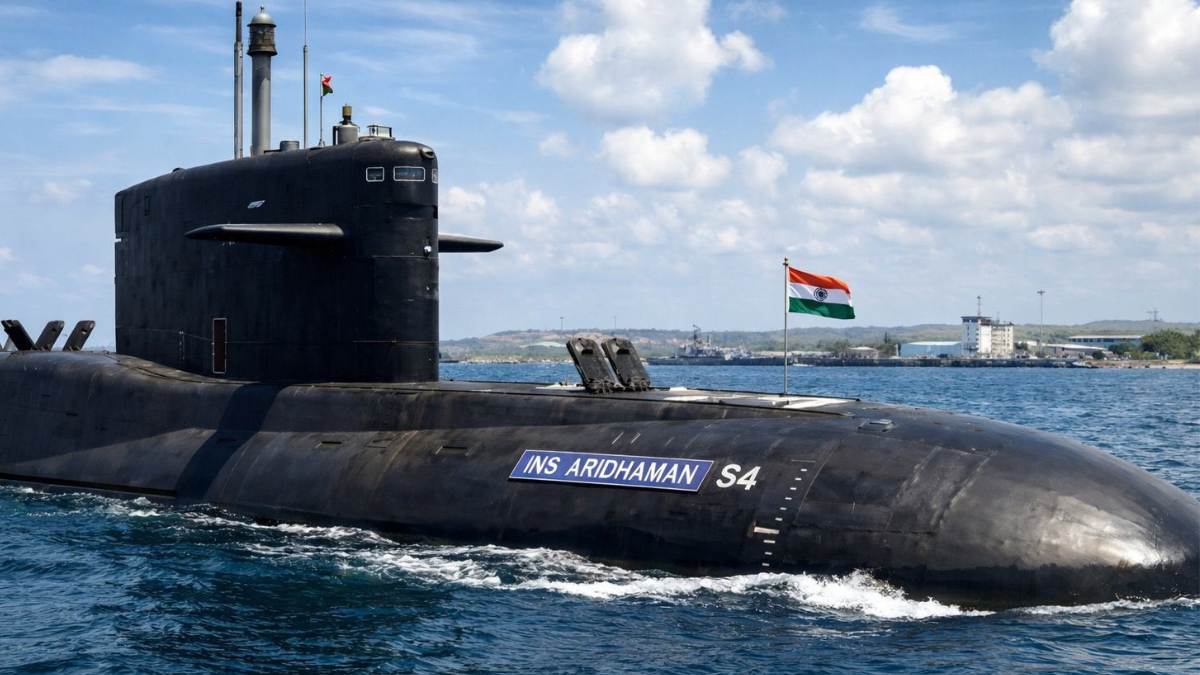

Defence Minister Rajnath Singh on April 3 commissioned INS Aridaman, India’s third Arihant-class nuclear-powered ballistic missile submarine, strengthening the country’s nuclear deterrence in Visakhapatnam.
In a twin boost to the Indian Navy, Singh also commissioned INS Taragiri, the fourth ship of the Nilgiri-class stealth frigates.
The commissioning of INS Aridaman bolsters India’s second-strike capability. It refers to the ability to survive an initial nuclear attack and still launch a retaliatory nuclear strike, with submarines serving as the hidden leg of this deterrent due to their stealth and mobility underwater.
The Indian Navy commissioned its first nuclear-powered ballistic missile submarine, INS Arihant, in 2016 and the second, INS Arighaat, in 2024.
INS Aridaman is said to be bigger and longer than both its predecessors and has a displacement of nearly 7,000 tonnes. Both INS Arihant and INS Arighaat have a displacement of 6,000 tonnes.
INS Aridaman submarine will carry both the 750-km-range K-15 missiles and the longer-range K-4 missiles, which are capable of hitting targets up to 3,500 km away.
The Indian Navy is set to receive two more SSBNs, with work on the two additional submarines already being undertaken.
Ahead of the commissioning, Defence Minister Rajnath Singh posted on X, “Not words, but power—Aridaman.”
Rajnath Singh on X: “शब्द नहीं शक्ति है, ‘अरिदमन’!” / X
There has been no formal announcement of the commissioning of INS Aridaman by the Indian Navy, given its highly strategic nature. To date, the Indian Navy has not publicised any of the three commissionings, preserving their strategic ambiguity and deterrent value.
As recently as December last year, India had reportedly test-fired the K-4 missile from INS Arighaat.
The Indian Navy also awaits a nuclear-powered attack submarine (SSN) from Russia, which is likely to arrive in 2027. In October 2024, the Cabinet Committee on Security (CCS) approved the indigenous construction of two Nuclear Attack Submarines (SSNs). The difference between an SSBN and an SSN is that while an SSBN carries nuclear warheads for strategic deterrence, an SSN is designed to hunt ships and submarines and conduct tactical strikes.
INS TARAGIRI
In addition to the commissioning of INS Aridaman, Defence Minister Rajnath Singh also commissioned the Indian Navy’s frigate INS Taragiri, the fourth ship of the Nilgiri class, or Project 17A class. According to the Indian Navy, its latest stealth frigate has a displacement of approximately 6,670 tonnes.
It has been designed by the Warship Design Bureau and built by Mazagon Dock Shipbuilders Limited, with the support of MSMEs, for multi-role operations. “It utilises advanced stealth technology to achieve a significantly reduced radar signature, providing a lethal edge in contested environments,” the Indian Navy said in a press statement.
Speaking at the commissioning, Rajnath Singh said, “This ship is capable of high-speed transit and can remain deployed at sea for extended periods. It is equipped with systems designed to monitor enemy movements, ensure its own security, and if necessary, deliver an immediate response.”
He added that INS Taragiri features modern radar, sonar, and missile systems—such as BrahMos and surface-to-air missiles—which further augment its operational prowess. “From high-intensity combat to maritime security, anti-piracy operations, coastal surveillance, and humanitarian missions, it fits perfectly into every role, making it a unique naval platform,” Singh said.
INS Taragiri is named after the fifth of the Leander-class frigates, commissioned in 1980. Chief of the Naval Staff (CNS) Admiral Dinesh K Tripathi, who was present at the event, said, “The Taragiri we commission today carries forward a proud legacy of operational excellence and technological ingenuity.”
He added that the Leander class was pioneering in its time, marking the Navy’s transition towards digital electronic systems and multi-dimensional capabilities. Mentioning a unique feature of the old Taragiri, the CNS said that despite being based on a foreign design, the Indian Navy specially redesigned it to operate the Sea King helicopter.
“Globally, operating such a helicopter from a Leander hull was considered impossible. This breakthrough enhanced our anti-submarine warfare capability and extended our operational reach,” he added.
Highlighting the challenges in the present security environment, Admiral Tripathi said that today’s security environment is rapidly evolving, driven by shifting geopolitics, technology, and tactics. He added that the ongoing tensions in West Asia clearly demonstrated how these factors collectively impact the maritime domain and that any disruption at sea is no longer local—it immediately affects global energy security and maritime trade.
In addition, Admiral Tripathi highlighted increasing incidents of interference in GPS and satellite services, which pose new challenges to the safety and reliability of maritime operations. “These challenges demand continuous surveillance, sustained presence, and modern combat capabilities,” he said.