


India Set To Commission Third Nuke-Armed Submarine Aridhaman In April-May
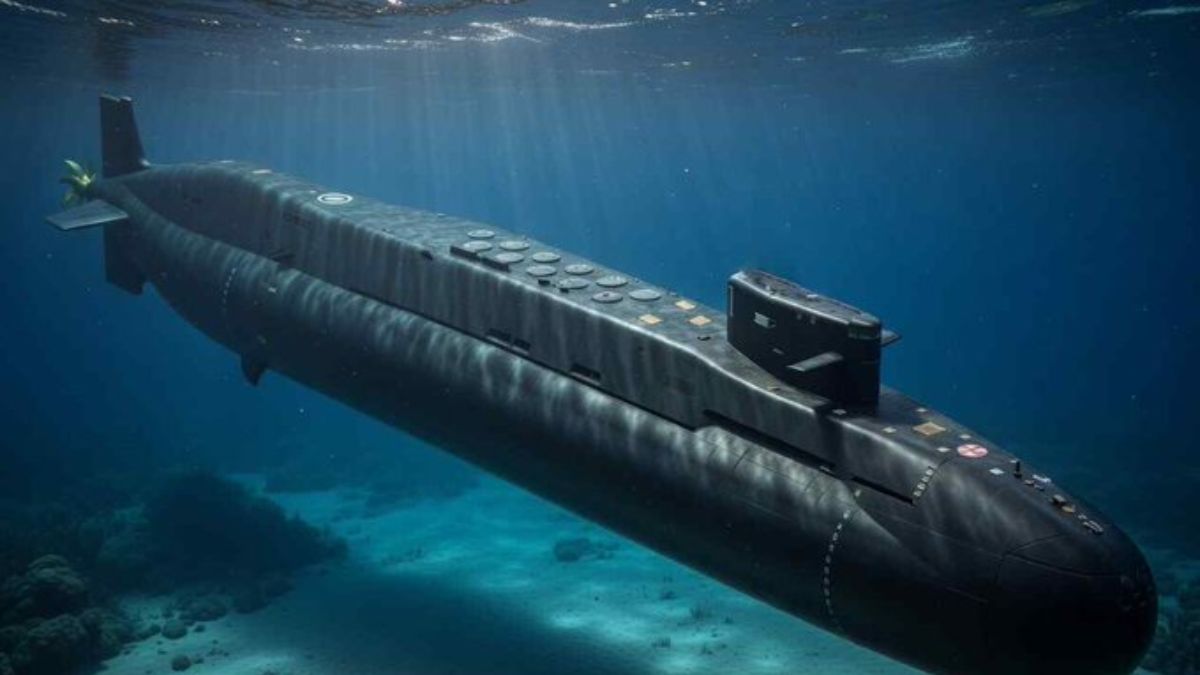
India is set to commission Aridhaman (S4), its third indigenously built nuclear-powered ballistic missile submarine, reinforcing the nation’s second-strike capability and advancing continuous at sea deterrence. Image courtesy: X.com/@DefenceDecode

India is all set to commission its third indigenously-built nuclear-powered ballistic missile submarine of the Arihant-class by April or May this year, providing a much needed boost to the nation’s second strike capability against nuclear-armed arch rivals Pakistan and China.
According to reports, the third nuke-armed submarine, tentatively named Aridhaman (S4), would be commissioned at the Submarine Building Centre at Visakhapatnam, as part of the secretive Advanced Technology Vessel project.
Following the induction of INS Arihant and INS Arighaat nuclear-armed submarines, Aridhaman’s induction would provide a credible response capability, building on stealth and confidentiality, lurking deep under the ocean for longer periods of time than conventional submarines.
Aridhaman, like INS Arihant and INS Arighaat, would boost India’s undersea nuclear missile delivery capability that which is a preserve of a select few nations in the world, including its arch rival China and friendly power, the US.
Weighing 7,000 tonnes, Aridhaman would be larger than INS Arihant and INS Arighaat that weigh 6,000 tonnes each.
Aridhaman would carry eight vertical launch system (VLS) tubes, compared to four on earlier vessels, allowing it to deploy up to 24 K-15 Sagarika short-range missiles with 750-km range and eight K-4 intermediate-range missiles of 3,500-km range. It can also later accommodate K-5 missiles with 6,000 km range.
Aridhaman would be powered by a 83 MW Compact Light Water Reactor (CLWR), an upgraded pressurised water reactor with a very low acoustic signature. Featuring a seven-blade propeller, Aridhaman can touch speeds of 12–15 knots on the surface and 24 knots submerged.
Advanced indigenous sonar systems USHUS and Panchendriya, along with anechoic tiles, on Aridhaman would improve its stealth features and prevent detection.
Once operational, India will have three SSBNs under the Strategic Forces Command, marking a key step towards achieving Continuous At-Sea Deterrence, which ensures at least one nuclear submarine is always on patrol, according to the reports.
Aridhaman would be based at Project Varsha, a high-security naval base with underground pens south of Visakhapatnam.
India is also set to acquire the Russian Akula-class nuclear-powered attack submarine, Chakra III, on a 10-year lease and is expected to join the Indian submarine fleet by 2027–28.
India is currently negotiating with Germany for six advanced diesel-electric submarines under Project-75(I) to be built at the state-run Mazagon Docks and Shipbuilders Limited.
India currently operates eight Kilo-class, four Foxtrot-class, and six Scorpene class submarines in the Indian Navy, forming the backbone of the conventional underwater fighting capabilities