



India Test-Fires 3,500-Km Range K-4 Missile From INS Arighaat, Boosting Sea-Based Nuclear Deterrence
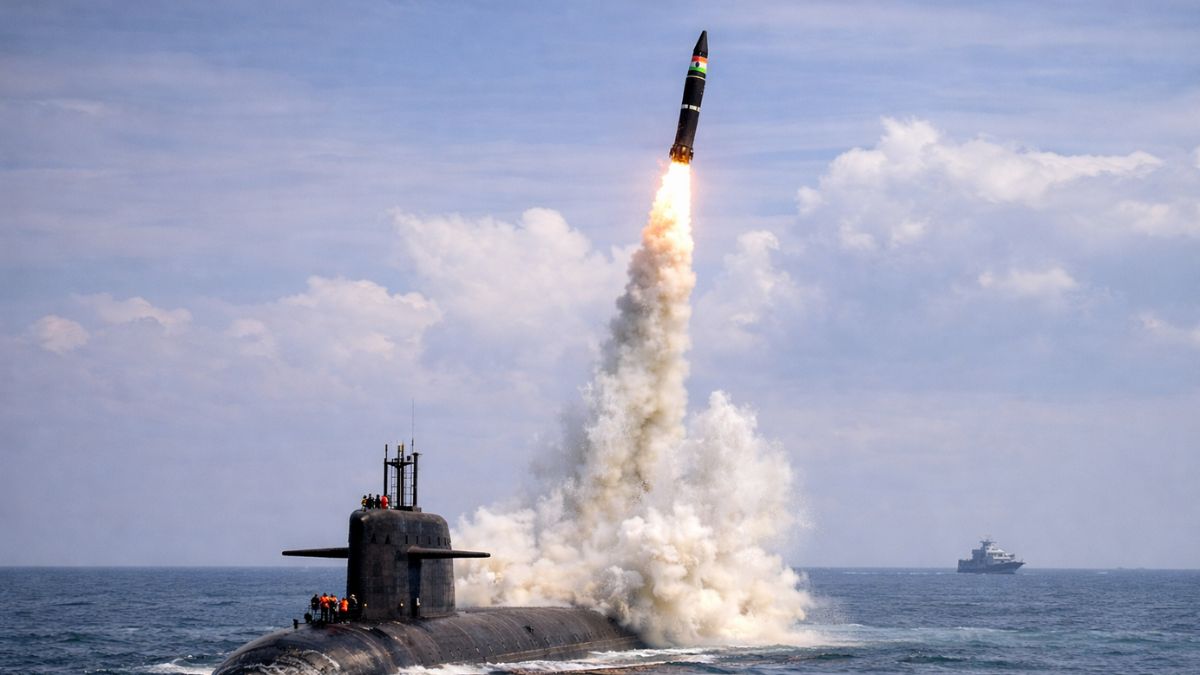
India has carried out a successful submarine launched ballistic missile test from INS Arighaat, strengthening the sea based leg of its nuclear deterrent and advancing undersea strategic capability. Image courtesy: AI generated picture via DALL-E

India has successfully test-fired the intermediate-range K-4 submarine-launched ballistic missile (SLBM) from its nuclear-powered ballistic missile submarine INS Arighaat in the Bay of Bengal, marking a major step toward strengthening the sea-based leg of the country’s nuclear triad.
The missile, capable of striking targets up to 3,500 km away, was launched on Tuesday (December 23, 2025) off the coast of Visakhapatnam, according to sources familiar with the development.
What is the significance of the K-4 missile test?
While there was no official confirmation from the defence ministry, sources said the solid-fuelled, two-stage K-4 missile was tested from the 6,000-tonne INS Arighaat, which is operated by the tri-service Strategic Forces Command.
The missile can reportedly carry a nuclear payload of up to two tonnes, making it central to India’s efforts to enhance the credibility and reach of its undersea nuclear deterrent.
Why is the K-4 test just another step in its deployment?
Officials cautioned that a detailed technical assessment will determine whether the test met all mission objectives.
Submarine-launched ballistic missiles typically undergo multiple trials before achieving full operational readiness, especially given the complexities involved in underwater launches.
The K-4 has undergone several earlier trials from submersible pontoons over the past few years, but its first test from INS Arighaat took place in November last year.
What is INS Arighaat and why is it important to India?
INS Arighaat, India’s second SSBN (nuclear-powered submarine armed with nuclear-tipped ballistic missiles), was commissioned on August 29 last year, following INS Arihant, which became fully operational in 2018. INS Arihant is limited to carrying the shorter-range 750-km K-15 missiles.
India plans to commission its third SSBN, INS Aridhaman, in the first quarter of 2026, followed by a fourth boat in 2027–28 under the highly classified ₹90,000-crore Advanced Technology Vessel (ATV) programme.
These newer submarines will displace around 7,000 tonnes, compared to the 6,000-tonne displacement of the first two.
What are India’s future submarine plans?
Looking ahead, India also plans to develop much larger 13,500-tonne SSBNs powered by more advanced 190 MW reactors.
Although India’s SSBNs remain significantly smaller than those operated by the US, Russia and China, the eventual induction of longer-range SLBMs such as the K-5 and K-6 (5,000–6,000 km range) is expected to narrow the capability gap.
While India’s land-based missiles like the Agni-5 and air-delivered nuclear platforms are already robust, SSBNs provide the most survivable and credible deterrent, reinforcing India’s “no first-use” nuclear doctrine.