


Indian Navy Receives Third Indigenous ASW Shallow Water Craft ‘Anjadip’
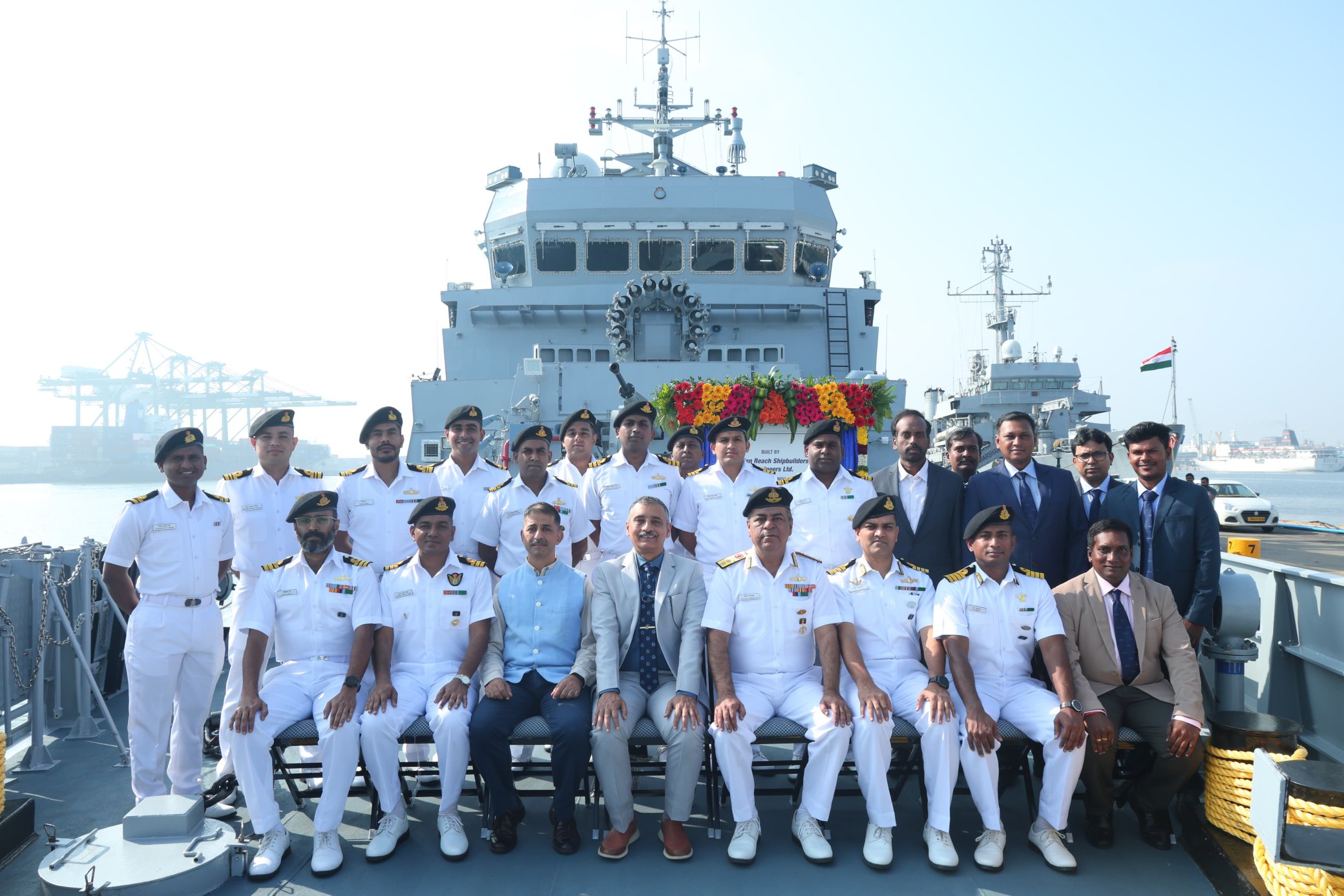
Indian Navy officers and officials pose aboard Anjadip during the delivery ceremony of the Anti-Submarine Warfare Shallow Water Craft in Chennai on December 22: Image courtesy @indiannavy

The Indian Navy has received Anjadip, the third of eight Anti-Submarine Warfare Shallow Water Craft (ASW SWC), marking another milestone in India’s indigenous naval shipbuilding programme. The vessel was delivered on December 22 at Chennai and has been designed and built by Garden Reach Shipbuilders and Engineers (GRSE), Kolkata.
The induction of Anjadip strengthens the Navy’s coastal and shallow-water combat capabilities while reinforcing India’s push towards self-reliance in defence manufacturing.
What is Anjadip and why is it significant?
Anjadip is the third vessel under the ASW Shallow Water Craft project, which aims to enhance the Indian Navy’s ability to detect, track, and neutralise submarine threats in coastal waters. The project is being executed under a Public-Private Partnership between Garden Reach Shipbuilders and Engineers and L&T Shipyard, Kattupalli.
The vessels have been designed and constructed in accordance with the classification rules of the Indian Register of Shipping (IRS), reflecting collaborative defence production within the domestic shipbuilding ecosystem.
What capabilities do ASW Shallow Water Craft offer?
At approximately 77 metres in length, the ASW SWCs are the largest Indian naval warships to be propelled by waterjets. The Navy said these platforms are equipped with state-of-the-art lightweight torpedoes, indigenously developed anti-submarine rockets, and shallow-water sonar systems.
These capabilities enable effective detection and engagement of underwater threats and significantly enhance the Navy’s anti-submarine warfare capacity, coastal surveillance, and mine-laying operations.
What is the background behind the name Anjadip?
The vessel is named after Anjadip Island, located off the coast of Karwar in Karnataka. It is also a reincarnation of the erstwhile INS Anjadip, a Petya-class corvette that was decommissioned in 2003.
According to the Navy, the naming reflects continuity in naval heritage and India’s commitment to safeguarding its maritime domain.
What does this delivery mean for GRSE and indigenous shipbuilding?
With the delivery of Anjadip, Garden Reach Shipbuilders and Engineers has delivered five warships to the Indian Navy in a single year, a rare achievement in naval shipbuilding. Anjadip is the 115th warship built by the shipyard and the 77th delivered to the Indian Navy.
The vessel was accepted by Rear Admiral Gautam Marwaha, VSM, Chief Staff Officer (Technical), Eastern Naval Command.
Earlier in 2025, GRSE delivered the Advanced Guided Missile Frigate Himgiri, the first two ASW Shallow Water Craft Arnala and Androth, and the Survey Vessel (Large) Ikshak, all of which have since been commissioned.
How does Anjadip align with Aatmanirbhar Bharat?
Anjadip is fitted with an indigenous 30 mm Naval Surface Gun and features over 80% indigenous content. The Navy said the platform exemplifies the government’s Aatmanirbhar Bharat vision and highlights the growing strength of India’s domestic defence manufacturing ecosystem.
The delivery adds momentum to the Navy’s modernisation drive while reinforcing indigenous capability development in maritime defence.