

Pakistan’s SMASH Test Sleight-of-Hand: Why the Launch Platform Had to Be Hidden
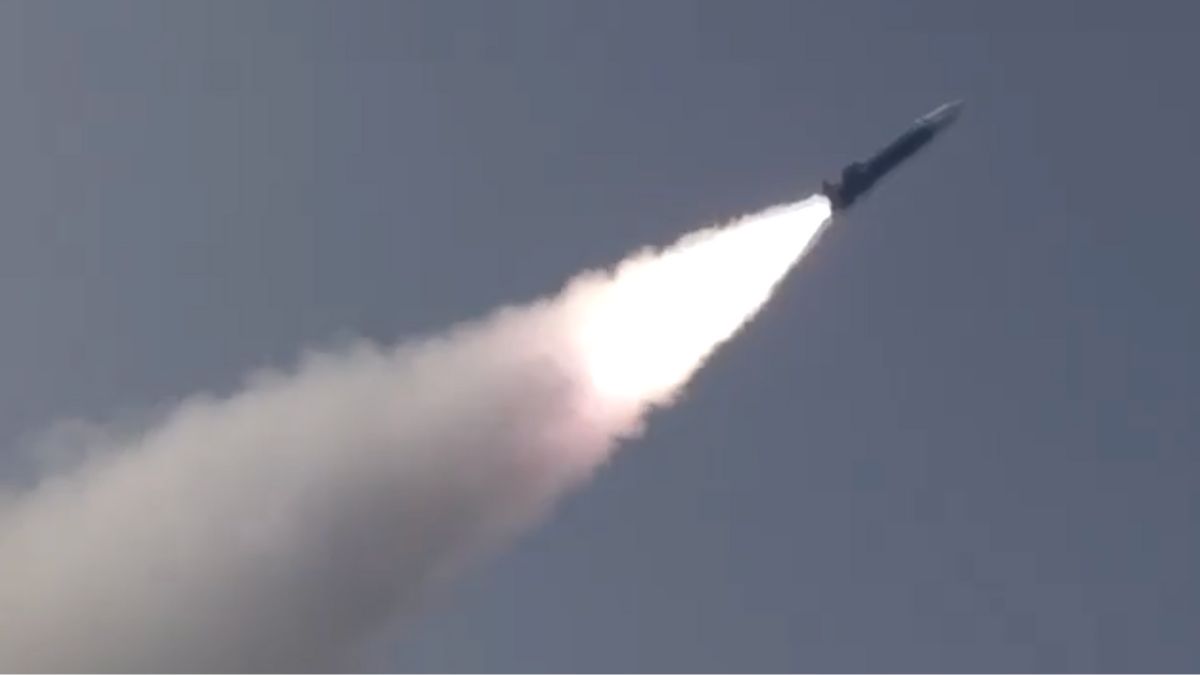
Various social media handles shared videos of Pakistan's SMASH missile test. Image courtesy: X.com

Pakistan recently showcased its Ship-Launched Medium-Range Ballistic Missile (SMASH) as a breakthrough in naval strike capability, with state media hailing it as historic and hypersonic-class. Clips circulated across ISPR channels, supportive commentators pointed to a new anti-carrier threat for India, and social media ecosystems treated the event as proof of a maturing sea-based deterrent.
Yet one detail was missing — the warship.
The missile, the plume and the splash are shown from multiple angles. But at no point is the launch platform visible in full. No hull number, no deck layout, no radar mast, no superstructure silhouette. Not even a single wide shot. What Pakistan showcased was a missile launch; what it carefully concealed was the ship that enabled it.
That absence matters. It is the key to understanding what Pakistan is signalling — and what it is avoiding.
Why does the missing warship raise questions?
The official footage offers tight, cropped visuals focused only on the canister and flame plume. Naval watchers know that identification of a launch platform usually requires only seconds of superstructure exposure — mast design, radar panels, antenna layout and deck geometry give away the class instantly.
Pakistan did not allow that possibility.
The launcher appears to be an angled canister mounted at roughly 35–45 degrees, consistent with a bolted-on rail or box launcher rather than a vertical launch system integrated into a combat management network. No evidence of an enclosed VLS grid or stabilised radar-tracking architecture is visible.
If Pakistan wanted to display an operational anti-ship ballistic missile deployment, the platform would have been the centrepiece. Instead, the visuals hide it.
How does this differ from Pakistan’s previous missile tests?
In a 2024 ship-launched ballistic test, imagery allowed analysts to associate the launch with a frontline surface combatant — widely assessed as a Zulfiquar-class frigate derived from China’s Type-053H3 design. The backdrop, deck line and electronic suite provided enough cues for open-source identification.
In 2025, rhetoric around SMASH grew bigger — hypersonic potential, new long-range sea strike, regional parity capability. But the visuals grew smaller. The more ambitious the claim, the less Pakistan showed.
This change is not a slip. It is an editorial decision.
When capability is robust, navies showcase platforms with confidence. When capability is fragile, they show only what cannot be analysed.
What norms do mature navies follow during capability reveals?
When the United States (US), India, France or Japan reveal new missile integration, the launch platform is central to the announcement. Navies name the hull, show the deck, display radar integration and publish technical stills. It allows analysts — including adversaries — to update threat models.
It has deterrent value because credibility is demonstrable.
Pakistan’s presentation broke with that norm. No telemetry overlay, no radar track, no target-motion evidence, no range profile. The impact footage hints at a static or slow-speed target barge, a standard demonstration environment — not proof of anti-carrier capability.
Professional militaries look for four elements: platform, sensor, shooter, battle network integration.
Pakistan showed only the shooter.
Why hide the launch platform?
Three strategic incentives stand out:
- If the missile was launched from a small platform, such as a patrol craft or commercial hull retrofitted with a canister, a single clear frame would expose fragility — limited radar reach, low endurance, minimal magazine depth, and negligible survivability against a carrier group.
- Anonymity allows narrative inflation. When the ship is invisible, Pakistan can imply fleet-wide integration without proving it. The public believes the capability exists everywhere; analysts cannot verify whether it exists anywhere.
- Ambiguity maintains hype without accountability. Without telemetry or platform disclosure, Pakistan may continue projecting a strategic breakthrough while retaining plausible deniability if claims are challenged.
In disinformation-led strategic signalling, absence is a tool. A hidden hull allows imaginations to fill the void.
What does this reveal about Pakistan’s maritime strategy?
The SMASH test reflects a pattern of spectacle over substance, perception over platform. Pakistan’s messaging seeks to create the impression of a leap in naval strike capability without confronting the engineering and integration threshold that anti-ship ballistic weapons demand.
A true shipborne ASBM capability requires:
- High-power naval radar or networked OTH cueing
- Mid-course guidance and terminal seeker integration
- Hardened combat management systems
- Sea-state-tolerant vertical launch architecture
- Real target-motion simulation at range
None of this was evidenced visually. Pakistan demonstrated a launch. It did not demonstrate a capability.