
Tech Overtaking Terrain In Modern War, CDS Says; Announces Future Operations Analysis Group At HQ-IDS
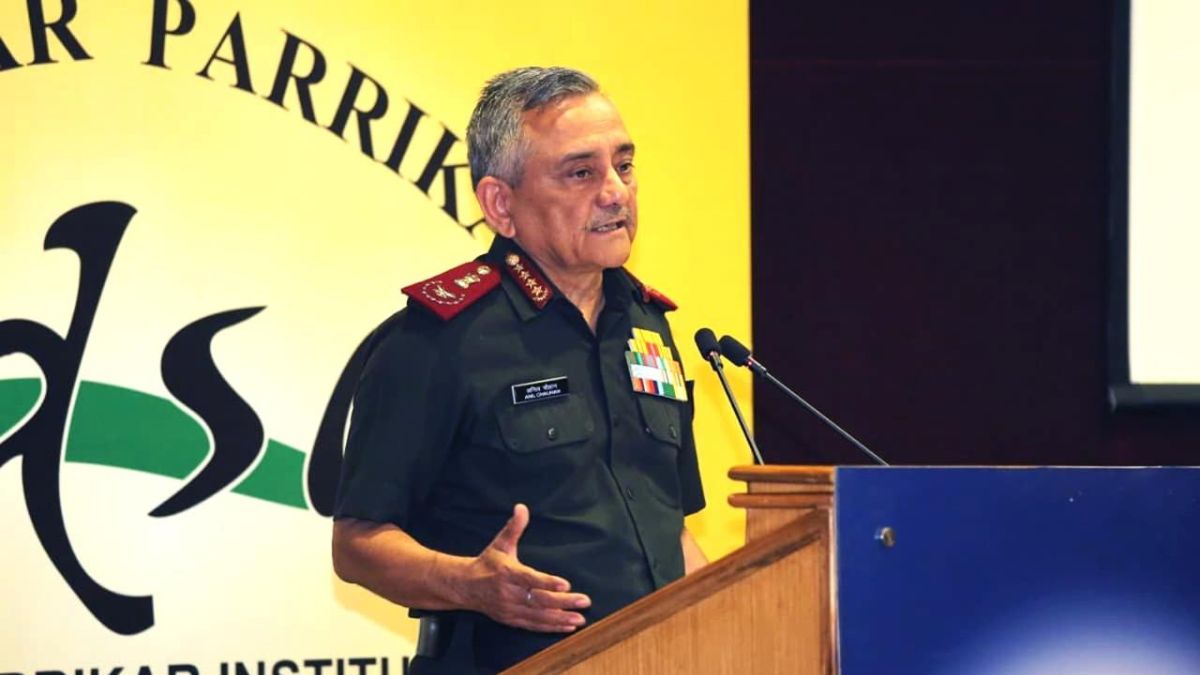
CDS General Anil Chauhan spoke at the 2nd edition of the Delhi Defence Dialogue organised by MP IDSA. Image courtesy: MP IDSA

India’s Chief of Defence Staff General Anil Chauhan said the centre of gravity in warfare has shifted from terrain to technology and outlined new steps to harden India’s joint warfighting architecture.
He was speaking at the second edition of the ‘Delhi Defence Dialogue’ organised by the Manohar Parrikar Institute for Defence Studies and Analyses (MP IDSA) in New Delhi on Tuesday (November 11). The focus of this edition is on “Harnessing New Age Technology for Defence Capability Development”.
“Let me begin with a fundamental truth–war is about winning,” he said, adding that this reality has always driven commanders “to seek every possible advantage over their adversaries.” He noted that “the stakes in any conflict are high and the very fate and survival of nations depends upon that,” and that winning remains rooted in strategy.
CDS General Chauhan traced how strategy “was largely derived from geography” in the past. Commanders chose high ground, exploited intervisibility for command and control, used terrain for surprise and deception, and selected routes for speed, manoeuvre and maintenance, he said. He added that deserts, mountain ranges and oceans could block invasion. Principles of war such as offensive action, momentum, flexibility, speed and mobility, he said, “are all linked to terrain.”
He then stressed the turn in the modern era. “The element of technology is taking over and overshadowing geography,” he said, arguing that while terrain once decided campaigns, technology now shapes outcomes. He cited the progression from gunpowder to the telegraph, tanks, aircraft and nuclear weapons, and set out three revolutions in military affairs–manoeuvre, network-centric warfare and a current phase of convergence where kinetic and non-kinetic, contact and non-contact effects combine across domains.
He said four technology trends define this phase: greater velocity and reach from subsonic to hypersonic systems alongside small drones; battlefield transparency driven by ubiquitous sensors and commercial devices; robotics and human–machine teaming; and extreme automation through artificial intelligence, machine learning, big data, edge and quantum computing.
Domains are changing accordingly. Land combat is moving into dense, vertical cities and subterranean spaces. Maritime competition includes the sub-surface. Air and near-space threats range from low-altitude swarms to high-altitude trajectories. Space has become contested, while cyber permeates governance and logistics. The cognitive domain now targets minds and social systems.
On reforms, CDS General Chauhan said the armed forces are “pushing tri-service integration” to drive doctrinal convergence, operational efficiency, capability development and procurements. “We are looking at joint operational control centres where kinds of information are merged and fused so that we get a comprehensive picture.” He added, “We have future warfare cells now in service headquarters and shortly we are going to have a Future Operations Analysis Group functional in Headquarters IDS.”
He listed new joint doctrines in cyber, space, heliborne and airborne operations, amphibious operations and logistics released this year; integration of networks for air defence, ISR, border management and maritime domain awareness; introduction of SDRs and datalinks; and a shift “from net centricity” toward “data centricity” to enable artificial intelligence. Investments include AI, high-performance computing, supercomputers and unmanned teaming such as the CATS ecosystem based on LCA Tejas and naval equivalents.
Concluding his address, CDS General Chauhan said that geography had shaped warfare for millennia, but today it is sidelined by technology. ”The task, he said, is to adapt, invest in advanced technology and preserve human judgement so that when conflict comes, India has the technology, expertise and superiority “to protect our nation and also prevail.”