

France To Build New Nuclear-Powered Aircraft Carrier By 2038, Doubling Down On Naval Power
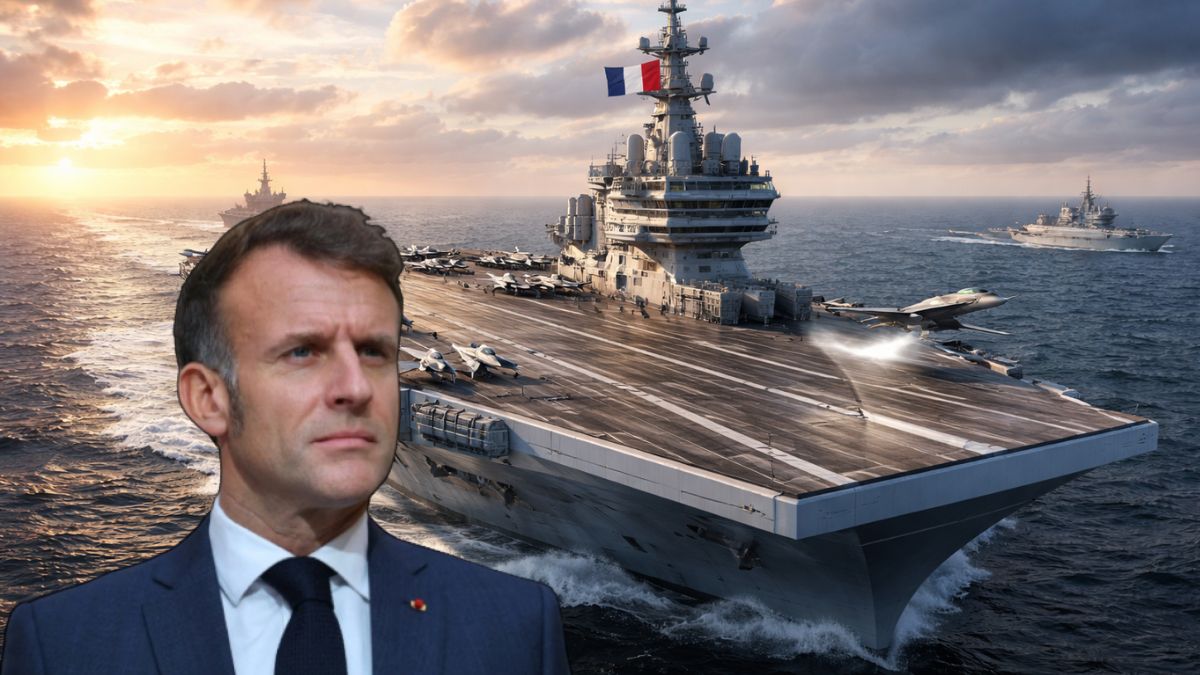
France has committed to building a new nuclear-powered aircraft carrier as part of a broader push to reinforce naval strength and project power at sea amid rising global instability. Image courtesy: AI modified picture via DALL-E

France will construct a new nuclear-powered aircraft carrier capable of operating up to 30 fighter jets and carrying around 2,000 sailors, President Emmanuel Macron announced on Sunday (December 21, 2925), underscoring Paris’ determination to strengthen its naval power amid growing global instability.
Speaking to French troops stationed in Abu Dhabi, Macron said the decision to launch the large-scale programme was taken this week following an extensive review.
What did Macron say about the aircraft carrier?
He described the new carrier as “the display of our nation’s power in the service of freedom on the seas,” stressing that maritime strength is essential “in an age of predators.”
The future aircraft carrier, scheduled to enter service in 2038, will replace the Charles de Gaulle, France’s only carrier currently in operation since 2001.
What would be the new aircraft carrier’s specifications?
Significantly larger than its predecessor, the new vessel will displace about 78,000 tonnes and measure 310 metres in length, compared with the Charles de Gaulle’s 42,000 tonnes and 261 metres. However, it will still be smaller than the US Navy’s USS Gerald R. Ford-class carriers, which exceed 100,000 tonnes.
Like Charles de Gaulle, the new carrier will be nuclear-powered and equipped with Rafale M fighter jets. According to the French defence ministry, it will be designed for heavily armed, long-range deployments at short notice and for sustained operations over extended periods.
How will the new project help France?
The programme is also expected to provide a major boost to France’s defence industrial base. Macron said hundreds of suppliers, most of them small and medium-sized enterprises, would benefit, pledging personal oversight and announcing a visit to the shipyard in February.
In 2023, the project’s cost was estimated at around €10 billion. The announcement aligns with Macron’s broader defence push, including €6.5 billion in additional military spending over the next two years and a target defence budget of €64 billion by 2027, double the level when he took office in 2017.
France currently fields about 200,000 active troops and over 40,000 reservists, with plans to expand the reserve force to 80,000 by 2030.