Why is Pakistan’s Largest-Ever $4 Billion Arms Deal With Libya Drawing Global Scrutiny?
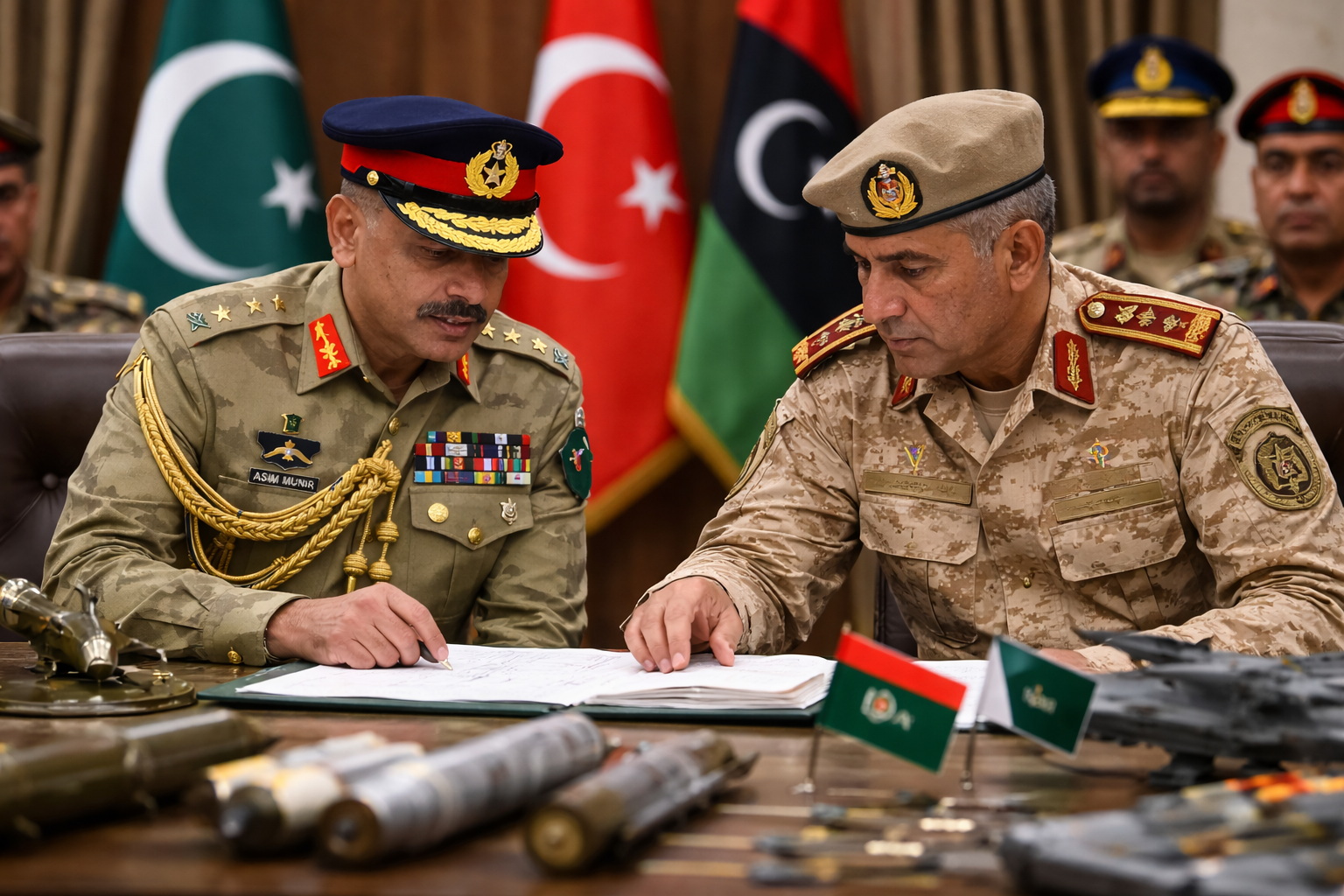
A conceptual illustration depicting defence-related discussions and military cooperation involving Pakistan and Libyan actors amid scrutiny over a reported arms deal. AI-generated Image via DALL·E

Pakistan has finalised what is being described as its largest-ever overseas weapons sale, a $4 billion deal with the Libyan National Army (LNA), triggering international scrutiny over legality, regional stability, and Islamabad’s expanding defence export ambitions.
The agreement was concluded under the direct supervision of Pakistan Army Field Marshal Asim Munir during a meeting with Saddam Khalifa Haftar, the LNA’s deputy commander-in-chief.
What does the Pakistan–Libya arms deal include?
The deal involves the sale of 16 JF-17 fighter jets and 12 Super Mushak trainer aircraft to the LNA. The JF-17 is a multi-role combat aircraft jointly developed by Pakistan and China, while the Super Mushak is used for basic pilot training.
If implemented, the transaction would mark Pakistan’s largest defence export deal to date and would significantly expand its footprint in North Africa.
Why has the deal attracted international attention?
The agreement has raised concerns because it appears to contravene a long-standing United Nations arms embargo on Libya, imposed following the country’s civil war after the fall of Muammar Gaddafi in 2011.
The embargo restricts the supply of weapons to Libyan factions without explicit UN approval. The LNA, which controls eastern Libya and key oilfields, does not recognise the UN-backed government in Tripoli, raising questions about the legality of supplying it with advanced military aircraft.
It is not immediately clear whether Pakistan or Libya had sought or obtained any exemptions to the embargo.
What are the legal and diplomatic risks for Pakistan?
Supplying arms to the LNA risks prolonging Libya’s internal conflict and could expose Pakistan to diplomatic backlash or sanctions. The LNA is often described by international observers as a non-state armed faction, making defence deals with it legally contentious under international law.
Pakistan, however, has pushed back on such criticism. One Pakistani official told the media that there are no sanctions on Khalifa Haftar personally. At the same time, another said Benghazi authorities have improved ties with Western governments due to rising fuel exports.
What do analysts say about the timing of the deal?
Michael Kugelman, Director of the South Asia Institute at the Wilson Center, said the deal is likely to raise eyebrows because it comes at a time when Pakistan is facing severe economic challenges.
“Pakistan continues to try to position itself as an emerging net security provider. But this massive reported deal—coming at a moment of deep economic fragility in Pakistan—to a force that controls only part of a fractured, faraway country will raise eyebrows,” Kugelman said in a post on X.
How does this connect to Pakistan’s regional posture?
From an Indian perspective, analysts have noted that increased defence exports could strengthen Pakistan’s military finances, potentially supporting force modernisation along the Line of Control. This comes after heightened India–Pakistan tensions following India’s military response under Operation Sindoor.
Pakistan has sought to leverage its post-Operation Sindoor narrative to market its defence capabilities internationally. Field Marshal Asim Munir recently cited the Pakistan Air Force’s performance during clashes with India as proof of advanced military capability, remarks broadcast by Al-Hadath.
“Our recent war with India demonstrated our advanced capabilities to the world,” Munir was quoted as saying.
What is Pakistan’s broader objective with the Libya deal?
Beyond immediate financial gains, the Libya deal is seen as part of Pakistan’s effort to expand its defence export portfolio and strategic presence in regions beyond South Asia. Libya’s oil-backed economy and fragmented security institutions have attracted interest from multiple regional and global powers.
The reported agreement would position Pakistan as a new defence supplier in North Africa, even as questions remain over the legal framework and long-term implications of the deal.