




DRDO’s ‘Fire & Forget’ MPATGM Clears Key Test; Unlocks Top Attack Capability Against Moving Target
The Thermal Target System was developed by Defence Laboratory, Jodhpur to simulate the target tank. Image courtesy: DRDO

In a significant boost to India’s battlefield capabilities, the Defence Research and Development Organisation (DRDO) on Monday (January 12, 2026) successfully flight-tested the third-generation Fire & Forget Man Portable Anti-Tank Guided Missile (MPATGM), validating its top-attack capability against a moving target.
The test was conducted at the KK Ranges in Ahilya Nagar, Maharashtra, with visuals released from the desert test range confirming a direct and lethal hit. The Man-Portable Anti Tank Guided Missile system consists of the missile, launcher, Target Acquisition System, and a fire control unit.
DRDO Fire & Forget anti-tank guided missile test
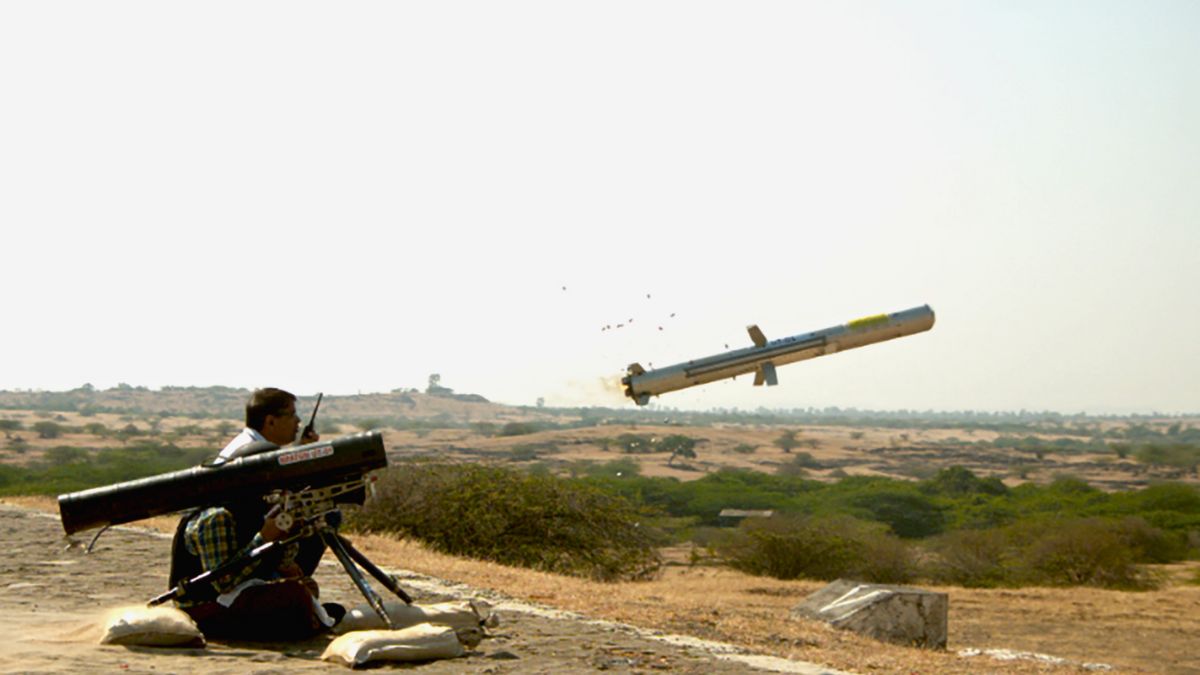
Footage from the trial showed a two-member crew operating a tripod-mounted launcher, already locked onto the target. Seconds after launch, the missile exited the launcher with a sharp muzzle flash and climbed steeply, clearly showcasing a top-attack flight trajectory, designed to strike the weakest armour of modern battle tanks.
In the terminal phase, the missile descended almost vertically, hitting the designated target with precision and triggering a powerful explosion, fireball and thick smoke, confirming successful warhead detonation.
Fire & Forget technology enhances infantry lethality
For the uninitiated, the MPATGM is a shoulder-launched, man-portable missile system designed to give infantry units a decisive edge against enemy tanks and armoured vehicles. Its fire-and-forget capability allows operators to disengage immediately after launch, significantly improving survivability on a high-intensity battlefield.
With an operational range of 200 to 4,000 metres, the missile enables Indian troops to neutralise armour threats from safe stand-off distances.
Lightweight yet lethal battlefield weapon
Weighing around 14.5 kg, with an additional 14.25 kg Command Launch Unit (CLU), the MPATGM is optimised for mobility and rapid deployment in diverse terrains—from deserts and plains to mountainous regions. The missile carries a high-explosive anti-tank (HEAT) tandem warhead, capable of defeating explosive reactive armour (ERA) and modern composite protection systems.
Additionally, the MPATGM incorporates cutting-edge indigenous technologies developed by DRDO and its sister laboratories, which include Imaging Infrared (IIR) Homing Seeker, All-electric Control Actuation System, Advanced Fire Control System, Tandem HEAT warhead, High-performance propulsion and sighting systems.
What makes this anti-tank guided missile even more lethal is the IIR seeker which is well accomplished with day and night combat operation capability; the warhead which is capable of defeating modern main Battle Tanks. Moreover, this missile can be launched from Tripod or Military Vehicle Launcher.
Strengthening Army’s anti-tank warfare doctrine
Once inducted, the MPATGM is expected to significantly enhance the Indian Army’s anti-tank warfare capabilities, particularly at the infantry level. It will reduce dependence on imported systems, improve operational flexibility, and align with India’s push for self-reliance in defence under Atmanirbhar Bharat.
The successful flight test marks another critical milestone in the missile’s development cycle and brings it closer to series production and operational deployment, reinforcing India’s growing indigenous missile ecosystem.
Defence Minister Rajnath Singh praised the DRDO, DcPP Partners and the Industry for the successful test. He termed it as an important step towards Aatmanirbhar Bharat.