India Partner Of Choice, $50 Billion Trade: German Chancellor Signals India-EU FTA Soon, Pushes Deeper Defence Ties
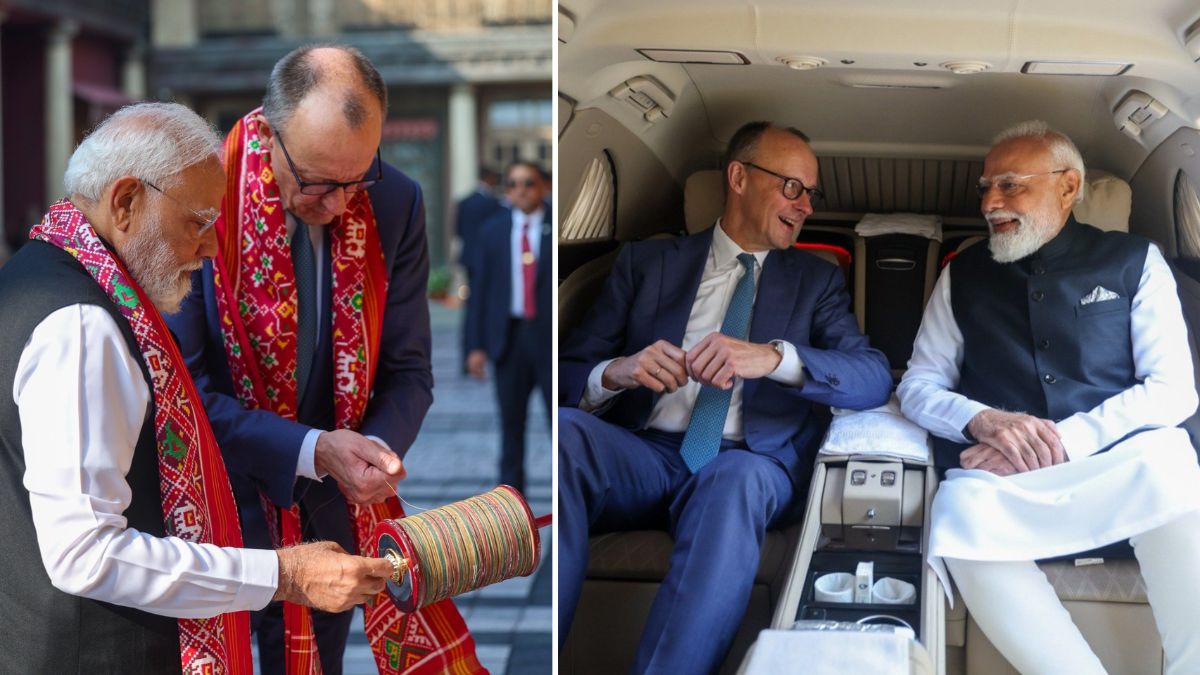
India and Germany completed 25 years of their strategic partnership last year and are celebrating 75 years of diplomatic relations. Image courtesy: RNA

German Chancellor Friedrich Merz on Monday warned of a “renaissance of protectionism”, cautioning that inward-looking trade policies would hurt both Germany and India, as he called for closer strategic and security cooperation between the two countries. Speaking during his first official visit to India, Merz made the remarks after high-level talks with Prime Minister Narendra Modi in Gandhinagar.
India and Germany completed 25 years of their strategic partnership last year and are celebrating 75 years of diplomatic relations, and what better way of commemorating the same than making fresh, strategic announcements. To further boost its ties with India, Germany is set to open an Honorary Consul in Ahmedabad.
A highly dynamic India and a highly technological Germany share key strategic interests, the German Chancellor said as he kick started his India trip in the vibrant state of Gujarat, attending the International Kite Festival 2026.
India-Germany trade crosses $50 billion
Signalling Berlin’s intent to elevate its partnership with New Delhi at a time of global economic uncertainty and geopolitical flux, Merz underlined that the partnership with India is a high priority for Germany. “Germany, as the largest member state of the European Union, and India, as the world’s largest democracy, are united by fundamental values,” he stated.
A key outcome of the Modi–Merz meeting was the announcement that bilateral trade between India and Germany has crossed the $50 billion mark, underlining the growing economic interdependence between Europe’s largest economy and the world’s fastest-growing major market.
Both leaders agreed that future growth must be anchored in open markets, resilient supply chains and technology-driven cooperation, pushing back against rising global protectionist trends.
Modi-Merz meeting: India-EU FTA soon?
He even said that India is a “desired partner” and a “partner of choice” for Germany, while expressing a strong commitment to elevate India-Germany relations to a higher and more strategic level. He also underscored the need to conclude negotiations on the India-European Union Free Trade Agreement (FTA) to unlock the full potential of economic ties.
“To tap into the full potential of India–Germany economic relations, we need to conclude the negotiations on a free trade agreement between India and the European Union,” Merz said while addressing a joint press conference with PM Modi in Gandhinagar. He stressed that both countries are determined to elevate their relationship to a new level.
German sources, cited by news agency Reuters, suggest that there are high expectations that a trade deal between India and the European Union could be signed at the end of January after “very intensive” talks between Merz and Modi. Commerce Minister Piyush Goyal, speaking at a separate event in the western state of Gujarat, said an agreement was almost at its final stages.
Defence and security cooperation takes centre stage
Merz highlighted the strategic dimension of the relationship, stressing that enhanced security cooperation with Germany and Europe would help India reduce its dependence on Russia for defence needs. “We want to deepen cooperation between our defence industries. This has strategic significance.”
Noting that closer collaboration in defence industries holds strategic significance for both sides, Chancellor Merz shared India and Germany have signed a Memorandum of Understanding (MoU) to enhance cooperation in defence industry development, production, innovation and the strengthening of global supply chains.
PM Modi welcomed Germany’s intent to participate in Naval Exercise MILAN, and 9th Indian Ocean Naval Symposium (IONS) Conclave of Chiefs in February 2026, Air Combat Exercise TARANG SHAKTI in September 2026, as well as Germany’s decision to deploy a Liaison Officer to the Information Fusion Centre–Indian Ocean Region (IFC-IOR).
Prime Minister Modi welcomed Germany’s move to simplify defence trade processes and announced a roadmap to expand co-development and co-production between the two countries’ defence industries, aligning with India’s push for defence indigenisation and diversification of partners.
MoUs signed across technology, energy and innovation
Several memoranda of understanding were signed in the presence of both leaders, covering a wide range of sectors including technology, defence, renewable energy and education. A standout initiative was the decision to establish an India–Germany Centre of Excellence, aimed at fostering innovation, joint research and advanced industrial collaboration.
They also made a joint declaration of intent on India Germany Semiconductor Ecosystem Partnership; on cooperation in the field of critical minerals, on cooperation in the field of telecommunications.
Education, technology and academic mobility boosted
Education and emerging technologies featured prominently in the talks, with both sides unveiling a comprehensive roadmap on higher education cooperation. Germany invited its universities to open campuses in India, a move expected to deepen academic exchanges and skill development.
Modi also highlighted the long-standing intellectual and cultural links between the two nations, recalling the influence of Rabindranath Tagore, Swami Vivekananda and Madam Cama in shaping India–Germany exchanges.
India, Germany’s shared stand on terrorism
On global and regional challenges, the two leaders discussed conflicts in Ukraine and Gaza, and reaffirmed their shared commitment to counter terrorism. “We are unanimous that terrorism is a serious threat to all of humanity. India and Germany will continue to fight it together with full determination,” PM Modi said.
The leaders also renewed their push for reform of international institutions. Modi pointed to the G4 grouping—India, Germany, Japan and Brazil—as a platform to press for United Nations Security Council reform. “Our joint effort through the G4 for reform of the UN Security Council is a testament to this thinking,” he said.
A boost to India-Germany ties
Prime Minister Modi expressed his gratitude to Chancellor Merz for announcing visa-free transit for Indian citizens. Both the sides also announced the establishment of Track 1.5 Foreign Policy and Security Dialogue; establishment of Bilateral dialogue mechanism on Indo-Pacific.
India and Germany will also adopt Work Plan of India-Germany Digital Dialogue (2025-2027).
Meanwhile, Chancellor Merz was welcomed in Gujarat by Governor Acharya Devvrat and joined PM Modi at the International Kite Festival at the Sabarmati Riverfront, showcasing cultural diplomacy alongside strategic engagement. The visit builds on momentum generated last November, when Modi and Merz met on the sidelines of the G20 Summit in South Africa.