Rafale Will Make India Stronger: Macron Backs 114-Jet Co-Production Plan, Pitches Make in India
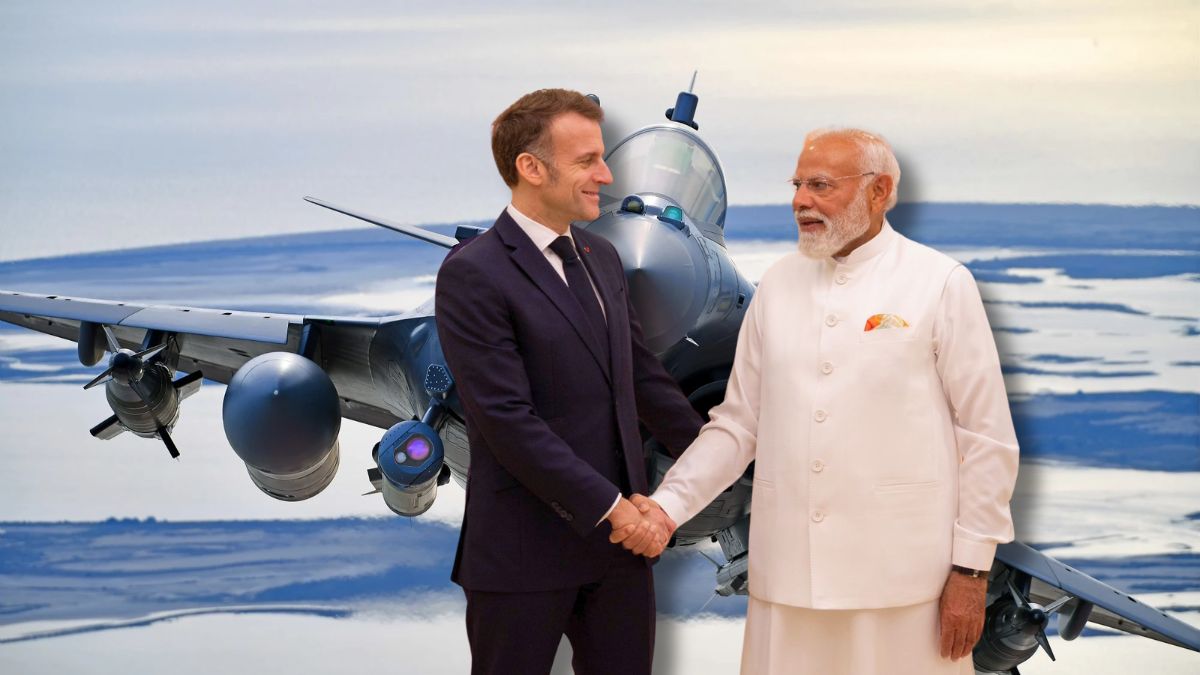
India last week cleared long-pending proposal to procure 114 Rafale fighter jets under a government-to-government framework with France. Image courtesy: RNA

There is no doubt that India is increasing domestic defence production and now it seeks to co-produce France-based Rafale fighter jets, a move that French President Emmanuel Macron has commended. He mounted a robust defence of India’s proposed acquisition and co-production of 114 Rafale fighter jets.
While speaking to reporters on his 3-day India visit for the AI Impact Summit 2026, Macron called criticism of the mega defence deal misplaced and asserting that the programme will significantly strengthen India’s military and industrial base. “I don’t understand why people are criticising the deal,” he said.
He framed the Rafale Multi-Role Fighter Aircraft (MRFA) proposal not merely as a procurement decision, but as a long-term strategic partnership anchored in co-production, technology collaboration and industrial integration. The French President stated, “It will make your country stronger, enhance strategic relations between the two nations, and create more jobs here.”
India-France Rafale deal: Why is Macron backing the co-production plan?
Macron described India’s ambition to move from buyer to co-producer as both “legitimate” and aligned with “the direction of history.” “The Indians, who are currently customers, want to co-produce with us… They want to handle more of the maintenance, which is legitimate,” he said.
The French President underscored that by 2040 and 2050, demand for advanced combat aviation will intensify globally, especially as regional powers such as China expand their air capabilities. “Looking ahead to 2040 and 2050, I am telling you, India will need combat aviation. This is the direction of history,” Macron remarked.
Why does the ‘Make in India’ component matter?
Macron made it clear that “Make in India” would be a core pillar of the proposed programme. “We are extremely committed to having a maximum number of Indian components and manufacturing a maximum number of critical devices in India,” he said, drawing parallels with the Tata-Airbus defence manufacturing collaboration.
Under the proposed structure, Rafale jets would be manufactured outside France for the first time, 40–50% localisation is expected under Make in India, integration of Indian weapons and systems will be enabled, maintenance and lifecycle support will increasingly shift to India.
Defence Secretary Rajesh Kumar Singh has confirmed that the programme will be executed via a government-to-government agreement, ensuring transparency and eliminating intermediaries.
Moreover, the localisation push matters because it strengthens indigenous aerospace manufacturing capability, supply chain resilience, skilled job creation, long-term sustainment autonomy. For India, co-production reduces dependence on external supply lines during crises and builds domestic defence capacity.
How urgent is India’s fighter jets requirement?
The proposed acquisition comes at a critical juncture for the Indian Air Force (IAF), whose fighter squadron strength has fallen to 31, significantly below the sanctioned strength of 42 squadrons. India currently operates 36 Rafales inducted under a 2015 government-to-government deal.
26 Rafale Marine jets have also been ordered for the Indian Navy under a Rs 64,000 crore agreement. The 114 MRFA proposal is designed to plug capability gaps while ensuring long-term industrial benefits.
By enabling domestic production, India could secure not just aircraft numbers but strategic manufacturing depth.
India-France Special Global Strategic Partnership
Macron positioned the Rafale programme as a cornerstone of the India–France “Special Global Strategic Partnership.” The deal strengthens cooperation in in number of areas like advanced aerospace technologies, defence industrial ecosystems, Indo-Pacific security coordination, long-term strategic alignment. Importantly, Macron suggested that the Rafale model could extend to other platforms, including submarines.
“Rafale is absolutely key… I hope we will do it on submarines. We offered additional capacities,” he said.