Indian Army Hosts UN Arms Control Fellowship In Jabalpur To Enhance Capacity To Address Illicit Small Arms Trade
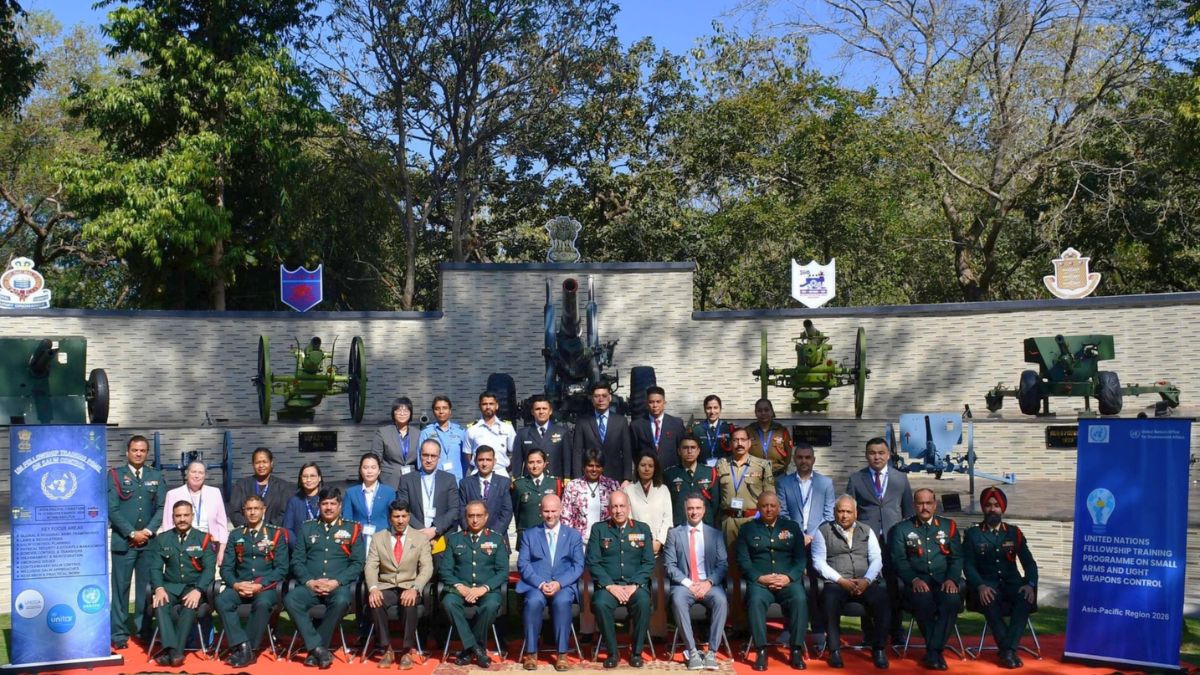
The initiative enhances technical capacity and regional cooperation to address illicit small arms trade. Image courtesy: X.com/@adgpi

India has a significant presence in global peace and disarmament efforts and in a notable show of defence diplomacy initiative, the Indian Army has launched the inaugural United Nations Fellowship Training Programme on Small Arms and Light Weapons (SALW) Control for the Asia-Pacific region at Jabalpur, Madhya Pradesh.
The three-week programme, which began at the Military College of Materials Management (MCMM) on Monday (February 16, 2026) and will conclude next month on March 6, brings together delegates from 13 Asia-Pacific nations under the aegis of India’s Ministries of External Affairs and Defence.
The initiative marks a strategic step in strengthening India’s role in global peace, disarmament and responsible arms governance, Indian Army said in a post on social media.
What is the UN fellowship programme all about?
The fellowship is being organised by the United Nations Office for Disarmament Affairs (UNODA) through its Regional Centre for Peace and Disarmament in Asia and the Pacific (UNRCPD). Its primary objective is to build the technical and operational capacity of government officials responsible for implementing:
The UN Programme of Action (PoA) on small arms and light weapons
The International Tracing Instrument (ITI)
These frameworks are central to preventing the illicit trade, diversion and misuse of small arms and light weapons worldwide. The fellowship commenced with UNRCPD Director Deepayan Basu Ray outlining the broader UN disarmament agenda and the global security challenges linked to illicit arms proliferation.
Why are small arms and light weapons a global concern?
Unlike strategic weapons systems, small arms and light weapons are easily trafficked, concealed and misused, making them a major driver of armed conflict, terrorism, organised crime, political instability, among other things. In view of such threats, this initiative marks a crucial step toward enhancing regional cooperation, improving tracing systems.
Illicit SALW proliferation has destabilised several regions globally, particularly in fragile and conflict-prone states. Weak stockpile management and poor tracing mechanisms often enable weapons to fall into the wrong hands.
By focusing on tracing systems, responsible stockpile management and enforcement best practices, the programme seeks to curb the shadow networks that fuel armed violence.
What is India aiming to achieve through this initiative?
The Indian Army’s hosting of the fellowship signals a broader strategic objective: positioning India as a key capacity-building partner in the Global South. Lieutenant General Sanjay Sethi, in his keynote address, underscored the importance of multilateral cooperation to address emerging security threats posed by illicit arms flows.
India aims to strengthen regional cooperation in the Asia-Pacific, enhance tracing and monitoring systems, promote responsible arms governance, reinforce its image as a responsible security provider. By hosting the programme, India is not only contributing to UN-led disarmament efforts but also deepening defence diplomacy ties with participating countries.
Over the past decade, India has expanded its defence outreach through joint exercises, training programmes and capacity-building initiatives across Africa, Southeast Asia and the Indo-Pacific. Hosting the UN fellowship aligns with India’s vision of being a net security provider in the region, one that supports peace, stability and institutional strengthening.
What happens next?
Over the next three weeks, participating officials will undergo intensive training on arms tracing methodologies, marking and record-keeping standards, stockpile security and risk mitigation, policy implementation under UN frameworks. The fellowship will culminate on March 6, with the expectation that participants will return to their home countries better equipped to implement global disarmament commitments.
The inaugural nature of the programme in the Asia-Pacific underscores its significance. By hosting it at a premier Army institution like MCMM Jabalpur, India is leveraging its institutional expertise to support global peace efforts.