



Domestic Industry Must Stay Ahead: Rajnath Singh Unveils BEL Missile Integration Hub, Mountain Fire Control Radar
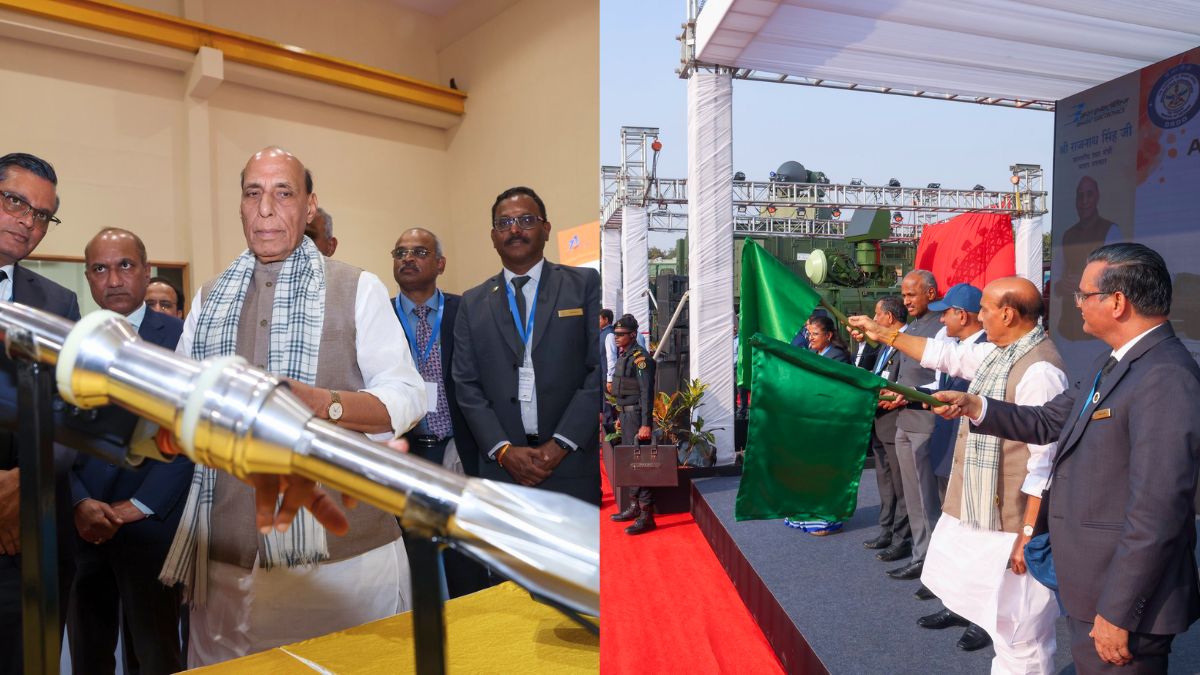
Rajnath Singh highlighted that indigenously developed air defence and anti-drone systems were effectively utilised during Op Sindoor. Image courtesy: RNA

Defence Minister Rajnath Singh commended leading defence PSU Bharat Electronics (BEL) for making headway in cutting-edge technologies such as electronic warfare systems, avionics, naval platforms, electro-optics, and tank electronics. BEL’s “integrated systems, real-time data sharing, and decision support capabilities have taken our combat effectiveness to a new level,” he said.
Singh made the remarks while inaugurating a new Missile Integration Facility at BEL premises on Monday (February 16, 2026). He also flagged off the Akash missile regiments’ combat systems, and launched an Artificial Intelligence policy aimed at transforming battlefield capabilities.
The high-profile visit signals a major step forward for the government’s Make in India and Aatmanirbhar Bharat initiatives, strengthening India’s air defence arsenal while accelerating indigenous R&D in next-generation warfare technologies.
What is the new missile integration facility at BEL?
The newly inaugurated Missile Integration Facility at BEL is expected to significantly enhance India’s capacity to assemble, integrate and test advanced missile systems domestically. Such facilities are critical for faster deployment of missile regiments, seamless integration of sensors, radars and weapon systems, reduced reliance on foreign supply chains, strengthening India’s network-centric warfare capabilities.
By expanding domestic missile integration infrastructure, India improves its ability to rapidly induct and operationalise air defence systems, a crucial requirement amid evolving aerial threats, including drones and precision-guided munitions.
What systems were flagged off?
During the visit, Singh flagged off the Akash 3rd and 4th Regiment Combat Systems, further boosting India’s layered air defence shield.
The Akash surface-to-air missile system, developed indigenously, is capable of intercepting aerial threats including fighter aircraft, cruise missiles and drones. The induction of additional regiments enhances India’s capacity to secure strategic airspace across multiple theatres.
He also unveiled the Mountain Fire Control Radar, designed to operate effectively in high-altitude and rugged terrain, a key capability for deployments along sensitive border regions.
How does this strengthen ‘Make in India’ in defence?
The developments underscore India’s accelerating shift from importer to producer of advanced defence systems. Officials briefed Singh on ongoing indigenous R&D aligned with major national programmes, including Quick Reaction Surface-to-Air Missile (QRSAM) systems, Light Combat Aircraft (LCA) Mk II, AMCA, Project Kusha (MR-SAM/LR-SAM), counter-drone systems, naval weapon control systems.
These projects represent the backbone of India’s future combat capabilities across land, air and sea domains. Singh highlighted that indigenous air defence and anti-drone systems were effectively deployed during Operation Sindoor, demonstrating operational reliability under real-world conditions.
“Only a self-reliant victory gives the country renewed confidence,” he said, underlining the strategic value of home-grown weapons.
How is AI reshaping India’s battlefield strategy?
In a parallel move, Singh remotely inaugurated BEL’s Centre of Excellence for Artificial Intelligence (CoE-AI) in Pune and formally launched the company’s AI Policy. The AI centre is expected to focus on threat prediction and early warning systems, autonomous systems, real-time battlefield decision support, cyber defence capabilities, precision targeting.
Singh noted that AI and quantum computing are no longer futuristic concepts but are actively reshaping modern warfare. “The advancement in threat prediction, early warning, and response mechanisms using AI instils operational confidence in our soldiers,” he noted.
Moreover, BEL’s integrated systems, real-time data sharing and decision-support tools are enhancing India’s move towards fully network-centric operations.