Op Sagar Bandhu: Indian Army Hospital Treats Over 2200 Cyclone-Hit In Sri Lanka; 3 Bailey Bridges Inducted
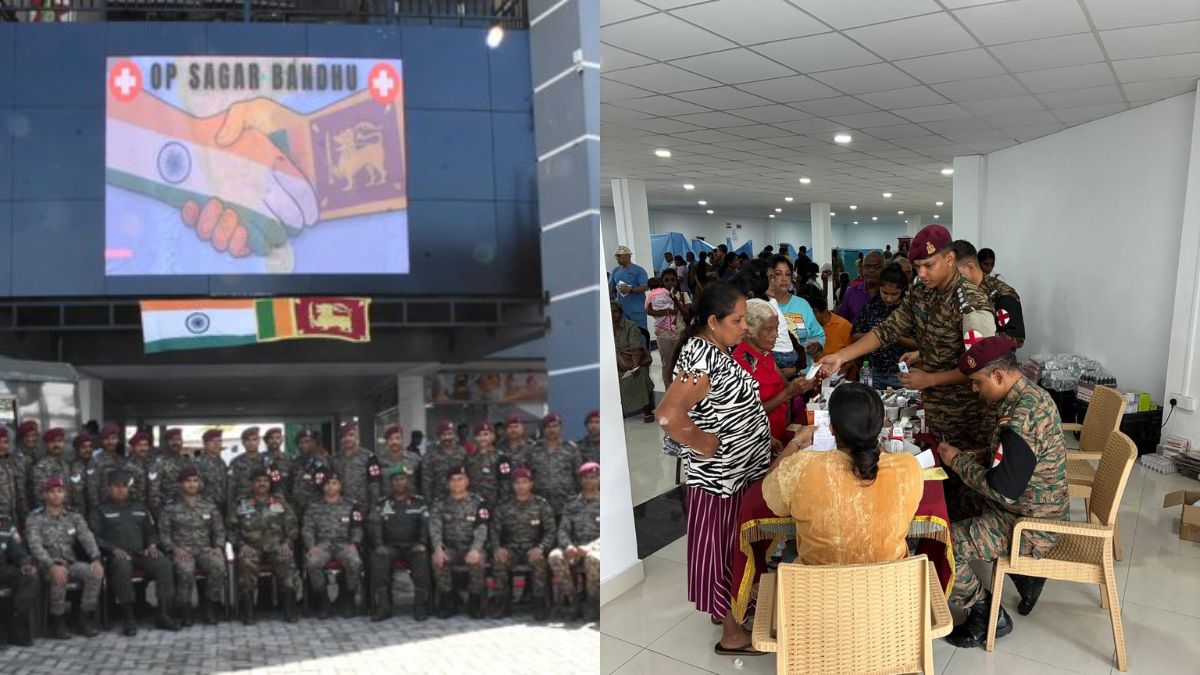
The Indian Army's Field Hospital has treated over 1,250 people so far, including five major emergency surgeries. Image courtesy: X.com/@adgpi

Showcasing its long-standing commitment to regional solidarity, the Indian Army has emerged as a frontline responder in Sri Lanka’s hour of need following the havoc caused by Cyclone Ditwah. As the neighbouring nation battles widespread destruction, India’s field hospital has already treated over 2,200 people, performing five major emergency surgeries.
Lieutenant General Lasantha Rodrigo, Commander of the Sri Lankan Army, personally visited the Indian medical facility, expressing deep gratitude for the swift, decisive and compassionate response by Indian personnel on the ground.
The MEA informed that the field hospital set up by India in Mahiyanganaya near Kandy, since December 5 has conducted 67 minor procedures. This comes just a few days after and IAF C-17 Globemaster airlifted a full para field hospital unit to Colombo.
Besides the field hospital in Mahiyanganaya, medical centres have also been set up in the badly hit Ja-Ela region and in Negombo. Indian Navy’s INS Vikrant, INS Udaygiri, and INS Sukanya provided immediate rescue and relief assistance to Sri Lanka.
India’s humanitarian aid to Sri Lanka: How the Army is going beyond medical efforts?
Beyond medical assistance, the Indian Army has deployed its engineering muscle by inducting three Bailey Bridges, critical modular structures that can be rapidly assembled to restore connectivity in disaster-hit regions. In close coordination with the Sri Lankan administration, suitable locations have already been identified for the bridges.
These Bailey Bridges will will reconnect isolated communities, enable faster relief movement and support long-term recovery. They arrived aboard multiple C-17 Globemaster aircraft, with the fourth aircraft, carrying 55 tonnes of bridge components, a JCB, and 13 engineering specialists, touching down in Colombo.
What drives India’s consistent humanitarian outreach to Its neighbours?
India’s support to Sri Lanka under Operation Sagar Bandhu reflects a broader doctrine deeply embedded in its foreign policy – when neighbours are in distress, India steps forward first. From earthquakes in Nepal and cyclones in Myanmar to water crises in the Maldives and medical aid during the pandemic, India has repeatedly demonstrated that its military is not just a force of defence, but also a force of compassion.
The ongoing relief mission in Sri Lanka underscores this ethos. The Indian Army, working seamlessly with the Ministry of External Affairs, has ensured a coordinated flow of medical teams, engineering units, essential supplies and emergency infrastructure, reaffirming India’s role as the region’s most reliable humanitarian responder.
At least 627 people have been killed and 190 remain missing as of Sunday noon due to catastrophic floods and landslides caused by extreme weather conditions since November 16.
Operation Sagar Bandhu: India’s relief mission in Sri Lanka
PM Narendra Modi approved Operation Sagar Bandhu on November 28, signalling India’s commitment to supporting Sri Lanka during its hour of need. The operation aims to bolster Sri Lanka’s strained disaster-response machinery with Humanitarian Assistance and Disaster Relief (HADR) support.
For thousands of affected families in Sri Lanka, India’s rapid mobilisation means more than just supplies. The combination of life-saving medical care, restoration of vital connectivity, and continuous arrival of relief material, is helping the island nation regain its footing faster.
Meanwhile, India has sent about 1000 tonnes of essential food items and clothes to the cyclone hit under Operation Sagar Bandhu contributed by the people of Tamil Nadu. Of these, about 300 tonnes reached Colombo in 3 Indian Naval Ships on Sunday (December 7, 2025) morning.
Operation Sagar Bandhu stands as a compelling example of how the Indian Army blends precision, professionalism and empathy, strengthening regional bonds in times of crisis.