
China, Pakistan And The Gwadar Power Plan That Refuses To Fix A Broken System
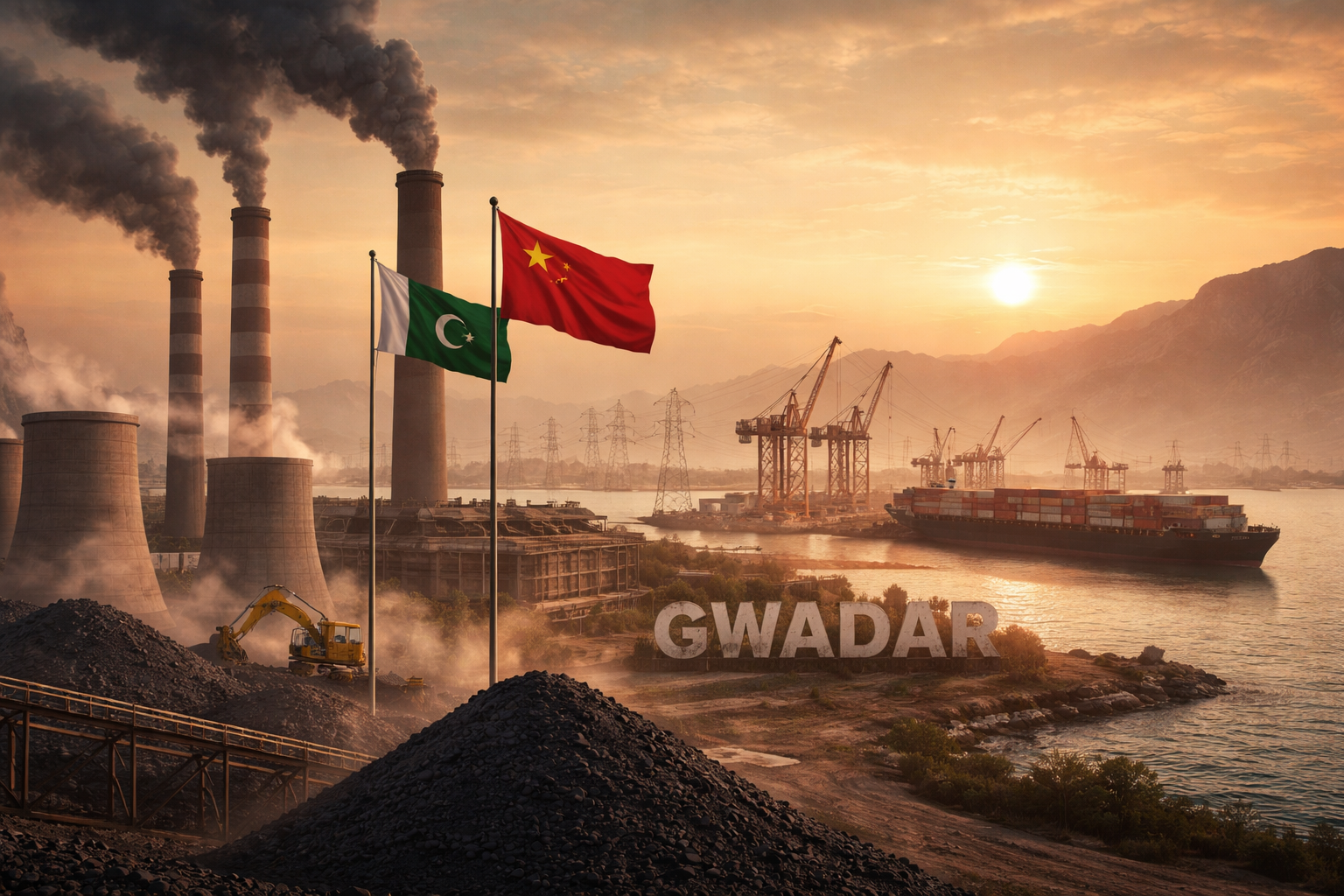
Pakistan appears to not have learnt from mistakes of the past, continuing to put its energy security at risk. Image courtesy: AI-generated picture via DALL-E

Pakistan’s energy debate has returned to a familiar comfort zone. New power projects promise capacity, investment and ribbon-cutting moments, even as households struggle with soaring bills and unreliable supply. The latest proposals, including the Azad Patan and Kohala hydropower schemes and a coal-fired plant at Gwadar, would add around 2,100 megawatts to the national grid. Yet the announcement lands in a system already weighed down by surplus electricity, financial stress and structural decay.
Installed capacity has grown steadily over the past decade, driven in large part by large-scale projects under the China-Pakistan Economic Corridor. On paper, Pakistan generates more electricity than it consumes. In reality, much of that power fails to reach users or arrives at prices many cannot afford. The problem lies less in production and more in the machinery that governs distribution, billing and planning.
Why does more capacity keep arriving in a system already under strain?
At the centre of the sector’s troubles sits circular debt, which has swollen into trillions of rupees. Power producers receive fixed capacity payments under long-term contracts, regardless of how much electricity the grid absorbs. When demand falls short or transmission bottlenecks prevent dispatch, plants remain idle while payments continue. Each new project signed under similar terms adds another layer of fixed cost.
Transmission and distribution infrastructure compounds the difficulty. Electricity often travels long distances from southern generation clusters to northern population centres through ageing lines prone to congestion and failure. When these corridors trip, generation stalls even as consumers face load-shedding. The coexistence of idle plants and power cuts has become a defining feature of Pakistan’s energy landscape.
Losses further drain the system. Technical inefficiencies and illegal connections swallow a significant share of generated electricity. Distribution companies struggle to collect bills in many regions, yet obligations to producers remain unchanged. The financial burden moves steadily upward, from utilities to the state and eventually to consumers.
In this context, fresh generation offers little relief. Without parallel investment in grids, governance and recovery mechanisms, new plants deepen imbalance rather than resolve it.
What does the choice of coal and mega projects reveal about policy priorities?
The Gwadar coal plant illustrates the tension between strategy and sustainability. Coal faces growing global scrutiny for its environmental and health impacts, while Pakistan ranks among the countries most exposed to climate shocks. A coal facility on the coast carries long-term risks tied to pollution, fuel imports and carbon exposure.
Gwadar requires dependable electricity to support development, ports and industry. That need could be met through solar, wind and flexible gas-based options paired with modern grid upgrades. Such approaches would align more closely with climate resilience and local demand patterns. The decision to pursue coal suggests geopolitical signalling and corridor politics have taken precedence over long-term cost and environmental assessment.
Hydropower projects at Azad Patan and Kohala appear more attractive due to their renewable credentials. Even so, they demand heavy upfront investment, extended construction timelines and complex regional coordination. With public finances stretched and external financing increasingly conditional, each major commitment raises questions about debt sustainability.
Reports of visits by China’s energy authorities to examine transmission losses point toward a different set of priorities. Grid rehabilitation, loss reduction, distribution reform and tariff restructuring offer the clearest path toward stability. These steps require political resolve, institutional reform and enforcement, including confronting theft and renegotiating unfavourable contracts.
Pakistan’s energy challenge calls for sequencing rather than spectacle. Repairing what already exists would ease pressure far more effectively than expanding capacity that the system struggles to absorb. Without such a shift, today’s announcements risk becoming tomorrow’s stranded assets, adding weight to a sector already carrying more than it can bear.