Xi Calls Trump On Taiwan “Return” Claim As Taipei Pushes Back; Japan, On Edge, Scrambles Jets
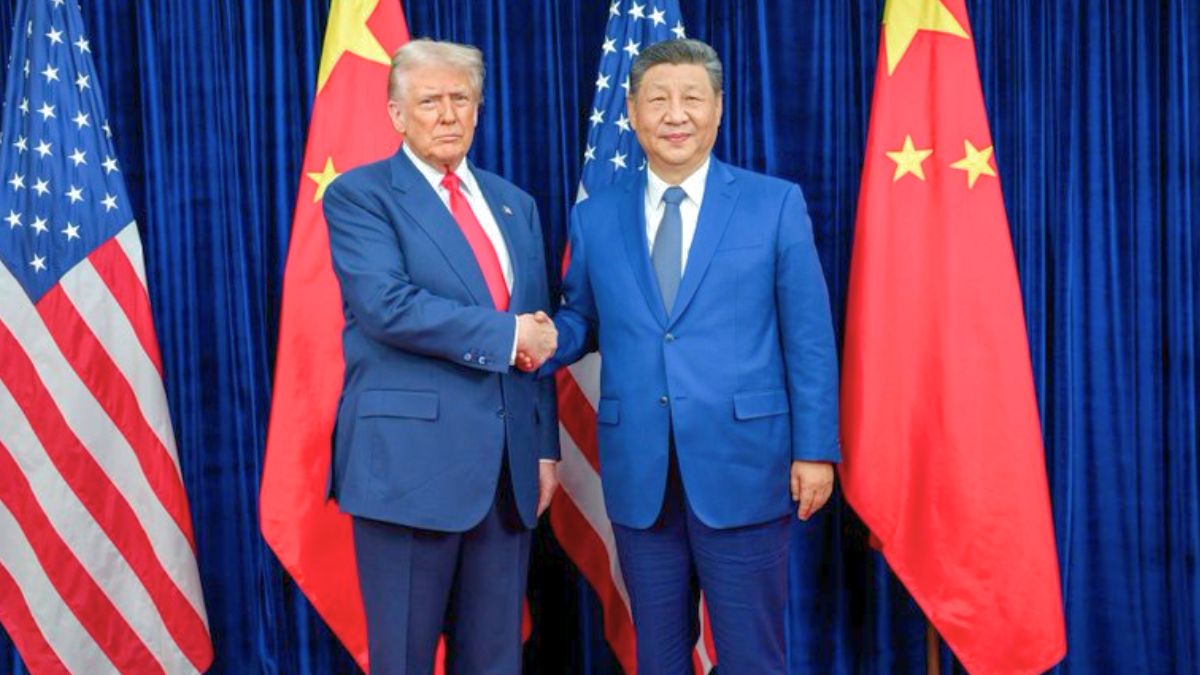
Amid ongoing tensions between China and Japan over Taiwan, Trump dialled Xi to discuss various issues. Image courtesy: X.com/@WhiteHouse

China’s leader Xi Jinping has reignited tensions over Taiwan in a high-stakes phone call with US President Donald Trump, asserting that the island’s “return” to China remains a non-negotiable element of the post-World War II order.
The conversation, which unfolded on Monday (November 24, 2025), came at a precarious moment in Asia, with Taiwan forcefully rejecting Beijing’s position and Japan scrambling fighter jets in response to a suspected Chinese drone near its territory.
What did Xi tell Trump about Taiwan?
According to China’s foreign ministry, Xi told Trump that Taiwan’s reunification was rooted in the “joint US-China struggle against fascism and militarism” and formed an integral part of the postwar settlement. Beijing views Taiwan as a breakaway province that must eventually be annexed, by force if necessary.
But Taiwan’s democratically elected government made its stance unmistakably clear. Premier Cho Jung-tai responded Tuesday (November 25), declaring that the island’s 23 million people would not accept any notion of “returning” to China.
“The Republic of China, Taiwan, is a fully sovereign and independent country,” Cho said, stressing that the idea of reunification “is not an option.”
What other issues did Trump and Xi discuss?
The call between Xi and Trump also covered trade and the Ukraine war. Both sides reaffirmed gains from an October meeting in South Korea, where they agreed to ease elements of the long-running trade war, ranging from Chinese rare-earth export restrictions to US tariffs on Chinese goods.
Trump, in his public remarks, avoided mentioning Taiwan but hailed “extremely strong” US-China relations, even as Beijing emphasised Washington’s understanding of China’s sensitivities.
What is the latest between China, Japan?
The diplomatic turbulence is unfolding against a separate but related crisis between China and Japan, triggered after Japan’s new Prime Minister Sanae Takaichi signalled that Tokyo might intervene militarily should China move against Taiwan.
The comment provoked a furious backlash from Beijing, leading to a drop in Chinese tourism to Japan, a seafood ban, and the freezing of cultural exchanges.
Why did Japan scramble fighter jets?
On Tuesday (November 25), Takaichi confirmed she had her own phone call with Trump, during which the two discussed US-Japan ties and the Indo-Pacific security environment.
Meanwhile, tensions spiked further when Japan announced it had scrambled fighter jets after detecting a suspected Chinese drone passing between Taiwan and Japan’s Yonaguni Island, the country’s westernmost territory and a key military outpost.
Tokyo plans to deploy Type 03 medium-range surface-to-air missiles on Yonaguni, a move China has denounced as a “deliberate attempt to create tension.”
Japanese Defence Minister Shinjiro Koizumi on Tuesday (November 25) dismissed Beijing’s objections, stating the weapons are purely defensive and designed to counter hostile aircraft and missile threats.
How did Taipei respond to Tokyo’s actions?
Taipei welcomed Japan’s enhanced defences on Yonaguni, saying the deployment “helps maintain security in the Taiwan Strait”—a region that analysts widely describe as the most dangerous flashpoint in Asia.
The dual crises underscore the rising volatility across the Indo-Pacific, where US-China competition, Taiwan’s defiance, and Japan’s newly assertive posture are converging into a multilayered strategic confrontation.
With Trump set to visit China in April and Xi expected in Washington in 2026, diplomacy will be tested as the region braces for further turbulence.