
China’s New Type 076 Warship Marks a Tech Leap; But Xi’s Military Purge Raises a Bigger Question
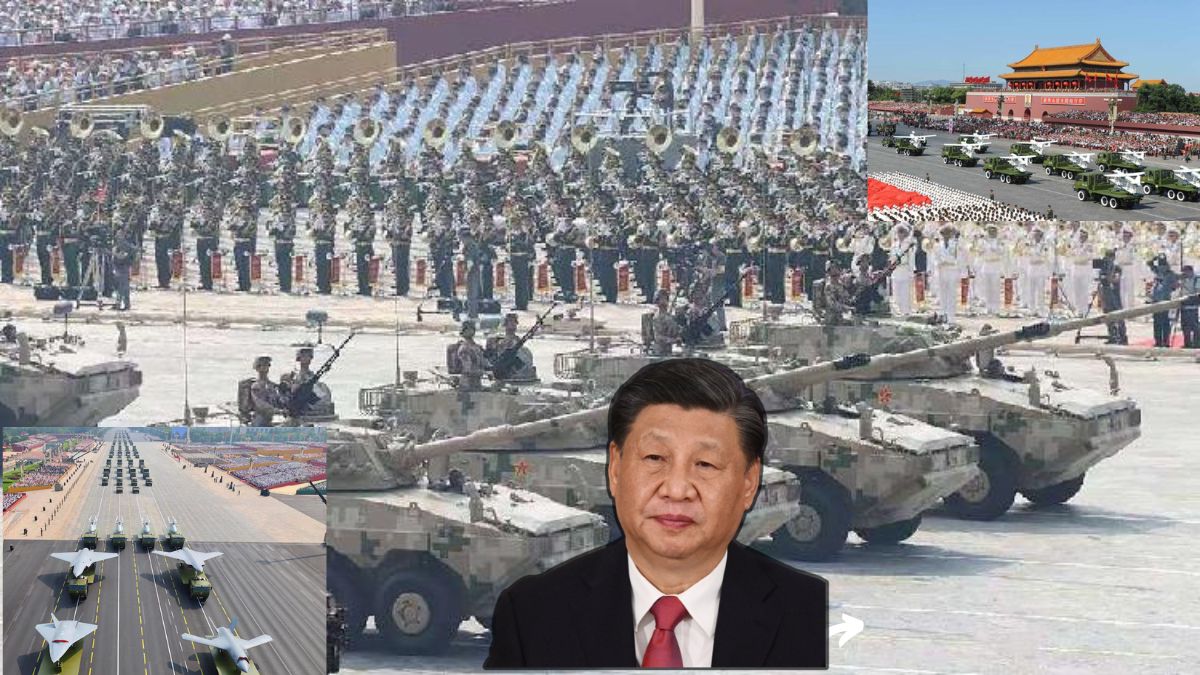
Xi Jinping’s military parade reveals China’s push to fuse AI, drones, and advanced weaponry into its bid for a world class military by 2050. Image courtesy: RNA

China has begun sea trials of the Sichuan, its most advanced amphibious assault ship to date, underscoring the pace at which Beijing is expanding and modernising the People’s Liberation Army Navy (PLAN).
The launch comes barely a week after China commissioned the Fujian, its newest aircraft carrier, signalling an aggressive push to project maritime power at a scale unmatched in its history.
Here is all about the Type 076 Sichuan warship?
At 40,000 tons, the Type 076 Sichuan is about half the size of the Fujian but carries outsized strategic significance. Designed and built domestically, the vessel blends the characteristics of a light aircraft carrier with those of traditional amphibious assault ships.
Crucially, it is equipped with an electromagnetic catapult system — the same next-generation technology fitted on the Fujian and a notable divergence from US Navy America- and Wasp-class assault ships, which are restricted to helicopters and STOVL aircraft.
Would the present tech upgrade help the Sichuan warship?
This tech upgrade could allow the Sichuan to launch not just drones and vertical-lift aircraft, but potentially fixed-wing jets, a capability that would dramatically expand China’s options in any high-intensity conflict, especially around Taiwan.
Chinese state media have hinted at these possibilities, though the full scope won’t become clear until later phases of the vessel’s trials.
What does this tech upgrade mean to Beijing?
For Beijing, amphibious assault ships are central to any military campaign aimed at Taiwan. Yet the island’s increasingly dense missile-defence network makes such operations exceptionally risky.
China may have the world’s largest navy by hull count, but analysts often point out that ship numbers alone do not translate into combat readiness.
And this is where the larger strategic contradiction emerges.
What is the strategic contradiction?
Even as China showcases cutting-edge naval platforms, President Xi Jinping’s sweeping purge of senior military officers, especially within the Rocket Force and key equipment departments, has exposed deep structural vulnerabilities.
The shake-up has raised questions over corruption, internal mistrust, and quality-control issues within China’s defence industrial base.
Several reports suggest that gaps in equipment performance, procurement integrity, and command reliability may be more severe than Beijing publicly acknowledges.
What is the Chinese paradox here?
The result is a paradox: China is making high-velocity strides in shipbuilding and naval technology, yet its actual preparedness for a protracted conflict remains uncertain. Modern hardware can enhance capability, but it cannot fully compensate for institutional turbulence at the top.
As the Sichuan pushes ahead with sea trials, the world sees both sides of China’s military evolution — breathtaking technological ambition shadowed by unresolved doubts about how effectively that power can be wielded.