Dynamic Foreign Policy To Reformed Multilateralism: Jaishankar Engages G4, G7 Counterparts At Munich Conference
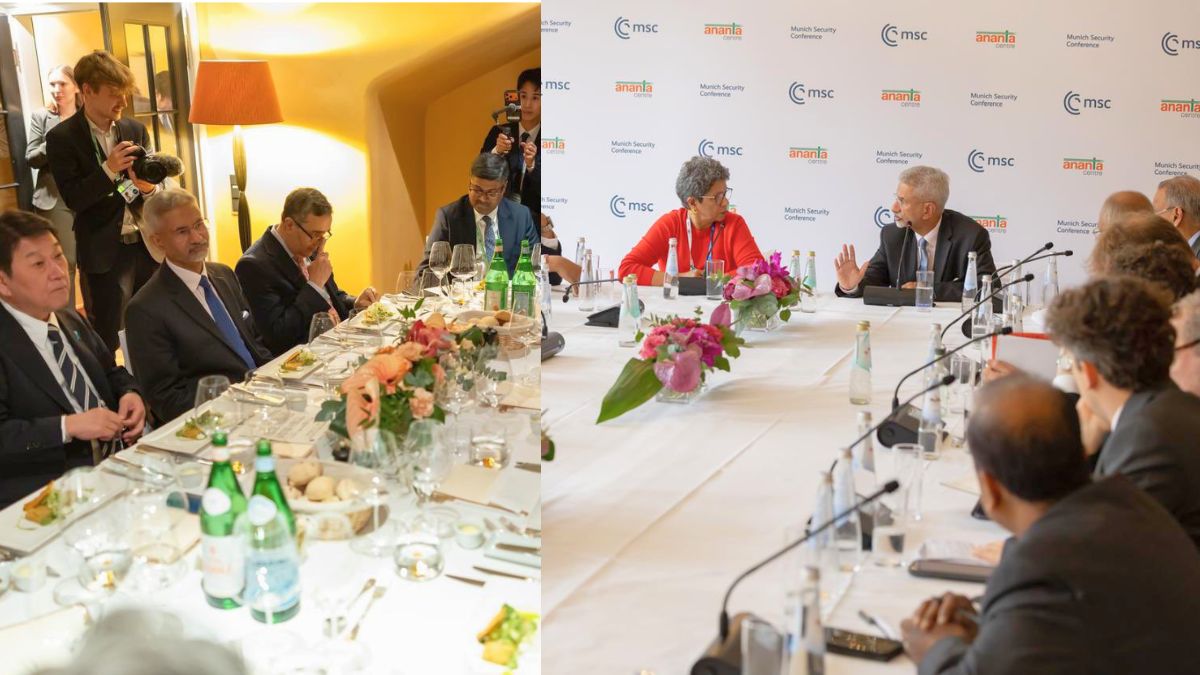
At the Munich Security Conference 2026, EAM Jaishankar emphasised the need for India to adopt a nimble and dynamic foreign policy. Imgae courtesy: RNA

As the world transitions from being bipolar to multipolar, there is a greater need for India to adopt a nimble and dynamic foreign policy to meet the demands of multipolarity. External Affairs Minister Dr. S Jaishankar highlighted the same while participating in the Munich Security Conference 2026.
At a time when the global order is being tested by wars, economic shocks and shifting power equations, EAM Jaishankar used MSC 2026 to articulate India’s evolving foreign policy playbook, suggesting it needs to be agile, economically driven and anchored in reformed multilateralism.
From pushing the India-EU Free Trade Agreement (FTA) to backing UN Security Council reform, Jaishankar also engaged both the G7 and G4 in Munich, reflecting a country positioning itself at the centre of an emerging multipolar world.
How does India view the global system today?
Speaking at a roundtable titled ‘Delhi Decides: Mapping India’s Policy Calculus’, hosted by Ananta Aspen, EAM Jaishankar offered a candid assessment of the current international landscape. “We have an order. It’s messy, it’s imperfect but it still exists,” he said, underscoring that while global systems are under strain, they have not collapsed.
With this, he pointed to a series of shocks over the past five years, ranging from the Covid-19 pandemic, the Ukraine war, to the instability in the Middle East, as accelerators of geopolitical change. The evolving stance of the US and the continued rise of China, Jaishankar noted, are reshaping power balances in profound ways.
“The cumulative impact is hitting us all,” he remarked, suggesting that today’s turbulence is the result of a decade-long transformation rather than a sudden rupture. For India, this means one thing: adaptability.
Why is agility the core of India’s foreign policy?
Jaishankar argued that a world moving toward greater multipolarity, where power is distributed across multiple centres, demands nimbleness and strategic clarity.
Rather than aligning rigidly with blocs, India is seeking diversified partnerships, calibrated engagement and issue-based coalitions. The message from Munich was clear that India intends to operate with flexibility in an increasingly competitive geopolitical environment.
Jaishankar also observed what he termed a “strategic reawakening of Europe,” as European nations reassess their security architecture, economic resilience and geopolitical positioning. This shift, India believes, opens new opportunities for deeper cooperation.
How is India-EU FTA a strategic game changer?
Economic statecraft featured prominently in Jaishankar’s remarks, with the External Affairs Minister flagging the India-EU Free Trade Agreement as a key priority, alongside progress on the India-US trade deal. In a world marked by supply chain disruptions and economic fragmentation, India is positioning trade agreements not merely as commercial arrangements but as strategic stabilisers.
Strengthening economic partnerships, Jaishankar suggested, is essential to navigating geopolitical volatility, and to embedding India more firmly in global value chains.
First-ever G4 meeting on the MSC sidelines?
In a significant diplomatic development, Jaishankar met his counterparts from the G4 – Germany, Japan and Brazil – to discuss “reformed multilateralism.”
“A G-4 meeting of India, Germany, Japan and Brazil to discuss reformed multilateralism. Held on the sidelines of the @MunSecConf for the first time,” EAM Jaishankar wrote on X.
The meeting marked the first time the G4 convened on the sidelines of the Munich Security Conference.
The G4 nations have long advocated expansion of the UN Security Council to reflect contemporary realities. At Munich, the conversation centred on meaningful reform and greater representation for emerging powers.
Germany’s Foreign Minister Johann Wadephul struck a notable tone, acknowledging that Europe’s earlier tendency to view countries primarily through the BRICS lens had been misplaced. “Some years ago, we first saw these countries as being members of the BRICS, and that sort of alienated us from them, and that was wrong,” he said.
He added that Germany now recognises shared interests and values with India and Brazil.
How is India engaging the G7?
Jaishankar also met G7 foreign ministers, reiterating India’s support for the UN@80 agenda and pressing for meaningful reform of the UN Security Council. In addition to institutional reform, India emphasised its operational contributions to global security – safeguarding sea lines of communication, acting as a first responder in crises, strengthening port security, supporting resilient submarine cable infrastructure,
“Our conversation brought out the many convergences and shared interests between India and the G7,” Jaishankar noted. The engagement underscored India’s effort to bridge established and emerging power groupings, engaging both BRICS members and G7 nations without contradiction.
What to make of Jaishankar’s Munich diplomacy?
The 62nd Munich Security Conference, attended by nearly 50 Heads of State and Government, has long been a barometer of global strategic thinking. This year’s edition, held at Hotel Bayerischer Hof and Rosewood Munich, reflected heightened concern over systemic fragmentation.
Against that backdrop, India’s message was consistent, that the world is moving toward multipolarity, and multilateral institutions must be reformed, not abandoned. Munich 2026 showed that India is no longer just responding to global change, it is actively seeking to shape the terms of the debate.