

Army Seeks ‘Drone Catchers’ As UAV Threat Surges: How This System Will Work
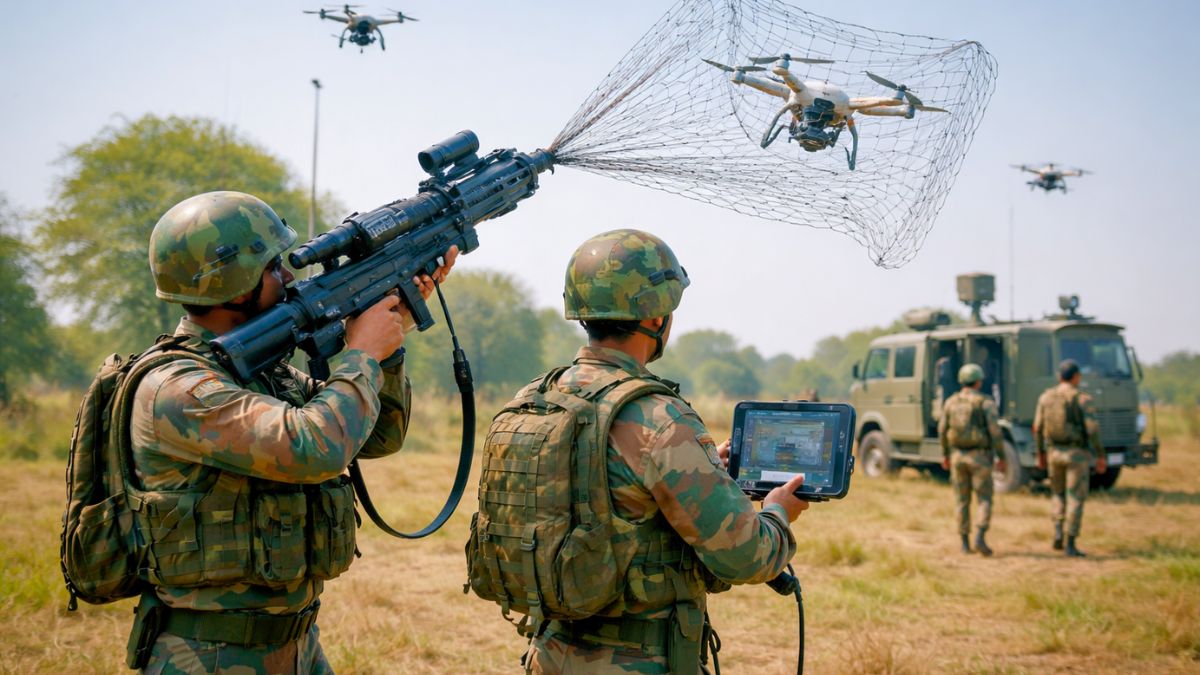
The DCS is required to detect and counter the low flying drones and UAS by utilising the net catcher. Image courtesy: AI-generated picture via Sora

It goes with saying that drones are becoming central to modern warfare at a breakneck speed, and India’s Operation Sindoor in May 2025 was a proof the same. While India is inreasingly seeking to induct more drones into its weaponry, but at the same time, the army is also looking to procure “drone catchers”.
With small drones and unmanned aerial systems (UAS) increasingly redefining the battlefield, the Indian Army has moved urgently to procure automated “drone catchers”, which are interceptor drones equipped with net systems designed to capture or neutralise hostile aerial threats.
The latest push comes amid growing concerns that low radar cross-section drones, deployed individually or in swarms, are becoming harder to detect and counter using conventional air defence systems.
Why is Army prioritising counter-drone systems now?
According to a Request for Information (RFI) issued by the Ministry of Defence on Friday (February 13, 2026), the threat from low-flying drones has “grown exponentially.” These platforms, often small, agile and difficult to detect on traditional radar, can carry surveillance payloads or explosives and operate in coordinated swarm formations.
Recent conflicts globally have demonstrated how inexpensive unmanned systems can overwhelm high-value military assets, disrupt logistics, and conduct precision strikes, forcing militaries worldwide to rethink air defence doctrines, according to a report in The Tribune.
What are ‘Drone Catchers’ and how will they work?
The proposed Drone Catcher System (DCS) will use autonomous interceptor drones fitted with net-capturing mechanisms to physically ensnare hostile UAVs mid-air. Unlike missile-based hard-kill systems, net catchers allow for controlled neutralisation, reducing collateral damage risks.
Each system is expected to include surveillance and detection sensor, a microprocessor-based targeting solution module, four interceptor drones with net-catching capability, a Ground Control Station (GCS). The system must operate either independently or in conjunction with existing air defence assets and other Counter-UAS (C-UAS) systems.
How advanced will the detection capabilities be?
The Army is seeking electronically scanned array (ESA) radar technology capable of scanning large volumes of airspace in a 360-degree sphere. Some of the key requirements include simultaneous detection and tracking of at least 20 drones, a minimum range of 4 km, automated prioritisation and target designation.
The sensor will transmit data to the Ground Control Station, which will guide the drone catcher to intercept and neutralise the threat.
Will the system integrate with India’s existing air defence network?
Yes. The proposed system has to be compatible so as to integrate with the Akashteer air defence control and reporting module, ensuring seamless coordination within India’s layered air defence architecture.
It must also meet Army Cyber Group evaluation standards for integration into the secure Army Data Network, which is a critical requirement as modern air defence becomes increasingly network-centric.
What role will electronic warfare play?
Beyond physical interception, the system will incorporate a jammer sub-system capable of electronic attack measures, including radio frequency denial, navigation system disruption, GNSS deception. The system must support selective soft-kill options while operating alongside hard-kill mechanisms without mutual interference.
The Army intends to deploy the Drone Catcher System across diverse terrains, from plains and deserts to coastal regions and high-altitude areas up to 15,000 feet. The system must function in extreme temperatures ranging from minus 15°C to 45°C, ensuring operational reliability across India’s varied climate conditions.
Meanwhile, the urgent move to procure drone catchers underscores a fundamental shift in air defence priorities. As unmanned systems become central to reconnaissance, targeting and attack operations, counter-drone capabilities are evolving into frontline defensive necessities rather than supplementary tools.