
First Dedicated Drone Runway To Come Up In Meerut; Inside Rs 406 Crore BRO Project Launched Post Op Sindoor
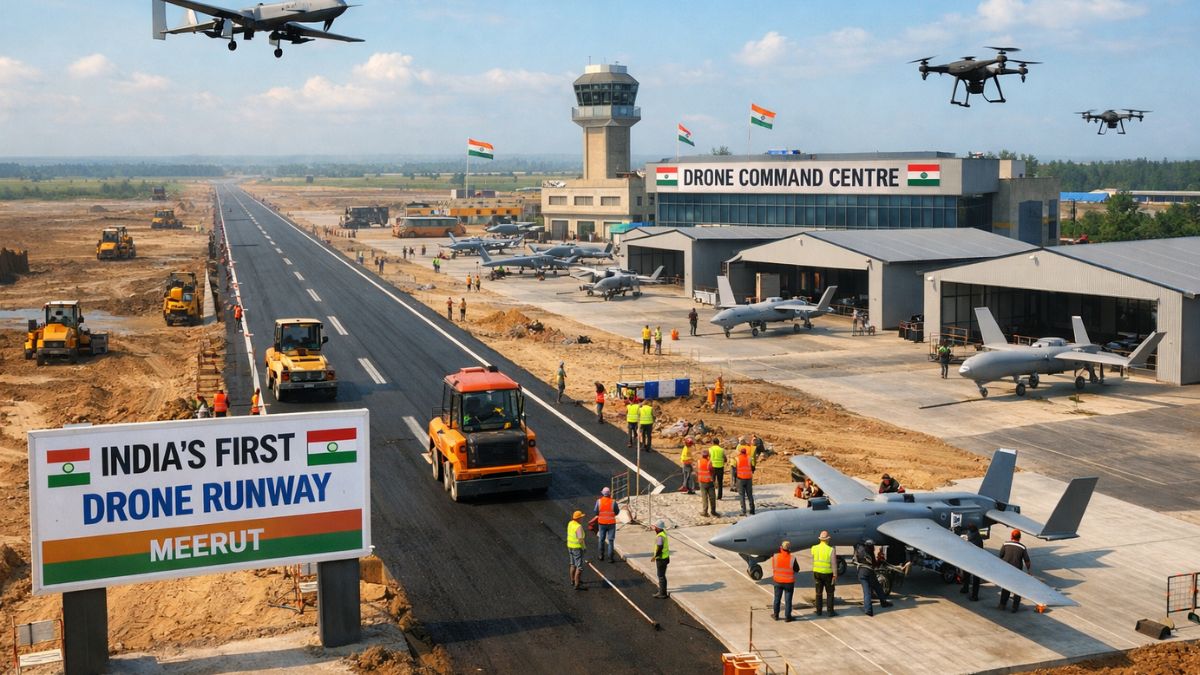
The runway will feature ICAO CAT-II compliant lighting and advanced navigational aids, enabling operations in low-visibility conditions. Image courtesy: AI-generated picture via Sora

The ongoing wars in Russia-Ukraine, Gaza are proof how significant an asset drones have become when it comes to modern warfare. Likewise, the four-day military conflict against terror bases in Pakistan – Operation Sindoor – in May 2025 also showed the importance of these unmanned aerial vehicles.
Now, taking a leaf out of the drone playbook and marking a significant post-Operation Sindoor military upgrade, India is set to establish its first dedicated runway for drones and Remotely Piloted Aircraft (RPA). With this facility, India is set to mark a decisive shift toward unmanned, data-driven warfare.
The Indian Army’s upcoming 900-acre aviation base in Meerut will be purpose-built to operate High Altitude Long Endurance (HALE) RPAs, platforms increasingly seen as the backbone of modern battlefield surveillance and precision engagement.
Dedicated runway for drones: Why is India investing in the Meerurt Airbase?
Spanning over 900 acres, the project comes against the backdrop of Operation Sindoor, which underscored how rapidly warfare is evolving. During the operation, unmanned aerial systems were deployed extensively for surveillance, reconnaissance and precision targeting, significantly enhancing situational awareness while reducing risks to personnel.
Military planners observed that sustained drone operations are no longer auxiliary, they are central to battlefield dominance. Lessons drawn from these missions have reinforced the need for dedicated infrastructure capable of supporting high-tempo unmanned operations round the clock.
What will the Meerut drone base include?
The Border Roads Organisation (BRO), under the Ministry of Defence, has initiated the process for constructing the Rs 406-crore facility and has invited bids for Project Management Consultancy services, according to a report by CNN-News18. At the heart of the base will be:
A 2,110-metre-long, 45-metre-wide runway
ICAO CAT-II compliant lighting for low-visibility operations
Advanced navigational aids
Two large hangars (60m x 50m each) for aircraft housing and maintenance
While primarily designed for HALE RPAs, the runway will also support transport aircraft in the C-295 and C-130 class, enhancing its dual-use operational capability.
How significant will the operational scale be?
This new Meerut base is expected to handle heavy aircraft movements annually along with approximately 1,500 RPA sorties per year, averaging nearly four drone missions daily. Such sustained operational tempo reflects the growing reliance on persistent aerial surveillance and long-duration intelligence gathering, particularly across sensitive borders.
High Altitude Long Endurance RPAs are designed to remain airborne for extended durations at high altitudes, providing real-time intelligence across vast geographic areas. In volatile border scenarios, their endurance offers commanders a decisive edge, shifting the military posture from reactive to anticipatory.
Globally, conflicts in recent years have demonstrated that drones are reshaping conventional doctrines. From reconnaissance to precision strikes, unmanned systems now form the backbone of network-centric warfare.
What does this signal about India’s future battlefield doctrine?
The Meerut base signals a structural transformation in India’s defence planning. Rather than operating drones as adjunct assets from conventional airfields, the Army is building infrastructure tailored for unmanned operations. The 85-month project timeline includes planning, construction, defect liability and long-term maintenance oversight.
Of these 85, seven months have been allocated for pre-award planning and preparation of the Detailed Project Report (DPR). Another 18 months are for supervised construction. Additionally, there is also a 24-month defect liability period and 36 months of maintenance oversight built into the execution plan.