Europeans Can No Longer Outsource Thinking About Nuclear Deterrence To US: Debate Over Nukes Gaining Momentum
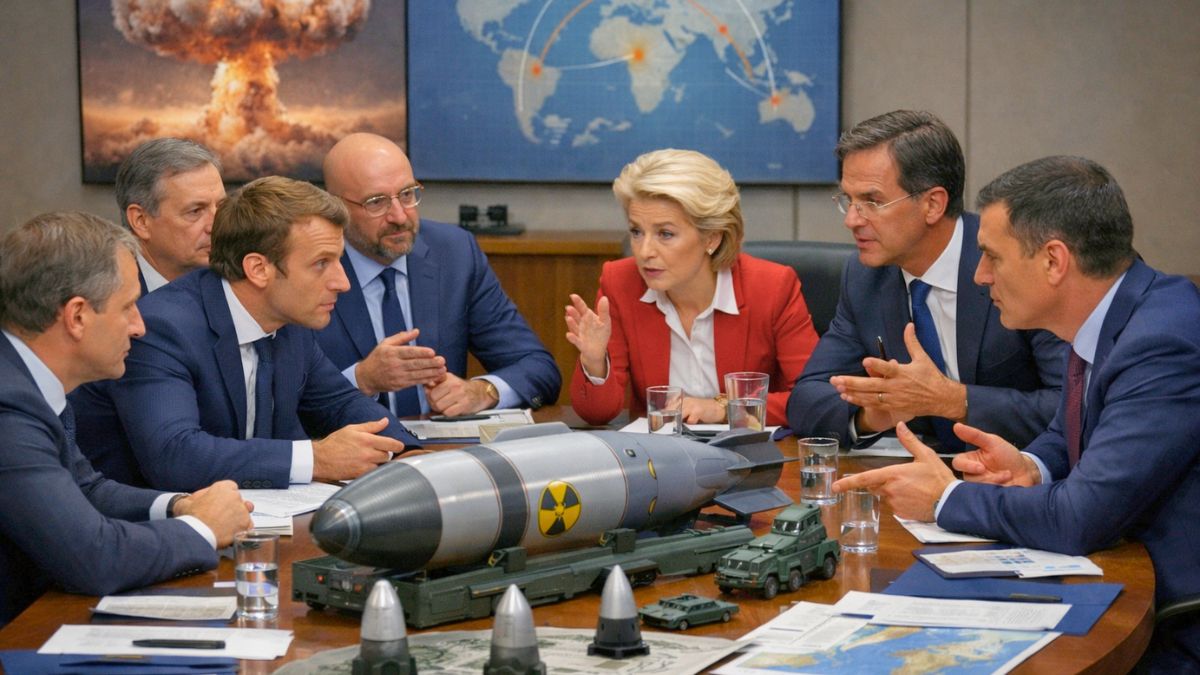
NATO secretary-general Mark Rutte insisted that “nobody” was considering fully replacing the American nuclear umbrella. Image courtesy: AI-generated picture via Sora

As Russia’s war in Ukraine grinds on and doubts grow over the United States’ long-term security guarantees, European leaders are openly confronting a once-taboo question: should Europe bolster its own nuclear deterrence? European leaders are now increasingly debating whether to bolster nuclear arsenals on the continent.
At the Munich Security Conference (MSC), senior officials signalled that the debate is now firmly in mainstream political discourse. While most agree the US nuclear umbrella remains indispensable, calls for greater European responsibility are intensifying amid what experts describe as a “new nuclear reality”.
Why is Europe rethinking nuclear deterrence now?
There are two major factors behind this renewed urgency. First is Russia’s nuclear posture. Moscow’s repeated nuclear signalling during the ongoing Ukraine war has heightened fears across Europe that the Kremlin could escalate beyond conventional warfare. Many European officials worry that Russia’s ambitions may not stop at Ukraine.
Second is the uncertainty over US commitments. US President Donald Trump’s sceptical comments about NATO and his transactional approach to alliances have unsettled European capitals. Though American officials insist the US extended nuclear deterrent remains intact, European leaders are increasingly asking whether reliance on Washington alone is sustainable in the long term.
A report prepared for the Munich Security Conference warned that “Europeans can no longer outsource their thinking about nuclear deterrence to the United States,” urging policymakers to “urgently confront a new nuclear reality.”
What is the current nuclear balance in Europe?
Globally, the United States and Russia possess thousands of nuclear warheads each. In Europe, however, only France and the United Kingdom maintain independent nuclear arsenals, numbering in the hundreds. NATO’s broader deterrence framework relies heavily on US nuclear capabilities deployed in Europe under alliance arrangements.
This asymmetry has sharpened debate over whether Europe should enhance its own nuclear capacity or remain anchored to American guarantees.
European leaders considering replacing US nuclear umbrella?
While the answer is in the negative on a public level, the conversation is evolving. NATO Secretary-General Mark Rutte has stressed that “nobody” in Europe is advocating replacing the American nuclear umbrella. Instead, discussions are framed as strengthening Europe’s contribution alongside the US.
US Undersecretary of Defence for Policy Elbridge Colby reaffirmed that America’s extended deterrent “continues to apply” to Europe, while signalling openness to greater European participation in NATO’s deterrence structure, albeit cautiously, given concerns about nuclear proliferation and instability.
What role are France and Britain playing?
France and the UK are at the centre of the debate. German Chancellor Friedrich Merz revealed he is holding “confidential talks” with French President Emmanuel Macron on European nuclear deterrence. British PM Keir Starmer emphasised that the UK’s nuclear forces already protect NATO allies and that London is “enhancing our nuclear cooperation with France.”
Starmer underscored that “any adversary must know that in a crisis, they could be confronted by our combined strength.”
Macron, who has previously floated the idea of extending France’s nuclear umbrella to European partners, is set to deliver a major speech on French nuclear doctrine later this month. He has hinted at expanded cooperation, including joint exercises and closer strategic coordination with key European states.
Options on the table
The MSC report outlined five potential paths for Europe, while cautioning that none are risk-free. These include maintaining reliance on US nuclear deterrence (the status quo), strengthen the European role of British and French nuclear forces, jointly developing a broader European nuclear capability, increasing the number of European countries with national nuclear arsenals, expanding conventional military power to reinforce non-nuclear deterrence.
The report also acknowledged that sticking with American protection remains “the most credible and feasible option” in the short term. Few analysts believe Europe can assume full nuclear responsibility immediately.
Authors of the report underlined that there was “no low-cost or risk-free way out of Europe’s nuclear predicament”, the authors of the report warned. “The era in which Europe could afford strategic complacency has ended,” they wrote. Moreover, they called on European policymakers “to confront the role of nuclear weapons in the defence of the continent directly and without delay – and to invest the resources needed to do so competently”.
Finnish Defence Minister Antti Hakkanen recently noted that while investing more in British or French deterrence could be beneficial, fully compensating for US protection is “not realistic at this point.”
What are the challenges of expanding Europe’s nuclear role?
Scaling up European nuclear capabilities would present significant hurdles like financial costs of expanding arsenals and delivery systems, political sensitivities in countries where nuclear weapons remain deeply unpopular, legal and non-proliferation concerns, along with complex questions over command and launch authority.
Extending French or British nuclear protection across Europe would also require clear agreements on decision-making in crisis scenarios.
For decades, nuclear deterrence was largely treated as an American responsibility within NATO. That era may be ending. “The era in which Europe could afford strategic complacency has ended,” the MSC report concluded, urging policymakers to address nuclear realities “directly and without delay.”
While no radical shift appears imminent, the debate itself marks a significant change. What was once politically unthinkable, open discussion of Europe’s nuclear future, is now central to high-level strategic conversations.