




Anti-Drone Shields, Air Defence Guns, 5000 Traffic Cops: Inside G20-Level Security For AI Impact Summit 2026
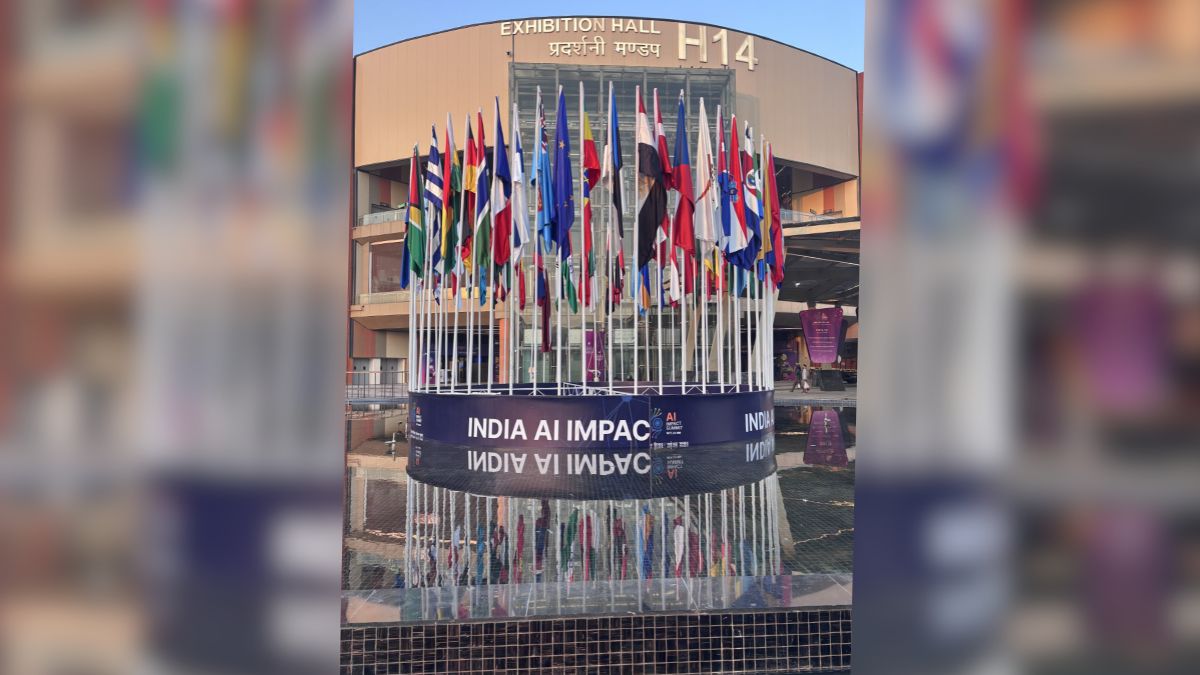
The Summit is anchored in three Sutras: People, Planet and Progress which define India’s approach to cooperation on AI. Image courtesy: X.com

New Delhi has rolled out a G20-style security grid for the five-day AI Impact Summit 2026 at Bharat Mandapam, with anti-drone systems, facial recognition cameras, bomb squads and thousands of police personnel forming a multi-layered security umbrella around the high-profile event. This is the first time that the event is being hosted at the Global South.
With global delegates, policymakers and technology leaders expected to attend, authorities say the capital is deploying one of its most sophisticated security frameworks since the G20 Leaders’ Summit in September 2023, also hosted at the same venue.
AI Impact Summit 2026 security: What makes the setup ‘G20-level’?
Officials described the security arrangements as comparable to the 2023 G20 summit, with a heavy focus on air defence, surveillance technology and rapid response teams. At the heart of the security grid is a robust air defence system, including:
Five anti-drone systems capable of detecting, tracking and neutralising rogue drones in real time
Multiple air defence guns positioned strategically around Bharat Mandapam
These systems are designed to prevent aerial threats, reflecting growing global concerns over drone-based disruptions at major events, according to a report in The Times of India.
How is technology powering the security architecture?
In a summit centred on artificial intelligence, the security apparatus itself is deeply tech-driven as more than 500 CCTV cameras have been installed at and around the venue. Most are equipped with advanced video analytics, facial recognition technology linked to a criminal database.
They are also equipped with Automatic Number Plate Recognition (ANPR) integrated with databases of stolen or suspicious vehicles, intrusion detection systems, suspect object identification tools. Moreover, a dedicated mini control room inside the venue will monitor all CCTV feeds in real time.
The control centre can directly alert police personnel on the ground, enabling immediate response to any suspicious activity. Guests have been given QR code-enabled passes, with entry set to be granted only after their QR codes are scanned at the entrance gate.
Another report in The Indian Express claimed that the entire AI Impact Summit 2026 venue is being monitored through the Command, Control, Communication, and Intelligence (C-4I) system, operated under the Safe City project. Moreover, security personnel have been given AI-enabled smart glasses, which are equipped with an integrated Facial Recognition System (FRS) and thermal imaging technology.
AI Impact Summit 2026 ground-level security measures
Authorities have deployed between 20 and 25 anti-sabotage teams, along with bomb detection and disposal squads, to conduct continuous security sweeps. These teams are already combing every section of Bharat Mandapam, adjacent buildings, and surrounding public spaces.
In addition, five teams of the National Disaster Response Force (NDRF) will remain stationed at the venue, with two more teams on standby to respond to any emergency or disaster scenario.
How are VIP hotels being secured?
Delegates and VIP guests will be accommodated across 10 hotels in and around Delhi, each placed under the direct supervision of a Deputy Commissioner of Police (DCP)-rank officer. At each hotel around 100 police personnel will be deployed. Entry and exit points will be tightly monitored, and guest movement will be tracked and regulated.
This translates to nearly 1,000 personnel dedicated solely to hotel security, apart from the main venue deployment.
What about crowd control and protests?
Authorities are taking preventive measures to avoid any protests or demonstrations near the venue. Twenty-five dedicated teams, equipped with wireless sets and buses, will monitor potential gatherings. If any assembly is detected, teams will immediately reach the location and detain protesters to prevent disruption.
With the summit coinciding with school examinations, traffic management has been prioritised to minimise public inconvenience. Around 5,000 traffic police personnel will be deployed across the city. To strengthen mobility management, Delhi Traffic Police have procured 81 vehicles, 3,000 light bars, 250 wireless communication sets.
Additional Commissioner of Police (Traffic) Dinesh Gupta confirmed that special arrangements are in place to assist students. If examination candidates are delayed due to congestion or road restrictions, police will help transport them safely to their exam centres. Dedicated nodal officers have been appointed to coordinate such interventions.
Why is the security so extensive?
The AI Impact Summit marks one of the largest global gatherings on artificial intelligence to be hosted in the Global South, attracting high-level international participation. Given the geopolitical sensitivity surrounding AI governance, emerging technologies and digital security, authorities are treating the summit as a high-security event on par with major multilateral meetings.


